

Future Fuels
403
along with producer gas are pyrolyzed in the hot agglomerating zone. Any
ash particles that stick together will fall and are cooled and removed at the
bottom of the gasifier. In fluidized bed gasification, rising oxygen enriched
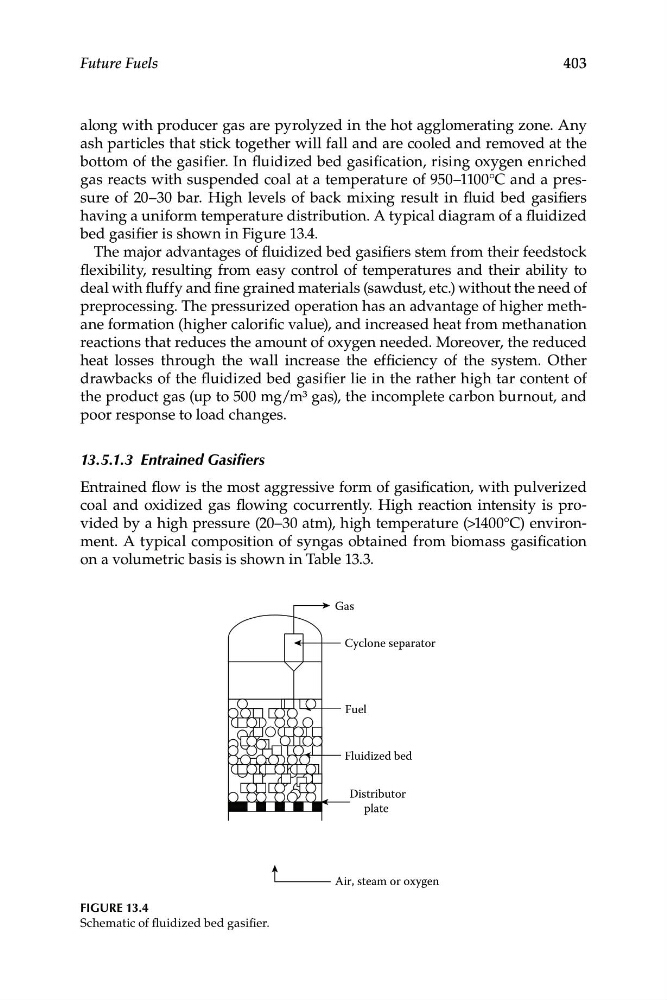
gas reacts with suspended coal at a temperature of 950–1100°C and a pressure of 20–30 bar. High levels of back mixing result in fluid bed gasifiers
having a uniform temperature distribution. A typical diagram of a fluidized
bed gasifier is shown in Figure 13.4.
The major advantages of fluidized bed gasifiers stem from their feedstock
flexibility, resulting from easy control of temperatures and their ability to
deal with fluffy and fine grained materials (sawdust, etc.) without the need of
preprocessing. The pressurized operation has an advantage of higher methane formation (higher calorific value), and increased heat from methanation
reactions that reduces the amount of oxygen needed. Moreover, the reduced
heat losses through the wall increase the efficiency of the system. Other
drawbacks of the fluidized bed gasifier lie in the rather high tar content of
the product gas (up to 500 mg/m³ gas), the incomplete carbon burnout, and
poor response to load changes.
13.5.1.3 Entrained Gasifiers
Entrained flow is the most aggressive form of gasification, with pulverized
coal and oxidized gas flowing cocurrently. High reaction intensity is provided by a high pressure (20–30 atm), high temperature (>1400°C) environment. A typical composition of syngas obtained from biomass gasification
on a volumetric basis is shown in Table 13.3.
Cyclone separator
Fluidized bed
Distributor
plate
Fuel
Gas
Air, steam or oxygen
Figure 13.4
Schematic of fluidized bed gasifier.
403
along with producer gas are pyrolyzed in the hot agglomerating zone. Any
ash particles that stick together will fall and are cooled and removed at the
bottom of the gasifier. In fluidized bed gasification, rising oxygen enriched
gas reacts with suspended coal at a temperature of 950–1100°C and a pressure of 20–30 bar. High levels of back mixing result in fluid bed gasifiers
having a uniform temperature distribution. A typical diagram of a fluidized
bed gasifier is shown in Figure 13.4.
The major advantages of fluidized bed gasifiers stem from their feedstock
flexibility, resulting from easy control of temperatures and their ability to
deal with fluffy and fine grained materials (sawdust, etc.) without the need of
preprocessing. The pressurized operation has an advantage of higher methane formation (higher calorific value), and increased heat from methanation
reactions that reduces the amount of oxygen needed. Moreover, the reduced
heat losses through the wall increase the efficiency of the system. Other
drawbacks of the fluidized bed gasifier lie in the rather high tar content of
the product gas (up to 500 mg/m³ gas), the incomplete carbon burnout, and
poor response to load changes.
13.5.1.3 Entrained Gasifiers
Entrained flow is the most aggressive form of gasification, with pulverized
coal and oxidized gas flowing cocurrently. High reaction intensity is provided by a high pressure (20–30 atm), high temperature (>1400°C) environment. A typical composition of syngas obtained from biomass gasification
on a volumetric basis is shown in Table 13.3.
Cyclone separator
Fluidized bed
Distributor
plate
Fuel
Gas
Air, steam or oxygen
Figure 13.4
Schematic of fluidized bed gasifier.