

406
Alternative Fuels for Transportation
Fast pyrolysis takes place at higher temperatures; a rapid heating process in
which water vapor is produced that is condensed to a dark brownish liquid bio-oil. The yield of bio-oil depends upon proper choice of reactor configuration; biomass feedstock particle size, and heat and mass transfer rate.
Fast pyrolysis produced bio-oils can be easily transported. Moreover, small
pyrolysis can be installed where sufficient amounts of biomass are available
for fast pyrolysis. This bio-oil is steam reformed to hydrogen and carbon
monoxide. The water–gas shift reaction is used to convert the reformed gas
into hydrogen. The pressure swing adsorption is used to purify the product. The yield from the gasification process is higher than the pyrolysis
process. Moreover, the yield increases with steam to sample ration in the
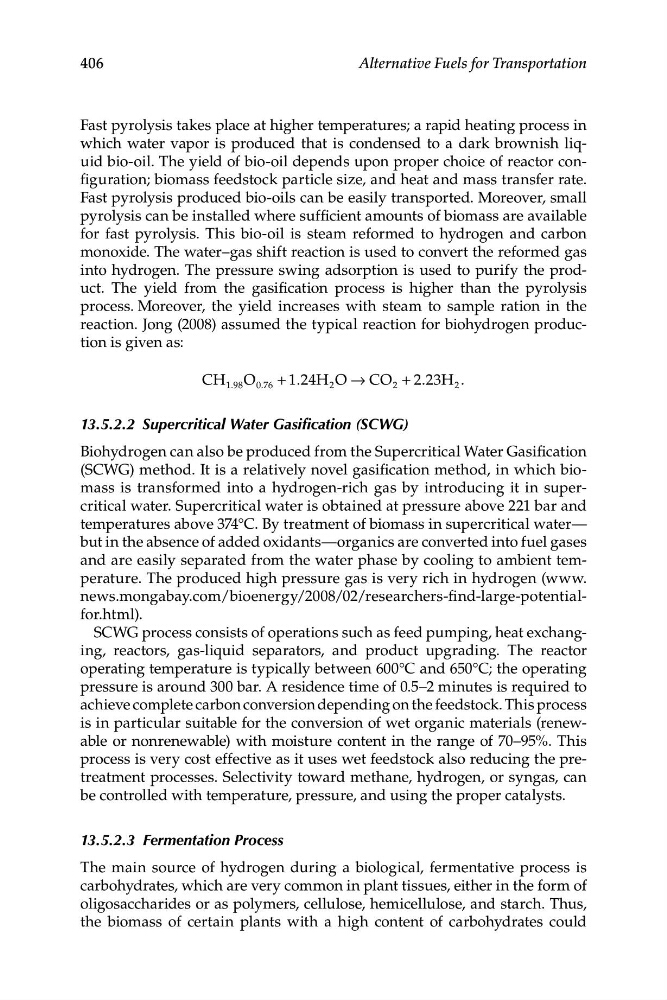
reaction. Jong (2008) assumed the typical reaction for biohydrogen production is given as:
CH O + 1 24
. HO → CO + 2 23 H .
.
1 98 076 .
2
2
2
.
13.5.2.2 Supercritical Water Gasification (SCWG)
Biohydrogen can also be produced from the Supercritical Water Gasification
(SCWG) method. It is a relatively novel gasification method, in which biomass is transformed into a hydrogen-rich gas by introducing it in supercritical water. Supercritical water is obtained at pressure above 221 bar and
temperatures above 374°C. By treatment of biomass in supercritical water—
but in the absence of added oxidants—organics are converted into fuel gases
and are easily separated from the water phase by cooling to ambient temperature. The produced high pressure gas is very rich in hydrogen (www.
news.mongabay.com/bioenergy/2008/02/researchers-find-large-potentialfor.html).
SCWG process consists of operations such as feed pumping, heat exchanging, reactors, gas-liquid separators, and product upgrading. The reactor
operating temperature is typically between 600°C and 650°C; the operating
pressure is around 300 bar. A residence time of 0.5–2 minutes is required to
achieve complete carbon conversion depending on the feedstock. This process
is in particular suitable for the conversion of wet organic materials (renewable or nonrenewable) with moisture content in the range of 70–95%. This
process is very cost effective as it uses wet feedstock also reducing the pretreatment processes. Selectivity toward methane, hydrogen, or syngas, can
be controlled with temperature, pressure, and using the proper catalysts.
13.5.2.3 Fermentation Process
The main source of hydrogen during a biological, fermentative process is
carbohydrates, which are very common in plant tissues, either in the form of
oligosaccharides or as polymers, cellulose, hemicellulose, and starch. Thus,
the biomass of certain plants with a high content of carbohydrates could
Alternative Fuels for Transportation
Fast pyrolysis takes place at higher temperatures; a rapid heating process in
which water vapor is produced that is condensed to a dark brownish liquid bio-oil. The yield of bio-oil depends upon proper choice of reactor configuration; biomass feedstock particle size, and heat and mass transfer rate.
Fast pyrolysis produced bio-oils can be easily transported. Moreover, small
pyrolysis can be installed where sufficient amounts of biomass are available
for fast pyrolysis. This bio-oil is steam reformed to hydrogen and carbon
monoxide. The water–gas shift reaction is used to convert the reformed gas
into hydrogen. The pressure swing adsorption is used to purify the product. The yield from the gasification process is higher than the pyrolysis
process. Moreover, the yield increases with steam to sample ration in the
reaction. Jong (2008) assumed the typical reaction for biohydrogen production is given as:
CH O + 1 24
. HO → CO + 2 23 H .
.
1 98 076 .
2
2
2
.
13.5.2.2 Supercritical Water Gasification (SCWG)
Biohydrogen can also be produced from the Supercritical Water Gasification
(SCWG) method. It is a relatively novel gasification method, in which biomass is transformed into a hydrogen-rich gas by introducing it in supercritical water. Supercritical water is obtained at pressure above 221 bar and
temperatures above 374°C. By treatment of biomass in supercritical water—
but in the absence of added oxidants—organics are converted into fuel gases
and are easily separated from the water phase by cooling to ambient temperature. The produced high pressure gas is very rich in hydrogen (www.
news.mongabay.com/bioenergy/2008/02/researchers-find-large-potentialfor.html).
SCWG process consists of operations such as feed pumping, heat exchanging, reactors, gas-liquid separators, and product upgrading. The reactor
operating temperature is typically between 600°C and 650°C; the operating
pressure is around 300 bar. A residence time of 0.5–2 minutes is required to
achieve complete carbon conversion depending on the feedstock. This process
is in particular suitable for the conversion of wet organic materials (renewable or nonrenewable) with moisture content in the range of 70–95%. This
process is very cost effective as it uses wet feedstock also reducing the pretreatment processes. Selectivity toward methane, hydrogen, or syngas, can
be controlled with temperature, pressure, and using the proper catalysts.
13.5.2.3 Fermentation Process
The main source of hydrogen during a biological, fermentative process is
carbohydrates, which are very common in plant tissues, either in the form of
oligosaccharides or as polymers, cellulose, hemicellulose, and starch. Thus,
the biomass of certain plants with a high content of carbohydrates could