

Future Fuels
399
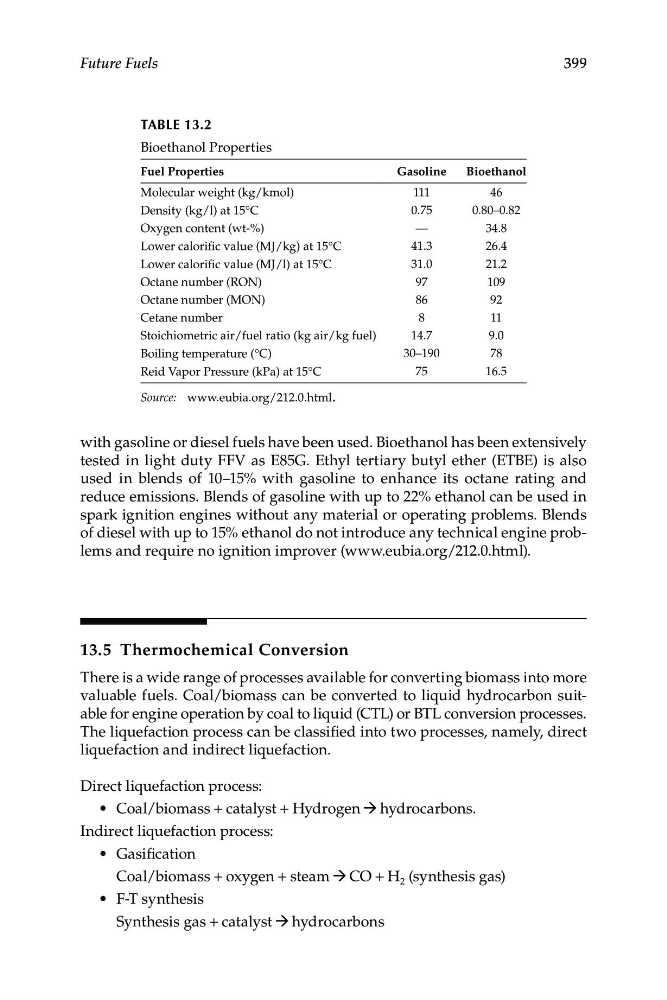
TABLe 13.2
Bioethanol Properties
Fuel Properties
Gasoline
Bioethanol
Molecular weight (kg/kmol)
111
46
Density (kg/l) at 15°C
0.75
0.80–0.82
Oxygen content (wt-%)
—
34.8
Lower calorific value (MJ/kg) at 15°C
41.3
26.4
Lower calorific value (MJ/l) at 15°C
31.0
21.2
Octane number (RON)
97
109
Octane number (MON)
86
92
Cetane number
8
11
Stoichiometric air/fuel ratio (kg air/kg fuel)
14.7
9.0
Boiling temperature (°C)
30–190
78
Reid Vapor Pressure (kPa) at 15°C
75
16.5
Source: www.eubia.org/212.0.html.
with gasoline or diesel fuels have been used. Bioethanol has been extensively
tested in light duty FFV as E85G. Ethyl tertiary butyl ether (ETBE) is also
used in blends of 10–15% with gasoline to enhance its octane rating and
reduce emissions. Blends of gasoline with up to 22% ethanol can be used in
spark ignition engines without any material or operating problems. Blends
of diesel with up to 15% ethanol do not introduce any technical engine problems and require no ignition improver (www.eubia.org/212.0.html).
13.5 Thermochemical Conversion
There is a wide range of processes available for converting biomass into more
valuable fuels. Coal/biomass can be converted to liquid hydrocarbon suitable for engine operation by coal to liquid (CTL) or BTL conversion processes.
The liquefaction process can be classified into two processes, namely, direct
liquefaction and indirect liquefaction.
Direct liquefaction process:
• Coal/biomass + catalyst + Hydrogen hydrocarbons.
Indirect liquefaction process:
• Gasification
Coal/biomass + oxygen + steam CO + H 2 (synthesis gas)
• F-T synthesis
Synthesis gas + catalyst hydrocarbons
399
TABLe 13.2
Bioethanol Properties
Fuel Properties
Gasoline
Bioethanol
Molecular weight (kg/kmol)
111
46
Density (kg/l) at 15°C
0.75
0.80–0.82
Oxygen content (wt-%)
—
34.8
Lower calorific value (MJ/kg) at 15°C
41.3
26.4
Lower calorific value (MJ/l) at 15°C
31.0
21.2
Octane number (RON)
97
109
Octane number (MON)
86
92
Cetane number
8
11
Stoichiometric air/fuel ratio (kg air/kg fuel)
14.7
9.0
Boiling temperature (°C)
30–190
78
Reid Vapor Pressure (kPa) at 15°C
75
16.5
Source: www.eubia.org/212.0.html.
with gasoline or diesel fuels have been used. Bioethanol has been extensively
tested in light duty FFV as E85G. Ethyl tertiary butyl ether (ETBE) is also
used in blends of 10–15% with gasoline to enhance its octane rating and
reduce emissions. Blends of gasoline with up to 22% ethanol can be used in
spark ignition engines without any material or operating problems. Blends
of diesel with up to 15% ethanol do not introduce any technical engine problems and require no ignition improver (www.eubia.org/212.0.html).
13.5 Thermochemical Conversion
There is a wide range of processes available for converting biomass into more
valuable fuels. Coal/biomass can be converted to liquid hydrocarbon suitable for engine operation by coal to liquid (CTL) or BTL conversion processes.
The liquefaction process can be classified into two processes, namely, direct
liquefaction and indirect liquefaction.
Direct liquefaction process:
• Coal/biomass + catalyst + Hydrogen hydrocarbons.
Indirect liquefaction process:
• Gasification
Coal/biomass + oxygen + steam CO + H 2 (synthesis gas)
• F-T synthesis
Synthesis gas + catalyst hydrocarbons