

HC
CO
Du
NO
SO
HC
CO
Du
NO
SO
0
100
Relative emissions (%)
st
x
x
st
x
x
ICEV
HEV
B EV
HC
CO
NO
SO
HC
CO
NO
SO
100
Relative emissions (%)
Dust
x
x
Dust
x
x
ICEV
HEV
BEV
0
387
Hybrid Vehicles
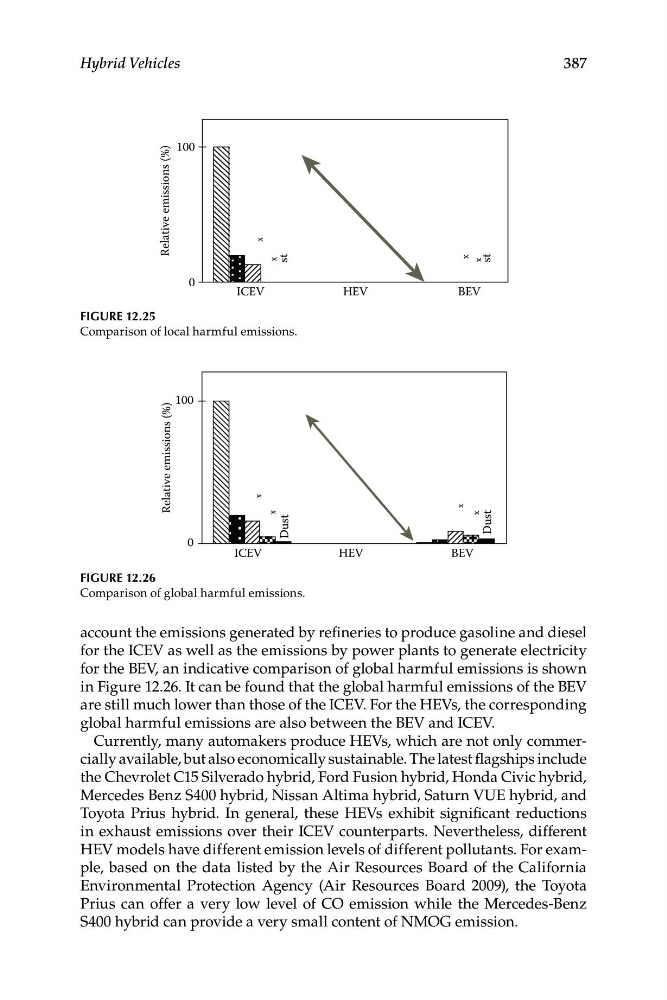
Figure 12.25
Comparison of local harmful emissions.
Figure 12.26
Comparison of global harmful emissions.
account the emissions generated by refineries to produce gasoline and diesel
for the ICEV as well as the emissions by power plants to generate electricity
for the BEV, an indicative comparison of global harmful emissions is shown
in Figure 1 2.26. It can be found that the global harmful emissions of the BEV
are still much lower than those of the ICEV. For the HEVs, the corresponding
global harmful emissions are also between the BEV and ICEV.
Currently, many automakers produce HEVs, which are not only commercially available, but also economically sustainable. The latest flagships include
the Chevrolet C15 Silverado hybrid, Ford Fusion hybrid, Honda Civic hybrid,
Mercedes Benz S400 hybrid, Nissan Altima hybrid, Saturn VUE hybrid, and
Toyota Prius hybrid. In general, these HEVs exhibit significant reductions
in exhaust emissions over their ICEV counterparts. Nevertheless, different
HEV models have different emission levels of different pollutants. For example, based on the data listed by the Air Resources Board of the California
Environmental Protection Agency (Air Resources Board 2009), the Toyota
Prius can offer a very low level of CO emission while the Mercedes-Benz
S400 hybrid can provide a very small content of NMOG emission.
CO
Du
NO
SO
HC
CO
Du
NO
SO
0
100
Relative emissions (%)
st
x
x
st
x
x
ICEV
HEV
B EV
HC
CO
NO
SO
HC
CO
NO
SO
100
Relative emissions (%)
Dust
x
x
Dust
x
x
ICEV
HEV
BEV
0
387
Hybrid Vehicles
Figure 12.25
Comparison of local harmful emissions.
Figure 12.26
Comparison of global harmful emissions.
account the emissions generated by refineries to produce gasoline and diesel
for the ICEV as well as the emissions by power plants to generate electricity
for the BEV, an indicative comparison of global harmful emissions is shown
in Figure 1 2.26. It can be found that the global harmful emissions of the BEV
are still much lower than those of the ICEV. For the HEVs, the corresponding
global harmful emissions are also between the BEV and ICEV.
Currently, many automakers produce HEVs, which are not only commercially available, but also economically sustainable. The latest flagships include
the Chevrolet C15 Silverado hybrid, Ford Fusion hybrid, Honda Civic hybrid,
Mercedes Benz S400 hybrid, Nissan Altima hybrid, Saturn VUE hybrid, and
Toyota Prius hybrid. In general, these HEVs exhibit significant reductions
in exhaust emissions over their ICEV counterparts. Nevertheless, different
HEV models have different emission levels of different pollutants. For example, based on the data listed by the Air Resources Board of the California
Environmental Protection Agency (Air Resources Board 2009), the Toyota
Prius can offer a very low level of CO emission while the Mercedes-Benz
S400 hybrid can provide a very small content of NMOG emission.