

ICEV
Relative noise (%)
BEV
HEV
Launching
Running Climbing
Braking
388
Alternative Fuels for Transportation
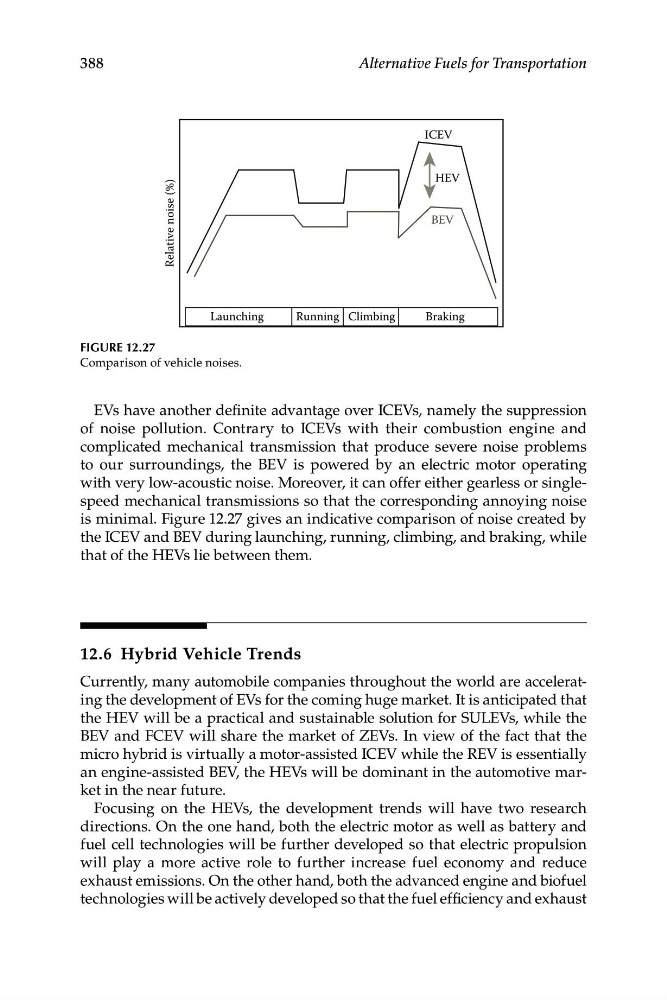
Figure 12.27
Comparison of vehicle noises.
EVs have another definite advantage over ICEVs, namely the suppression
of noise pollution. Contrary to ICEVs with their combustion engine and
complicated mechanical transmission that produce severe noise problems
to our surroundings, the BEV is powered by an electric motor operating
with very low-acoustic noise. Moreover, it can offer either gearless or singlespeed mechanical transmissions so that the corresponding annoying noise
is minimal. Figure 12.27 gives an indicative comparison of noise created by
the ICEV and BEV during launching, running, climbing, and braking, while
that of the HEVs lie between them.
12.6 Hybrid Vehicle Trends
Currently, many automobile companies throughout the world are accelerating the development of EVs for the coming huge market. It is anticipated that
the HEV will be a practical and sustainable solution for SULEVs, while the
BEV and FCEV will share the market of ZEVs. In view of the fact that the
micro hybrid is virtually a motor-assisted ICEV while the REV is essentially
an engine-assisted BEV, the HEVs will be dominant in the automotive market in the near future.
Focusing on the HEVs, the development trends will have two research
directions. On the one hand, both the electric motor as well as battery and
fuel cell technologies will be further developed so that electric propulsion
will play a more active role to further increase fuel economy and reduce
exhaust emissions. On the other hand, both the advanced engine and biofuel
technologies will be actively developed so that the fuel efficiency and exhaust
Relative noise (%)
BEV
HEV
Launching
Running Climbing
Braking
388
Alternative Fuels for Transportation
Figure 12.27
Comparison of vehicle noises.
EVs have another definite advantage over ICEVs, namely the suppression
of noise pollution. Contrary to ICEVs with their combustion engine and
complicated mechanical transmission that produce severe noise problems
to our surroundings, the BEV is powered by an electric motor operating
with very low-acoustic noise. Moreover, it can offer either gearless or singlespeed mechanical transmissions so that the corresponding annoying noise
is minimal. Figure 12.27 gives an indicative comparison of noise created by
the ICEV and BEV during launching, running, climbing, and braking, while
that of the HEVs lie between them.
12.6 Hybrid Vehicle Trends
Currently, many automobile companies throughout the world are accelerating the development of EVs for the coming huge market. It is anticipated that
the HEV will be a practical and sustainable solution for SULEVs, while the
BEV and FCEV will share the market of ZEVs. In view of the fact that the
micro hybrid is virtually a motor-assisted ICEV while the REV is essentially
an engine-assisted BEV, the HEVs will be dominant in the automotive market in the near future.
Focusing on the HEVs, the development trends will have two research
directions. On the one hand, both the electric motor as well as battery and
fuel cell technologies will be further developed so that electric propulsion
will play a more active role to further increase fuel economy and reduce
exhaust emissions. On the other hand, both the advanced engine and biofuel
technologies will be actively developed so that the fuel efficiency and exhaust