

386
Alternative Fuels for Transportation
100%
95%
Crude oil
Crude oil
Oil
refinery
(fuel oil)
Oil
refinery
(gasoline)
Gas
station
Power
plant
Power
transfer
Battery
BEV
ICEV
36%
34%
25%
18%
87%
83%
13%
HEV
13%~18%
100%
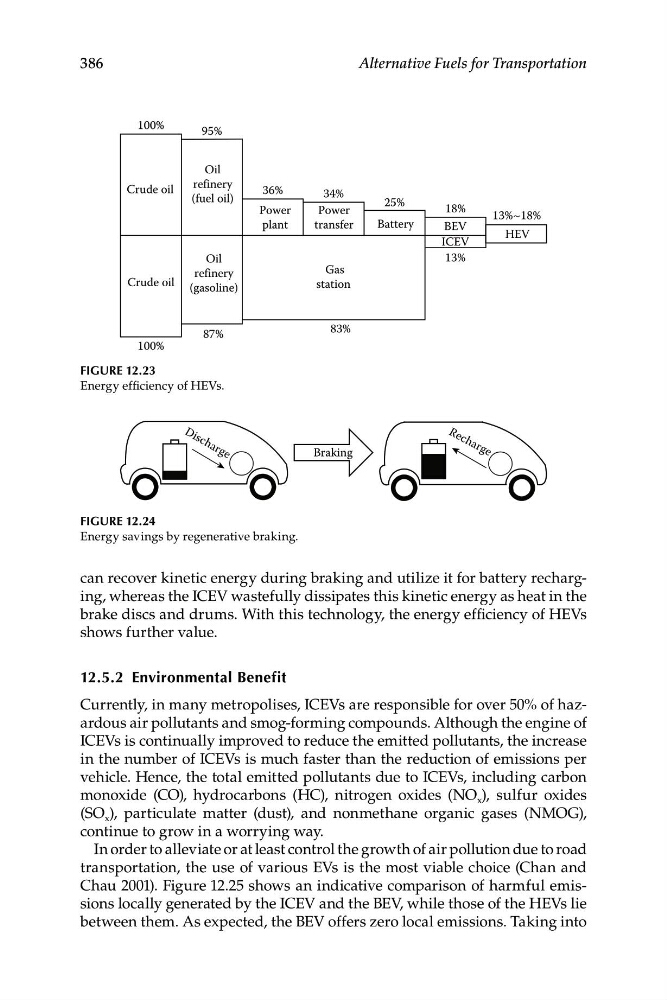
Figure 12.23
Energy efficiency of HEVs.
Braking
D i s c h a r g e
R e c h a r g e
Figure 12.24
Energy savings by regenerative braking.
can recover kinetic energy during braking and utilize it for battery recharging, whereas the ICEV wastefully dissipates this kinetic energy as heat in the
brake discs and drums. With this technology, the energy efficiency of HEVs
shows further value.
12.5.2 environmental Benefit
Currently, in many metropolises, ICEVs are responsible for over 50% of hazardous air pollutants and smog-forming compounds. Although the engine of
ICEVs is continually improved to reduce the emitted pollutants, the increase
in the number of ICEVs is much faster than the reduction of emissions per
vehicle. Hence, the total emitted pollutants due to ICEVs, including carbon
monoxide (CO), hydrocarbons (HC), nitrogen oxides (NO x ), sulfur oxides
(SO x ), particulate matter (dust), and nonmethane organic gases (NMOG),
continue to grow in a worrying way.
In order to alleviate or at least control the growth of air pollution due to road
transportation, the use of various EVs is the most viable choice (Chan and
Chau 2001). Figure 12.25 shows an indicative comparison of harmful emissions locally generated by the ICEV and the BEV, while those of the HEVs lie
between them. As expected, the BEV offers zero local emissions. Taking into
Alternative Fuels for Transportation
100%
95%
Crude oil
Crude oil
Oil
refinery
(fuel oil)
Oil
refinery
(gasoline)
Gas
station
Power
plant
Power
transfer
Battery
BEV
ICEV
36%
34%
25%
18%
87%
83%
13%
HEV
13%~18%
100%
Figure 12.23
Energy efficiency of HEVs.
Braking
D i s c h a r g e
R e c h a r g e
Figure 12.24
Energy savings by regenerative braking.
can recover kinetic energy during braking and utilize it for battery recharging, whereas the ICEV wastefully dissipates this kinetic energy as heat in the
brake discs and drums. With this technology, the energy efficiency of HEVs
shows further value.
12.5.2 environmental Benefit
Currently, in many metropolises, ICEVs are responsible for over 50% of hazardous air pollutants and smog-forming compounds. Although the engine of
ICEVs is continually improved to reduce the emitted pollutants, the increase
in the number of ICEVs is much faster than the reduction of emissions per
vehicle. Hence, the total emitted pollutants due to ICEVs, including carbon
monoxide (CO), hydrocarbons (HC), nitrogen oxides (NO x ), sulfur oxides
(SO x ), particulate matter (dust), and nonmethane organic gases (NMOG),
continue to grow in a worrying way.
In order to alleviate or at least control the growth of air pollution due to road
transportation, the use of various EVs is the most viable choice (Chan and
Chau 2001). Figure 12.25 shows an indicative comparison of harmful emissions locally generated by the ICEV and the BEV, while those of the HEVs lie
between them. As expected, the BEV offers zero local emissions. Taking into