

385
Hybrid Vehicles
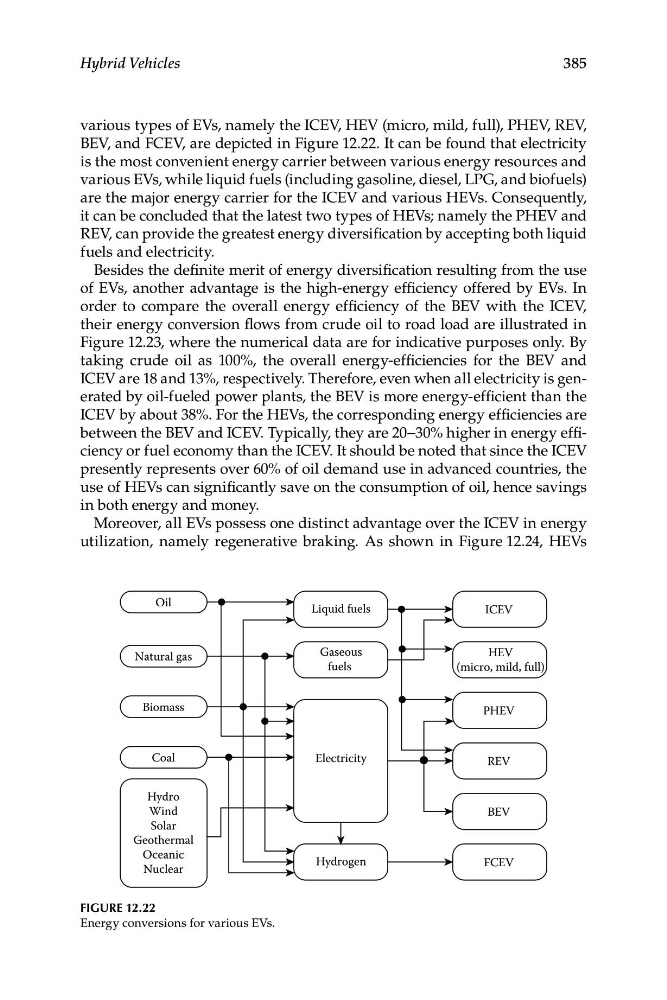
various types of EVs, namely the ICEV, HEV (micro, mild, full), PHEV, REV,
BEV, and FCEV, are depicted in Figure 12.22. It can be found that electricity
is the most convenient energy carrier between various energy resources and
various EVs, while liquid fuels (including gasoline, diesel, LPG, and biofuels)
are the major energy carrier for the ICEV and various HEVs. Consequently,
it can be concluded that the latest two types of HEVs; namely the PHEV and
REV, can provide the greatest energy diversification by accepting both liquid
fuels and electricity.
Besides the definite merit of energy diversification resulting from the use
of EVs, another advantage is the high-energy efficiency offered by EVs. In
order to compare the overall energy efficiency of the BEV with the ICEV,
their energy conversion flows from crude oil to road load are illustrated in
Figure 12.23, where the numerical data are for indicative purposes only. By
taking crude oil as 100%, the overall energy-efficiencies for the BEV and
ICEV are 18 and 13%, respectively. Therefore, even when all electricity is generated by oil-fueled power plants, the BEV is more energy-efficient than the
ICEV by about 38%. For the HEVs, the corresponding energy efficiencies are
between the BEV and ICEV. Typically, they are 20−30% higher in energy efficiency or fuel economy than the ICEV. It should be noted that since the ICEV
presently represents over 60% of oil demand use in advanced countries, the
use of HEVs can significantly save on the consumption of oil, hence savings
in both energy and money.
Moreover, all EVs possess one distinct advantage over the ICEV in energy
utilization, namely regenerative braking. As shown in Figure 12.24, HEVs
Liquid fuels
Oil
BEV
PHEV
HEV
(micro, mild, full)
FCEV
ICEV
REV
Natural gas
Biomass
Coal
Hydro
Wind
Solar
Geothermal
Oceanic
Nuclear
Gaseous
fuels
Electricity
Hydrogen
Figure 12.22
Energy conversions for various EVs.
Hybrid Vehicles
various types of EVs, namely the ICEV, HEV (micro, mild, full), PHEV, REV,
BEV, and FCEV, are depicted in Figure 12.22. It can be found that electricity
is the most convenient energy carrier between various energy resources and
various EVs, while liquid fuels (including gasoline, diesel, LPG, and biofuels)
are the major energy carrier for the ICEV and various HEVs. Consequently,
it can be concluded that the latest two types of HEVs; namely the PHEV and
REV, can provide the greatest energy diversification by accepting both liquid
fuels and electricity.
Besides the definite merit of energy diversification resulting from the use
of EVs, another advantage is the high-energy efficiency offered by EVs. In
order to compare the overall energy efficiency of the BEV with the ICEV,
their energy conversion flows from crude oil to road load are illustrated in
Figure 12.23, where the numerical data are for indicative purposes only. By
taking crude oil as 100%, the overall energy-efficiencies for the BEV and
ICEV are 18 and 13%, respectively. Therefore, even when all electricity is generated by oil-fueled power plants, the BEV is more energy-efficient than the
ICEV by about 38%. For the HEVs, the corresponding energy efficiencies are
between the BEV and ICEV. Typically, they are 20−30% higher in energy efficiency or fuel economy than the ICEV. It should be noted that since the ICEV
presently represents over 60% of oil demand use in advanced countries, the
use of HEVs can significantly save on the consumption of oil, hence savings
in both energy and money.
Moreover, all EVs possess one distinct advantage over the ICEV in energy
utilization, namely regenerative braking. As shown in Figure 12.24, HEVs
Liquid fuels
Oil
BEV
PHEV
HEV
(micro, mild, full)
FCEV
ICEV
REV
Natural gas
Biomass
Coal
Hydro
Wind
Solar
Geothermal
Oceanic
Nuclear
Gaseous
fuels
Electricity
Hydrogen
Figure 12.22
Energy conversions for various EVs.