

384
Alternative Fuels for Transportation
and the driveline shaft. The principle of operation is similar to that of the
planetary gear-based ECVT propulsion system.
12.5 Hybrid Vehicle Benefits
The use of EVs, no matter if they are BEV, HEV, or FCEV can have two major
benefits. Namely, the energy benefit resulting from better energy diversification and higher energy efficiency, as well as the environmental benefit resulting from better air quality and lower noise pollution.
12.5.1 energy Benefit
Derived from oil, gasoline and diesel are the major fuels for ICEVs. Although
the development of biofuels has taken on an accelerated pace in recent years,
our present transportation means are still heavily dependent on crude oil.
EVs are an excellent solution to regulate this unhealthy dependence because
electricity can be generated by almost any kind of energy resource in the
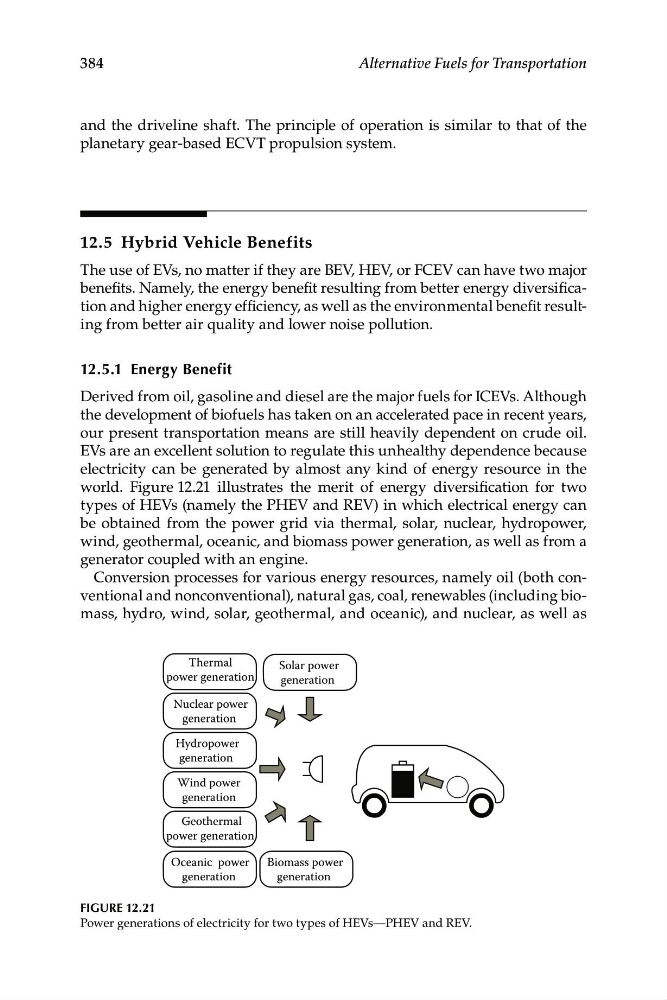
world. Figure 12.21 illustrates the merit of energy diversification for two
types of HEVs (namely the PHEV and REV) in which electrical energy can
be obtained from the power grid via thermal, solar, nuclear, hydropower,
wind, geothermal, oceanic, and biomass power generation, as well as from a
generator coupled with an engine.
Conversion processes for various energy resources, namely oil (both conventional and nonconventional), natural gas, coal, renewables (including biomass, hydro, wind, solar, geothermal, and oceanic), and nuclear, as well as
Thermal
power generation
Nuclear power
generation
Hydropower
generation
Wind power
generation
Oceanic power
generation
Solar power
generation
Geothermal
power generation
Biomass power
generation
Figure 12.21
Power generations of electricity for two types of HEVs—PHEV and REV.
Alternative Fuels for Transportation
and the driveline shaft. The principle of operation is similar to that of the
planetary gear-based ECVT propulsion system.
12.5 Hybrid Vehicle Benefits
The use of EVs, no matter if they are BEV, HEV, or FCEV can have two major
benefits. Namely, the energy benefit resulting from better energy diversification and higher energy efficiency, as well as the environmental benefit resulting from better air quality and lower noise pollution.
12.5.1 energy Benefit
Derived from oil, gasoline and diesel are the major fuels for ICEVs. Although
the development of biofuels has taken on an accelerated pace in recent years,
our present transportation means are still heavily dependent on crude oil.
EVs are an excellent solution to regulate this unhealthy dependence because
electricity can be generated by almost any kind of energy resource in the
world. Figure 12.21 illustrates the merit of energy diversification for two
types of HEVs (namely the PHEV and REV) in which electrical energy can
be obtained from the power grid via thermal, solar, nuclear, hydropower,
wind, geothermal, oceanic, and biomass power generation, as well as from a
generator coupled with an engine.
Conversion processes for various energy resources, namely oil (both conventional and nonconventional), natural gas, coal, renewables (including biomass, hydro, wind, solar, geothermal, and oceanic), and nuclear, as well as
Thermal
power generation
Nuclear power
generation
Hydropower
generation
Wind power
generation
Oceanic power
generation
Solar power
generation
Geothermal
power generation
Biomass power
generation
Figure 12.21
Power generations of electricity for two types of HEVs—PHEV and REV.