

350
Alternative Fuels for Transportation
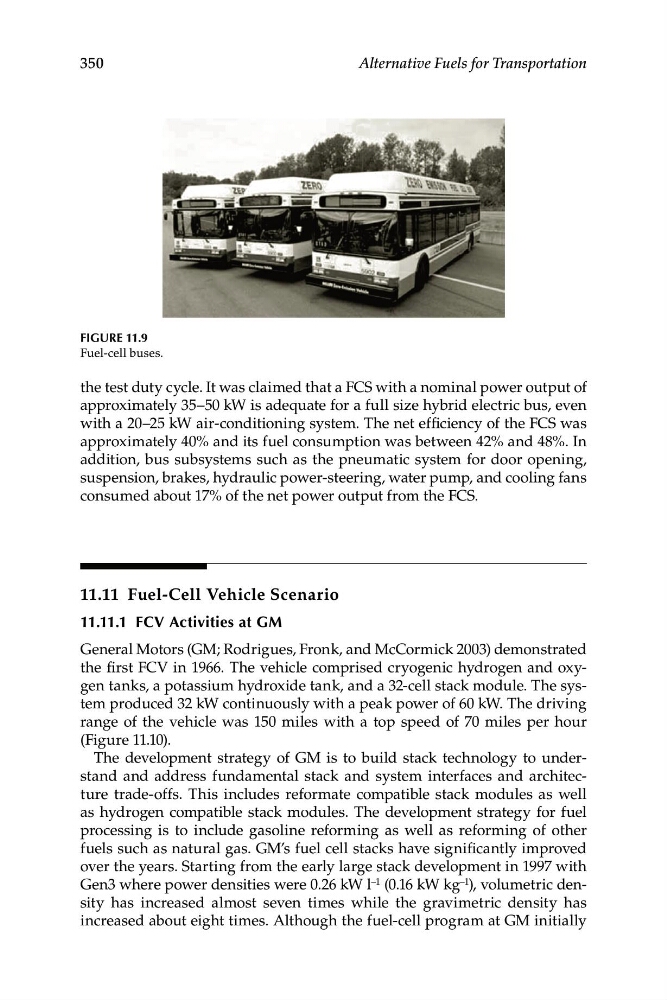
Figure 11.9
Fuel-cell buses.
the test duty cycle. It was claimed that a FCS with a nominal power output of
approximately 35–50 kW is adequate for a full size hybrid electric bus, even
with a 20–25 kW air-conditioning system. The net efficiency of the FCS was
approximately 40% and its fuel consumption was between 42% and 48%. In
addition, bus subsystems such as the pneumatic system for door opening,
suspension, brakes, hydraulic power-steering, water pump, and cooling fans
consumed about 17% of the net power output from the FCS.
11.11 Fuel-Cell Vehicle Scenario
11.11.1 FCV Activities at gM
General Motors (GM; Rodrigues, Fronk, and McCormick 2003) demonstrated
the first FCV in 1966. The vehicle comprised cryogenic hydrogen and oxygen tanks, a potassium hydroxide tank, and a 32-cell stack module. The system produced 32 kW continuously with a peak power of 60 kW. The driving
range of the vehicle was 150 miles with a top speed of 70 miles per hour
(Figure 11.10).
The development strategy of GM is to build stack technology to understand and address fundamental stack and system interfaces and architecture trade-offs. This includes reformate compatible stack modules as well
as hydrogen compatible stack modules. The development strategy for fuel
processing is to include gasoline reforming as well as reforming of other
fuels such as natural gas. GM’s fuel cell stacks have significantly improved
over the years. Starting from the early large stack development in 1997 with
Gen3 where power densities were 0.26 kW l –1 (0.16 kW kg –1 ), volumetric density has increased almost seven times while the gravimetric density has
increased about eight times. Although the fuel-cell program at GM initially
Alternative Fuels for Transportation
Figure 11.9
Fuel-cell buses.
the test duty cycle. It was claimed that a FCS with a nominal power output of
approximately 35–50 kW is adequate for a full size hybrid electric bus, even
with a 20–25 kW air-conditioning system. The net efficiency of the FCS was
approximately 40% and its fuel consumption was between 42% and 48%. In
addition, bus subsystems such as the pneumatic system for door opening,
suspension, brakes, hydraulic power-steering, water pump, and cooling fans
consumed about 17% of the net power output from the FCS.
11.11 Fuel-Cell Vehicle Scenario
11.11.1 FCV Activities at gM
General Motors (GM; Rodrigues, Fronk, and McCormick 2003) demonstrated
the first FCV in 1966. The vehicle comprised cryogenic hydrogen and oxygen tanks, a potassium hydroxide tank, and a 32-cell stack module. The system produced 32 kW continuously with a peak power of 60 kW. The driving
range of the vehicle was 150 miles with a top speed of 70 miles per hour
(Figure 11.10).
The development strategy of GM is to build stack technology to understand and address fundamental stack and system interfaces and architecture trade-offs. This includes reformate compatible stack modules as well
as hydrogen compatible stack modules. The development strategy for fuel
processing is to include gasoline reforming as well as reforming of other
fuels such as natural gas. GM’s fuel cell stacks have significantly improved
over the years. Starting from the early large stack development in 1997 with
Gen3 where power densities were 0.26 kW l –1 (0.16 kW kg –1 ), volumetric density has increased almost seven times while the gravimetric density has
increased about eight times. Although the fuel-cell program at GM initially