

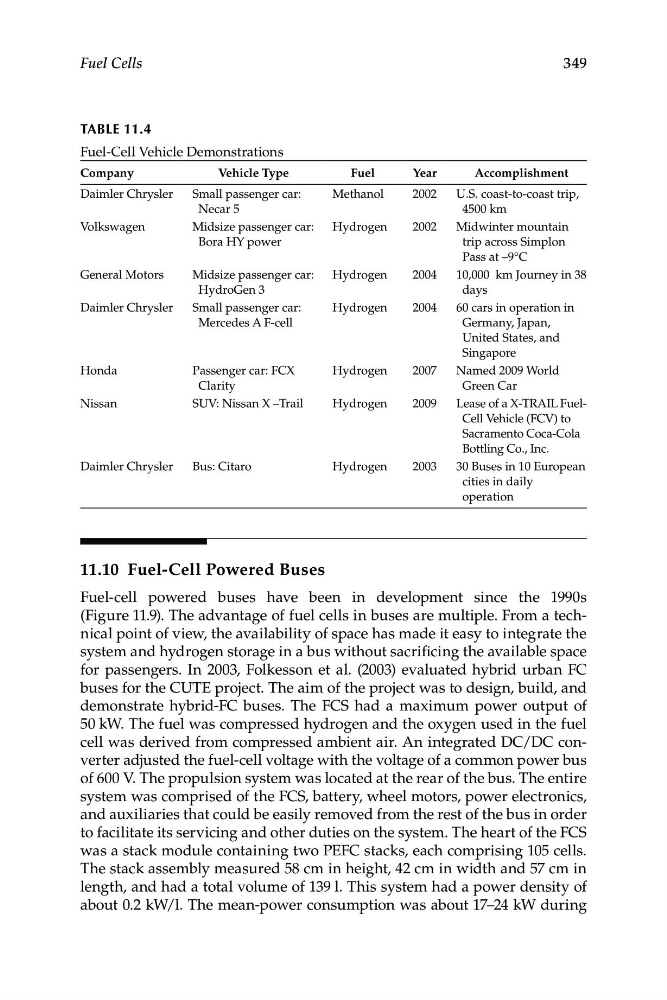
Company
Vehicle Type
Fuel
Year
Accomplishment
Daimler Chrysler
Small passenger car:
Methanol
2002
U.S. coast-to-coast trip,
Necar 5
4500 km
Volkswagen
Midsize passenger car:
Hydrogen
2002
Midwinter mountain
Bora HY power
trip across Simplon
Pass at –9°C
General Motors
Midsize passenger car:
Hydrogen
2004
10,000 km Journey in 38
HydroGen 3
days
Daimler Chrysler
Small passenger car:
Hydrogen
2004
60 cars in operation in
Mercedes A F-cell
Germany, Japan,
United States, and
Singapore
Honda
Passenger car: FCX
Hydrogen
2007
Named 2009 World
Clarity
Green Car
Nissan
SUV: Nissan X –Trail
Hydrogen
2009
Lease of a X-TRAIL FuelCell Vehicle (FCV) to
Sacramento Coca-Cola
Bottling Co., Inc.
Daimler Chrysler
Bus: Citaro
Hydrogen
2003
30 Buses in 10 European
cities in daily
operation
Fuel Cells
349
TABLe 11.4
Fuel-Cell Vehicle Demonstrations
11.10 Fuel-Cell Powered Buses
Fuel-cell powered buses have been in development since the 1990s
(Figure 11.9). The advantage of fuel cells in buses are multiple. From a technical point of view, the availability of space has made it easy to integrate the
system and hydrogen storage in a bus without sacrificing the available space
for passengers. In 2003, Folkesson et al. (2003) evaluated hybrid urban FC
buses for the CUTE project. The aim of the project was to design, build, and
demonstrate hybrid-FC buses. The FCS had a maximum power output of
50 kW. The fuel was compressed hydrogen and the oxygen used in the fuel
cell was derived from compressed ambient air. An integrated DC/DC converter adjusted the fuel-cell voltage with the voltage of a common power bus
of 600 V. The propulsion system was located at the rear of the bus. The entire
system was comprised of the FCS, battery, wheel motors, power electronics,
and auxiliaries that could be easily removed from the rest of the bus in order
to facilitate its servicing and other duties on the system. The heart of the FCS
was a stack module containing two PEFC stacks, each comprising 105 cells.
The stack assembly measured 58 cm in height, 42 cm in width and 57 cm in
length, and had a total volume of 139 l. This system had a power density of
about 0.2 kW/l. The mean-power consumption was about 17–24 kW during
Vehicle Type
Fuel
Year
Accomplishment
Daimler Chrysler
Small passenger car:
Methanol
2002
U.S. coast-to-coast trip,
Necar 5
4500 km
Volkswagen
Midsize passenger car:
Hydrogen
2002
Midwinter mountain
Bora HY power
trip across Simplon
Pass at –9°C
General Motors
Midsize passenger car:
Hydrogen
2004
10,000 km Journey in 38
HydroGen 3
days
Daimler Chrysler
Small passenger car:
Hydrogen
2004
60 cars in operation in
Mercedes A F-cell
Germany, Japan,
United States, and
Singapore
Honda
Passenger car: FCX
Hydrogen
2007
Named 2009 World
Clarity
Green Car
Nissan
SUV: Nissan X –Trail
Hydrogen
2009
Lease of a X-TRAIL FuelCell Vehicle (FCV) to
Sacramento Coca-Cola
Bottling Co., Inc.
Daimler Chrysler
Bus: Citaro
Hydrogen
2003
30 Buses in 10 European
cities in daily
operation
Fuel Cells
349
TABLe 11.4
Fuel-Cell Vehicle Demonstrations
11.10 Fuel-Cell Powered Buses
Fuel-cell powered buses have been in development since the 1990s
(Figure 11.9). The advantage of fuel cells in buses are multiple. From a technical point of view, the availability of space has made it easy to integrate the
system and hydrogen storage in a bus without sacrificing the available space
for passengers. In 2003, Folkesson et al. (2003) evaluated hybrid urban FC
buses for the CUTE project. The aim of the project was to design, build, and
demonstrate hybrid-FC buses. The FCS had a maximum power output of
50 kW. The fuel was compressed hydrogen and the oxygen used in the fuel
cell was derived from compressed ambient air. An integrated DC/DC converter adjusted the fuel-cell voltage with the voltage of a common power bus
of 600 V. The propulsion system was located at the rear of the bus. The entire
system was comprised of the FCS, battery, wheel motors, power electronics,
and auxiliaries that could be easily removed from the rest of the bus in order
to facilitate its servicing and other duties on the system. The heart of the FCS
was a stack module containing two PEFC stacks, each comprising 105 cells.
The stack assembly measured 58 cm in height, 42 cm in width and 57 cm in
length, and had a total volume of 139 l. This system had a power density of
about 0.2 kW/l. The mean-power consumption was about 17–24 kW during