

Fuel cell
Battery
Power
conversion
unit
DC bus
Traction drive
Transmission
Driven wheels
348
Alternative Fuels for Transportation
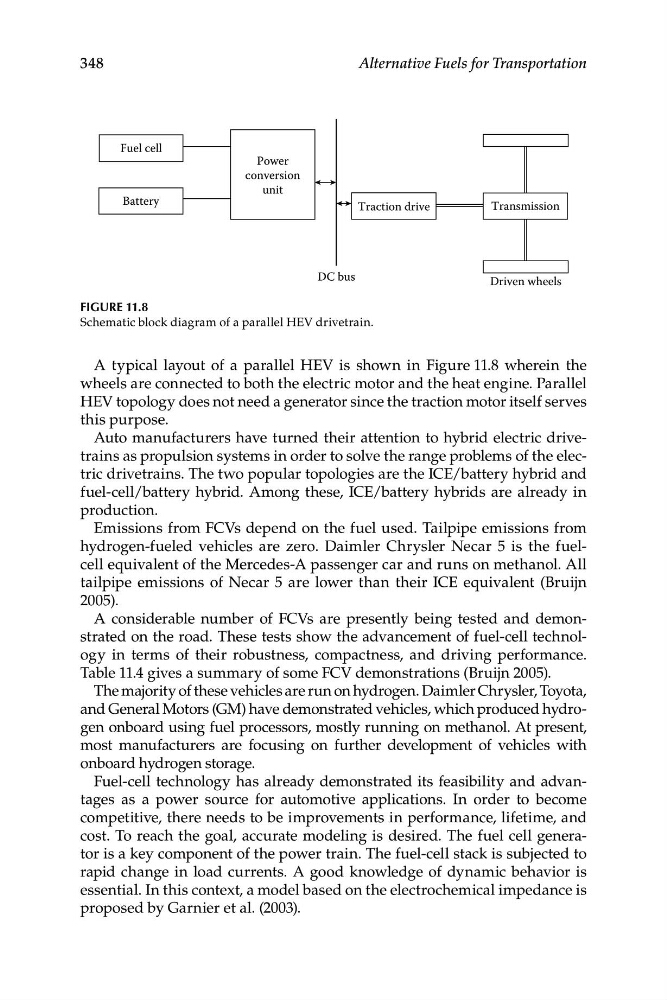
Figure 11.8
Schematic block diagram of a parallel HEV drivetrain.
A typical layout of a parallel HEV is shown in Figure 11.8 wherein the
wheels are connected to both the electric motor and the heat engine. Parallel
HEV topology does not need a generator since the traction motor itself serves
this purpose.
Auto manufacturers have turned their attention to hybrid electric drivetrains as propulsion systems in order to solve the range problems of the electric drivetrains. The two popular topologies are the ICE/battery hybrid and
fuel-cell/battery hybrid. Among these, ICE/battery hybrids are already in
production.
Emissions from FCVs depend on the fuel used. Tailpipe emissions from
hydrogen-fueled vehicles are zero. Daimler Chrysler Necar 5 is the fuelcell equivalent of the Mercedes-A passenger car and runs on methanol. All
tailpipe emissions of Necar 5 are lower than their ICE equivalent (Bruijn
2005).
A considerable number of FCVs are presently being tested and demonstrated on the road. These tests show the advancement of fuel-cell technology in terms of their robustness, compactness, and driving performance.
Table 11.4 gives a summary of some FCV demonstrations (Bruijn 2005).
The majority of these vehicles are run on hydrogen. Daimler Chrysler, Toyota,
and General Motors (GM) have demonstrated vehicles, which produced hydrogen onboard using fuel processors, mostly running on methanol. At present,
most manufacturers are focusing on further development of vehicles with
onboard hydrogen storage.
Fuel-cell technology has already demonstrated its feasibility and advantages as a power source for automotive applications. In order to become
competitive, there needs to be improvements in performance, lifetime, and
cost. To reach the goal, accurate modeling is desired. The fuel cell generator is a key component of the power train. The fuel-cell stack is subjected to
rapid change in load currents. A good knowledge of dynamic behavior is
essential. In this context, a model based on the electrochemical impedance is
proposed by Garnier et al. (2003).
Battery
Power
conversion
unit
DC bus
Traction drive
Transmission
Driven wheels
348
Alternative Fuels for Transportation
Figure 11.8
Schematic block diagram of a parallel HEV drivetrain.
A typical layout of a parallel HEV is shown in Figure 11.8 wherein the
wheels are connected to both the electric motor and the heat engine. Parallel
HEV topology does not need a generator since the traction motor itself serves
this purpose.
Auto manufacturers have turned their attention to hybrid electric drivetrains as propulsion systems in order to solve the range problems of the electric drivetrains. The two popular topologies are the ICE/battery hybrid and
fuel-cell/battery hybrid. Among these, ICE/battery hybrids are already in
production.
Emissions from FCVs depend on the fuel used. Tailpipe emissions from
hydrogen-fueled vehicles are zero. Daimler Chrysler Necar 5 is the fuelcell equivalent of the Mercedes-A passenger car and runs on methanol. All
tailpipe emissions of Necar 5 are lower than their ICE equivalent (Bruijn
2005).
A considerable number of FCVs are presently being tested and demonstrated on the road. These tests show the advancement of fuel-cell technology in terms of their robustness, compactness, and driving performance.
Table 11.4 gives a summary of some FCV demonstrations (Bruijn 2005).
The majority of these vehicles are run on hydrogen. Daimler Chrysler, Toyota,
and General Motors (GM) have demonstrated vehicles, which produced hydrogen onboard using fuel processors, mostly running on methanol. At present,
most manufacturers are focusing on further development of vehicles with
onboard hydrogen storage.
Fuel-cell technology has already demonstrated its feasibility and advantages as a power source for automotive applications. In order to become
competitive, there needs to be improvements in performance, lifetime, and
cost. To reach the goal, accurate modeling is desired. The fuel cell generator is a key component of the power train. The fuel-cell stack is subjected to
rapid change in load currents. A good knowledge of dynamic behavior is
essential. In this context, a model based on the electrochemical impedance is
proposed by Garnier et al. (2003).