

S. No.
Cell Characterization Tests
Unit
1
Ah capacity
3 b rate
2
Specific power
W/kg
3
Specific energy
Wh/kg
4
Cycle life
80% DOD
5
Utilization of active material
%
Source: From Brandt, D. D., Journal of Power Sources,
40, 73–79, 1992. Reprinted with permission
from Elsevier Publications.
315
Electric Vehicles
Aqueous batteries are developed and used in EV applications. For competitive traction applications, high performance batteries are being developed.
An EV with an advanced Li-ion battery could in principle achieve a 400–480
km (250–300 miles) range, but these batteries would take up 450–600 liters of
space (equivalent to a 120–160 gallon gasoline tank).
10.5 Vehicle Tests
Testing of batteries for EVs has two distinct focuses. For batteries, testing concentrates on optimizing battery performance and cycle life. It normally uses
constant current or constant power and simple cycles. For EV systems, testing
focuses on the total vehicle including the battery. This testing is multifaceted
and usually involves a complex driving life cycle. These tests are demanding
and require much higher physical and electrical performance than a constantcurrent cycling regime. Tests commonly used today are FUDS, SFUDS, and
GSFUDS life cycle profiles. These tests have shown to be a much better predictor of battery life cycle performance than constant-current or constant-power
cycling. Driving life cycle tests are one facet of the six characteristics considered when evaluating EV batteries and EV systems.
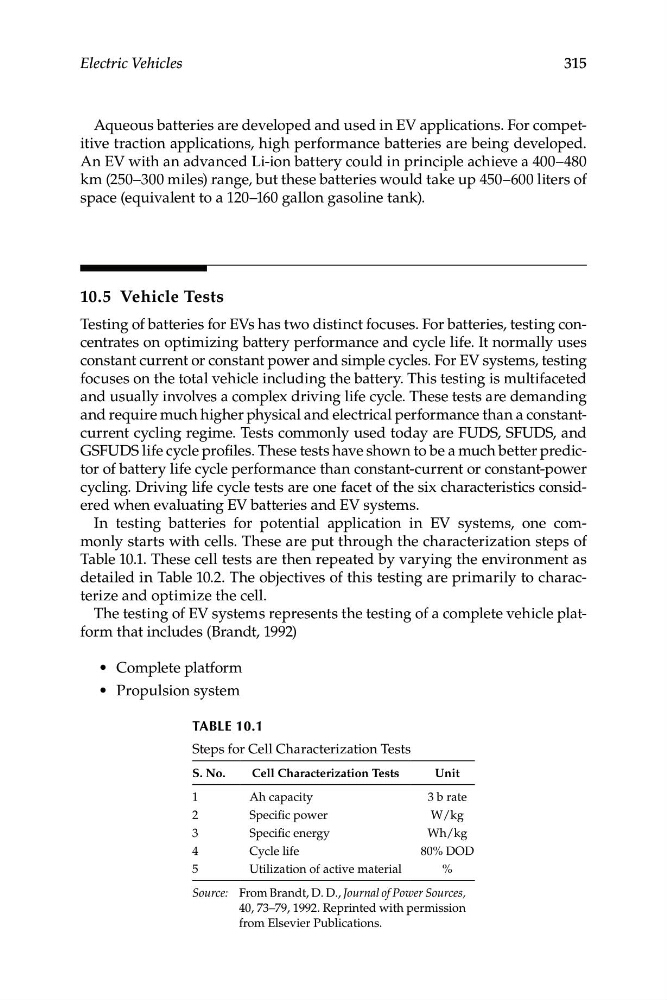
In testing batteries for potential application in EV systems, one commonly starts with cells. These are put through the characterization steps of
Table 10.1. These cell tests are then repeated by varying the environment as
detailed in Table 10.2. The objectives of this testing are primarily to characterize and optimize the cell.
The testing of EV systems represents the testing of a complete vehicle platform that includes (Brandt, 1992)
• Complete platform
• Propulsion system
TABLe 10.1
Steps for Cell Characterization Tests
Cell Characterization Tests
Unit
1
Ah capacity
3 b rate
2
Specific power
W/kg
3
Specific energy
Wh/kg
4
Cycle life
80% DOD
5
Utilization of active material
%
Source: From Brandt, D. D., Journal of Power Sources,
40, 73–79, 1992. Reprinted with permission
from Elsevier Publications.
315
Electric Vehicles
Aqueous batteries are developed and used in EV applications. For competitive traction applications, high performance batteries are being developed.
An EV with an advanced Li-ion battery could in principle achieve a 400–480
km (250–300 miles) range, but these batteries would take up 450–600 liters of
space (equivalent to a 120–160 gallon gasoline tank).
10.5 Vehicle Tests
Testing of batteries for EVs has two distinct focuses. For batteries, testing concentrates on optimizing battery performance and cycle life. It normally uses
constant current or constant power and simple cycles. For EV systems, testing
focuses on the total vehicle including the battery. This testing is multifaceted
and usually involves a complex driving life cycle. These tests are demanding
and require much higher physical and electrical performance than a constantcurrent cycling regime. Tests commonly used today are FUDS, SFUDS, and
GSFUDS life cycle profiles. These tests have shown to be a much better predictor of battery life cycle performance than constant-current or constant-power
cycling. Driving life cycle tests are one facet of the six characteristics considered when evaluating EV batteries and EV systems.
In testing batteries for potential application in EV systems, one commonly starts with cells. These are put through the characterization steps of
Table 10.1. These cell tests are then repeated by varying the environment as
detailed in Table 10.2. The objectives of this testing are primarily to characterize and optimize the cell.
The testing of EV systems represents the testing of a complete vehicle platform that includes (Brandt, 1992)
• Complete platform
• Propulsion system
TABLe 10.1
Steps for Cell Characterization Tests