

314
Alternative Fuels for Transportation
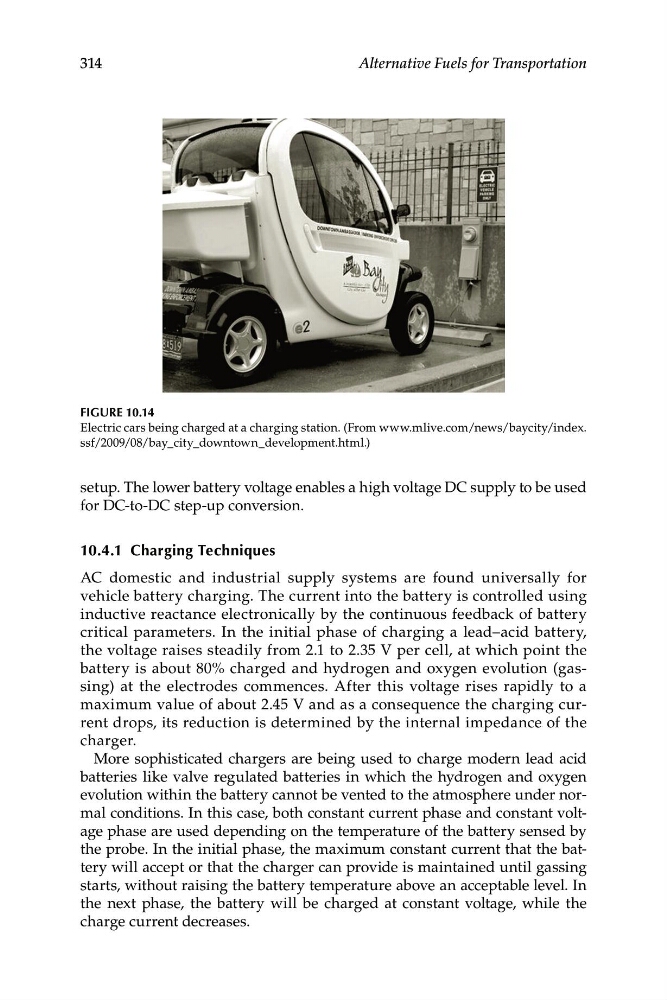
Figure 10.14
Electric cars being charged at a charging station. (From www.mlive.com/news/baycity/index.
ssf/2009/08/bay_city_downtown_development.html.)
setup. The lower battery voltage enables a high voltage DC supply to be used
for DC-to-DC step-up conversion.
10.4.1 Charging Techniques
AC domestic and industrial supply systems are found universally for
vehicle battery charging. The current into the battery is controlled using
inductive reactance electronically by the continuous feedback of battery
critical parameters. In the initial phase of charging a lead–acid battery,
the voltage raises steadily from 2.1 to 2.35 V per cell, at which point the
battery is about 80% charged and hydrogen and oxygen evolution (gassing) at the electrodes commences. After this voltage rises rapidly to a
maximum value of about 2.45 V and as a consequence the charging current drops, its reduction is determined by the internal impedance of the
charger.
More sophisticated chargers are being used to charge modern lead acid
batteries like valve regulated batteries in which the hydrogen and oxygen
evolution within the battery cannot be vented to the atmosphere under normal conditions. In this case, both constant current phase and constant voltage phase are used depending on the temperature of the battery sensed by
the probe. In the initial phase, the maximum constant current that the battery will accept or that the charger can provide is maintained until gassing
starts, without raising the battery temperature above an acceptable level. In
the next phase, the battery will be charged at constant voltage, while the
charge current decreases.
Alternative Fuels for Transportation
Figure 10.14
Electric cars being charged at a charging station. (From www.mlive.com/news/baycity/index.
ssf/2009/08/bay_city_downtown_development.html.)
setup. The lower battery voltage enables a high voltage DC supply to be used
for DC-to-DC step-up conversion.
10.4.1 Charging Techniques
AC domestic and industrial supply systems are found universally for
vehicle battery charging. The current into the battery is controlled using
inductive reactance electronically by the continuous feedback of battery
critical parameters. In the initial phase of charging a lead–acid battery,
the voltage raises steadily from 2.1 to 2.35 V per cell, at which point the
battery is about 80% charged and hydrogen and oxygen evolution (gassing) at the electrodes commences. After this voltage rises rapidly to a
maximum value of about 2.45 V and as a consequence the charging current drops, its reduction is determined by the internal impedance of the
charger.
More sophisticated chargers are being used to charge modern lead acid
batteries like valve regulated batteries in which the hydrogen and oxygen
evolution within the battery cannot be vented to the atmosphere under normal conditions. In this case, both constant current phase and constant voltage phase are used depending on the temperature of the battery sensed by
the probe. In the initial phase, the maximum constant current that the battery will accept or that the charger can provide is maintained until gassing
starts, without raising the battery temperature above an acceptable level. In
the next phase, the battery will be charged at constant voltage, while the
charge current decreases.