

Low power (low speed)
Voltage
100
80
60
20
40
0 0 5 10 15 20 25 30 35 40 45 50 55 60 65 70 75 80 85 90 95 100
Period
Time, ms
High power (high speed)
Voltage
100
80
60
40
20
0
Period
0 5 10 15 20 25 30 35 40 45 50 55 60 65 70 75 80 85 90 95 100
Time, ms
Pulse signal
Average value (DC)
313
Electric Vehicles
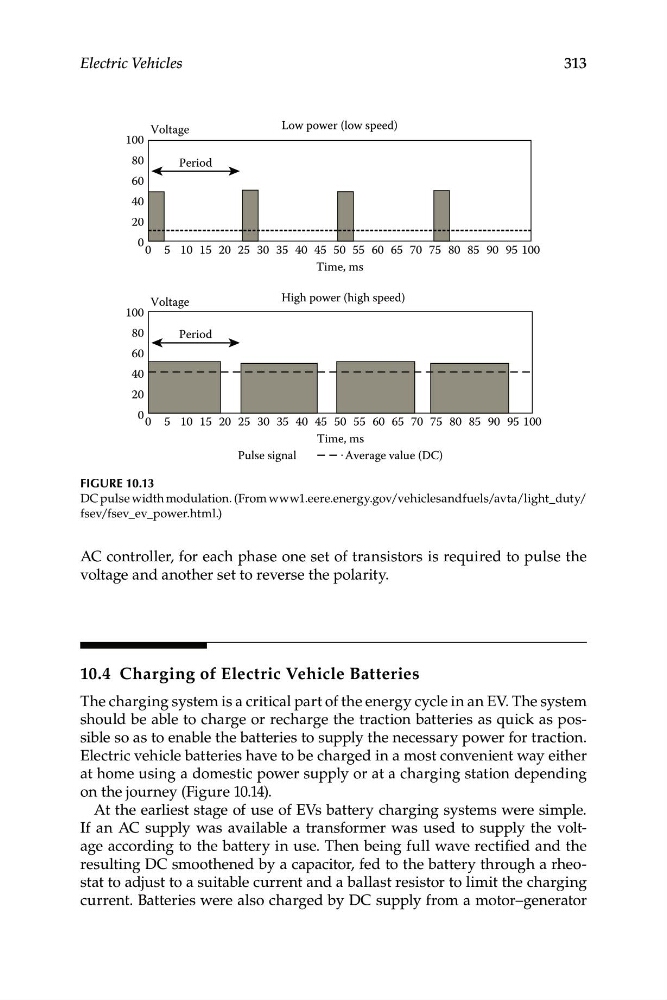
Figure 10.13
DC pulse width modulation. (From www1.eere.energy.gov/vehiclesandfuels/avta/light_duty/
fsev/fsev_ev_power.html.)
AC controller, for each phase one set of transistors is required to pulse the
voltage and another set to reverse the polarity.
10.4 Charging of Electric Vehicle Batteries
The charging system is a critical part of the energy cycle in an EV. The system
should be able to charge or recharge the traction batteries as quick as possible so as to enable the batteries to supply the necessary power for traction.
Electric vehicle batteries have to be charged in a most convenient way either
at home using a domestic power supply or at a charging station depending
on the journey (Figure 10.14).
At the earliest stage of use of EVs battery charging systems were simple.
If an AC supply was available a transformer was used to supply the voltage according to the battery in use. Then being full wave rectified and the
resulting DC smoothened by a capacitor, fed to the battery through a rheostat to adjust to a suitable current and a ballast resistor to limit the charging
current. Batteries were also charged by DC supply from a motor–generator
Voltage
100
80
60
20
40
0 0 5 10 15 20 25 30 35 40 45 50 55 60 65 70 75 80 85 90 95 100
Period
Time, ms
High power (high speed)
Voltage
100
80
60
40
20
0
Period
0 5 10 15 20 25 30 35 40 45 50 55 60 65 70 75 80 85 90 95 100
Time, ms
Pulse signal
Average value (DC)
313
Electric Vehicles
Figure 10.13
DC pulse width modulation. (From www1.eere.energy.gov/vehiclesandfuels/avta/light_duty/
fsev/fsev_ev_power.html.)
AC controller, for each phase one set of transistors is required to pulse the
voltage and another set to reverse the polarity.
10.4 Charging of Electric Vehicle Batteries
The charging system is a critical part of the energy cycle in an EV. The system
should be able to charge or recharge the traction batteries as quick as possible so as to enable the batteries to supply the necessary power for traction.
Electric vehicle batteries have to be charged in a most convenient way either
at home using a domestic power supply or at a charging station depending
on the journey (Figure 10.14).
At the earliest stage of use of EVs battery charging systems were simple.
If an AC supply was available a transformer was used to supply the voltage according to the battery in use. Then being full wave rectified and the
resulting DC smoothened by a capacitor, fed to the battery through a rheostat to adjust to a suitable current and a ballast resistor to limit the charging
current. Batteries were also charged by DC supply from a motor–generator