

S. No.
Cell Characterization Tests
1
Cell environment variables
2
Discharge (vary the rate and type)
3
Recharge (constant voltage or pulsed)
4
Cycling at various states-of-discharge
5
High and low-temperature performance
6
Variation in cell geometry and electrolyte
7
Variation of raw materials and separators
8
Operation with mechanical vibration
Source: From Brandt, D. D., Journal of Power Sources,
40, 73–79, 1992. Reprinted with permission
from Elsevier Publications.
316
Alternative Fuels for Transportation
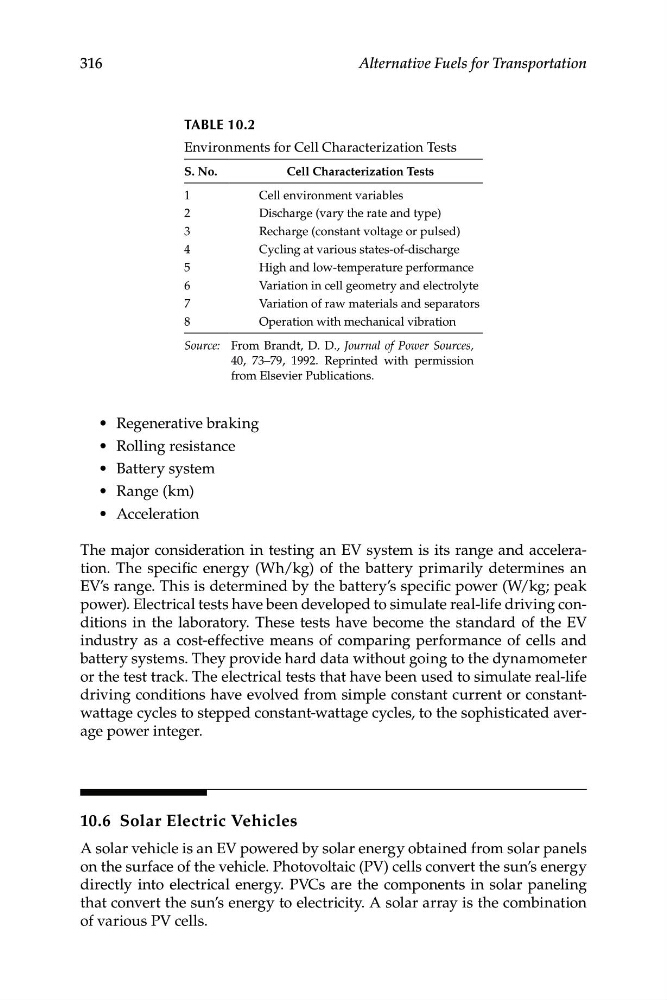
TABLe 10.2
Environments for Cell Characterization Tests
• Regenerative braking
• Rolling resistance
• Battery system
• Range (km)
• Acceleration
The major consideration in testing an EV system is its range and acceleration. The specific energy (Wh/kg) of the battery primarily determines an
EV’s range. This is determined by the battery’s specific power (W/kg; peak
power). Electrical tests have been developed to simulate real-life driving conditions in the laboratory. These tests have become the standard of the EV
industry as a cost-effective means of comparing performance of cells and
battery systems. They provide hard data without going to the dynamometer
or the test track. The electrical tests that have been used to simulate real-life
driving conditions have evolved from simple constant current or constantwattage cycles to stepped constant-wattage cycles, to the sophisticated average power integer.
10.6 Solar Electric Vehicles
A solar vehicle is an EV powered by solar energy obtained from solar panels
on the surface of the vehicle. Photovoltaic (PV) cells convert the sun’s energy
directly into electrical energy. PVCs are the components in solar paneling
that convert the sun’s energy to electricity. A solar array is the combination
of various PV cells.
Cell Characterization Tests
1
Cell environment variables
2
Discharge (vary the rate and type)
3
Recharge (constant voltage or pulsed)
4
Cycling at various states-of-discharge
5
High and low-temperature performance
6
Variation in cell geometry and electrolyte
7
Variation of raw materials and separators
8
Operation with mechanical vibration
Source: From Brandt, D. D., Journal of Power Sources,
40, 73–79, 1992. Reprinted with permission
from Elsevier Publications.
316
Alternative Fuels for Transportation
TABLe 10.2
Environments for Cell Characterization Tests
• Regenerative braking
• Rolling resistance
• Battery system
• Range (km)
• Acceleration
The major consideration in testing an EV system is its range and acceleration. The specific energy (Wh/kg) of the battery primarily determines an
EV’s range. This is determined by the battery’s specific power (W/kg; peak
power). Electrical tests have been developed to simulate real-life driving conditions in the laboratory. These tests have become the standard of the EV
industry as a cost-effective means of comparing performance of cells and
battery systems. They provide hard data without going to the dynamometer
or the test track. The electrical tests that have been used to simulate real-life
driving conditions have evolved from simple constant current or constantwattage cycles to stepped constant-wattage cycles, to the sophisticated average power integer.
10.6 Solar Electric Vehicles
A solar vehicle is an EV powered by solar energy obtained from solar panels
on the surface of the vehicle. Photovoltaic (PV) cells convert the sun’s energy
directly into electrical energy. PVCs are the components in solar paneling
that convert the sun’s energy to electricity. A solar array is the combination
of various PV cells.