

1. Lead–acid batteries
2. Nickel-based batteries
a. Nickel–iron battery
b. Nickel–zinc battery
c. Nickel–cadmium battery
d. Nickel-metal hydride battery
3. Lithium-based batteries
a. Lithium-solid polymer battery
b. Lithium-ion battery
4. Other types
a. Sodium–sulfur battery
b. Sodium–nickel chloride battery
306
Alternative Fuels for Transportation
the electrolyte and the electrode to which negatively charged ions migrate;
that is, negative electrode or anode. The other half-cell includes the electrolyte and the electrode to which positively charged ions migrate; that is, the
positive electrode or cathode. In the battery, addition of electrons occurs at
the cathode, while removal of electrons occurs at the anode. The electrodes
are not physically touching each other but are electrically connected by the
electrolyte, which can be either solid or liquid.
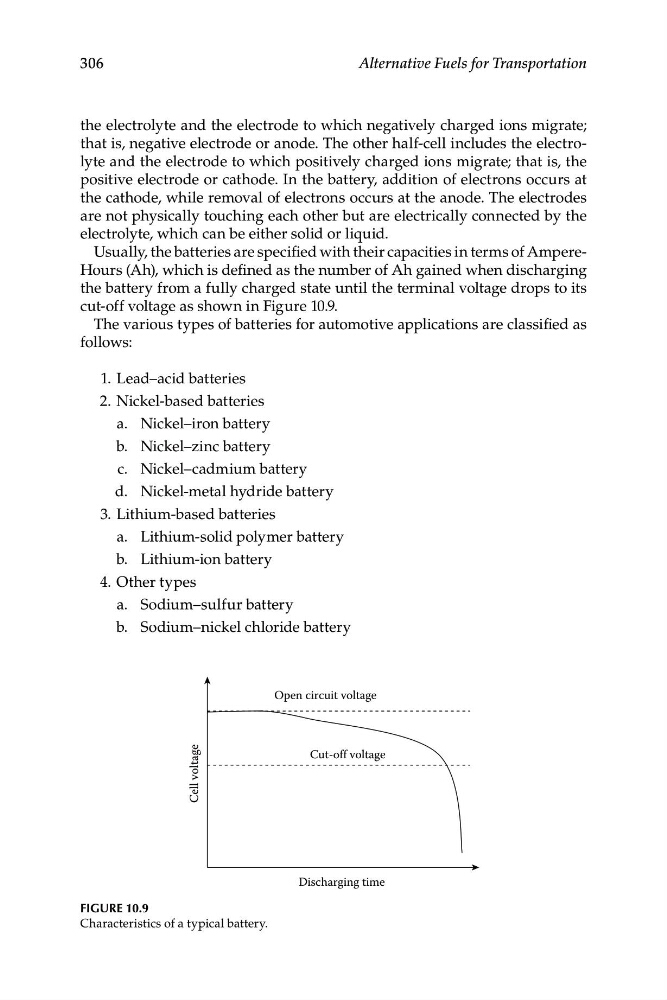
Usually, the batteries are specified with their capacities in terms of AmpereHours (Ah), which is defined as the number of Ah gained when discharging
the battery from a fully charged state until the terminal voltage drops to its
cut-off voltage as shown in Figure 10.9.
The various types of batteries for automotive applications are classified as
follows:
Open circuit voltage
Cell voltage
Cut-off voltage
Discharging time
Figure 10.9
Characteristics of a typical battery.
2. Nickel-based batteries
a. Nickel–iron battery
b. Nickel–zinc battery
c. Nickel–cadmium battery
d. Nickel-metal hydride battery
3. Lithium-based batteries
a. Lithium-solid polymer battery
b. Lithium-ion battery
4. Other types
a. Sodium–sulfur battery
b. Sodium–nickel chloride battery
306
Alternative Fuels for Transportation
the electrolyte and the electrode to which negatively charged ions migrate;
that is, negative electrode or anode. The other half-cell includes the electrolyte and the electrode to which positively charged ions migrate; that is, the
positive electrode or cathode. In the battery, addition of electrons occurs at
the cathode, while removal of electrons occurs at the anode. The electrodes
are not physically touching each other but are electrically connected by the
electrolyte, which can be either solid or liquid.
Usually, the batteries are specified with their capacities in terms of AmpereHours (Ah), which is defined as the number of Ah gained when discharging
the battery from a fully charged state until the terminal voltage drops to its
cut-off voltage as shown in Figure 10.9.
The various types of batteries for automotive applications are classified as
follows:
Open circuit voltage
Cell voltage
Cut-off voltage
Discharging time
Figure 10.9
Characteristics of a typical battery.