

300
Alternative Fuels for Transportation
• Brushes are two flexible metal plates or carbon rods, which are fixed
that they constantly touch the revolving rings. The fixed brushes
are connected alternatively to opposite ends of the rotor for every
180º of shaft rotation. The direction of current flow in the rotor is
reversed twice for every turn of the rotor to maintain the rotation of
the rotor.
• The battery is connected to the brushes, which convey current to the
rings where it is carried to the armature.
The advantage of using an electric motor as a propeller are: quieter and a
more efficient propulsor, easier to install the regenerative braking system,
more efficient transmission through the possibility of direct connection to
the wheels, fewer moving parts, and lower operating/maintenance costs.
In general, DC motors are classified into four types based on the windings
configuration:
1. DC series motor
2. DC shunt motor
3. DC compound motor
4. Separately excited DC motor
10.3.1.1 DC Series Motor
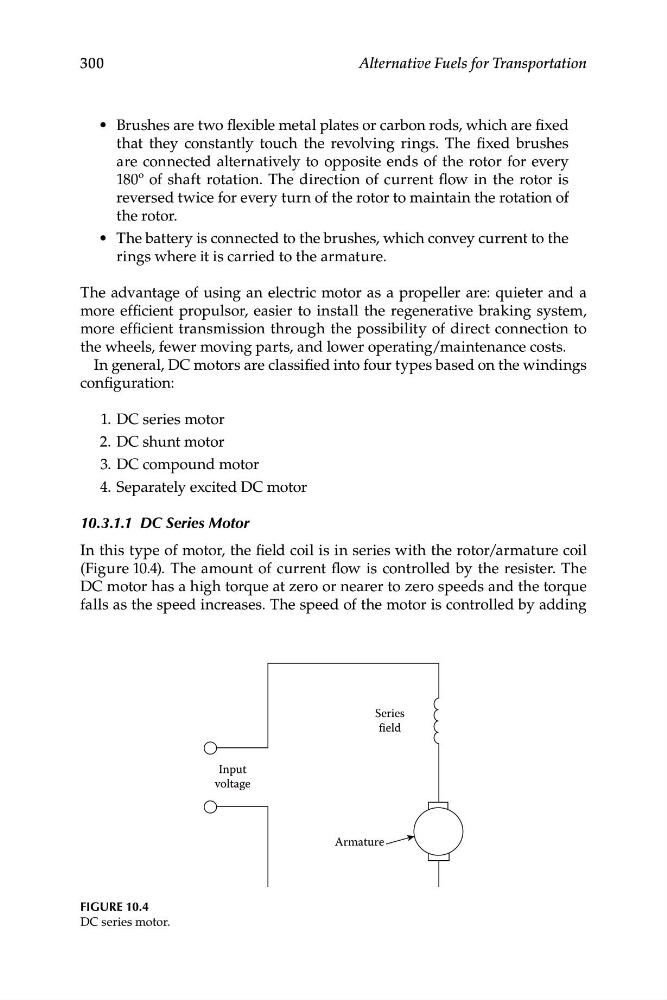
In this type of motor, the field coil is in series with the rotor/armature coil
(Figure 1 0.4). The amount of current flow is controlled by the resister. The
DC motor has a high torque at zero or nearer to zero speeds and the torque
falls as the speed increases. The speed of the motor is controlled by adding
Series
field
Armature
Input
voltage
Figure 10.4
DC series motor.
Alternative Fuels for Transportation
• Brushes are two flexible metal plates or carbon rods, which are fixed
that they constantly touch the revolving rings. The fixed brushes
are connected alternatively to opposite ends of the rotor for every
180º of shaft rotation. The direction of current flow in the rotor is
reversed twice for every turn of the rotor to maintain the rotation of
the rotor.
• The battery is connected to the brushes, which convey current to the
rings where it is carried to the armature.
The advantage of using an electric motor as a propeller are: quieter and a
more efficient propulsor, easier to install the regenerative braking system,
more efficient transmission through the possibility of direct connection to
the wheels, fewer moving parts, and lower operating/maintenance costs.
In general, DC motors are classified into four types based on the windings
configuration:
1. DC series motor
2. DC shunt motor
3. DC compound motor
4. Separately excited DC motor
10.3.1.1 DC Series Motor
In this type of motor, the field coil is in series with the rotor/armature coil
(Figure 1 0.4). The amount of current flow is controlled by the resister. The
DC motor has a high torque at zero or nearer to zero speeds and the torque
falls as the speed increases. The speed of the motor is controlled by adding
Series
field
Armature
Input
voltage
Figure 10.4
DC series motor.