

301
Electric Vehicles
additional resistance in series or parallel with the field. The series motor is
suitable for EVs and it gives excellent acceleration.
10.3.1.2 DC Shunt Motor
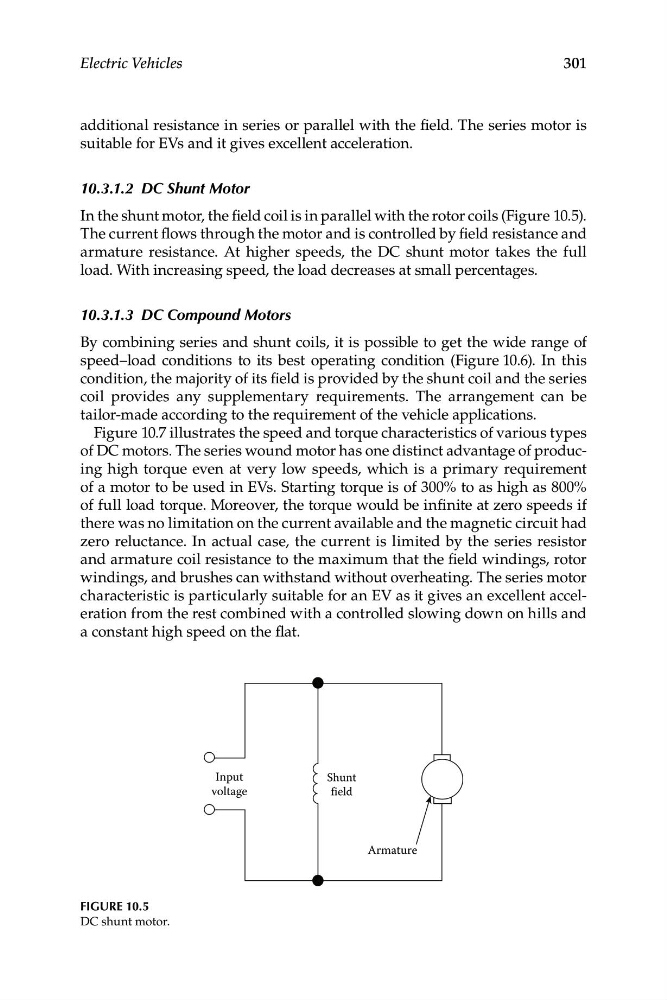
In the shunt motor, the field coil is in parallel with the rotor coils (Figure 10.5).
The current flows through the motor and is controlled by field resistance and
armature resistance. At higher speeds, the DC shunt motor takes the full
load. With increasing speed, the load decreases at small percentages.
10.3.1.3 DC Compound Motors
By combining series and shunt coils, it is possible to get the wide range of
speed–load conditions to its best operating condition (Figure 10.6). In this
condition, the majority of its field is provided by the shunt coil and the series
coil provides any supplementary requirements. The arrangement can be
tailor-made according to the requirement of the vehicle applications.
Figure 10.7 illustrates the speed and torque characteristics of various types
of DC motors. The series wound motor has one distinct advantage of producing high torque even at very low speeds, which is a primary requirement
of a motor to be used in EVs. Starting torque is of 300% to as high as 800%
of full load torque. Moreover, the torque would be infinite at zero speeds if
there was no limitation on the current available and the magnetic circuit had
zero reluctance. In actual case, the current is limited by the series resistor
and armature coil resistance to the maximum that the field windings, rotor
windings, and brushes can withstand without overheating. The series motor
characteristic is particularly suitable for an EV as it gives an excellent acceleration from the rest combined with a controlled slowing down on hills and
a constant high speed on the flat.
Shunt
field
Armature
Input
voltage
Figure 10.5
DC shunt motor.
Electric Vehicles
additional resistance in series or parallel with the field. The series motor is
suitable for EVs and it gives excellent acceleration.
10.3.1.2 DC Shunt Motor
In the shunt motor, the field coil is in parallel with the rotor coils (Figure 10.5).
The current flows through the motor and is controlled by field resistance and
armature resistance. At higher speeds, the DC shunt motor takes the full
load. With increasing speed, the load decreases at small percentages.
10.3.1.3 DC Compound Motors
By combining series and shunt coils, it is possible to get the wide range of
speed–load conditions to its best operating condition (Figure 10.6). In this
condition, the majority of its field is provided by the shunt coil and the series
coil provides any supplementary requirements. The arrangement can be
tailor-made according to the requirement of the vehicle applications.
Figure 10.7 illustrates the speed and torque characteristics of various types
of DC motors. The series wound motor has one distinct advantage of producing high torque even at very low speeds, which is a primary requirement
of a motor to be used in EVs. Starting torque is of 300% to as high as 800%
of full load torque. Moreover, the torque would be infinite at zero speeds if
there was no limitation on the current available and the magnetic circuit had
zero reluctance. In actual case, the current is limited by the series resistor
and armature coil resistance to the maximum that the field windings, rotor
windings, and brushes can withstand without overheating. The series motor
characteristic is particularly suitable for an EV as it gives an excellent acceleration from the rest combined with a controlled slowing down on hills and
a constant high speed on the flat.
Shunt
field
Armature
Input
voltage
Figure 10.5
DC shunt motor.