

299
Armature
Windings
Brushes
Commutator
Stator magnets
Terminals
Electric Vehicles
each. Thus the armature coil continuously rotates in the same direction; that
is, counterclockwise.
Motor efficiency is the ratio of back e.m.f (electromagnetic force) to applied
e.m.f. The back e.m.f is due to changes in magnetic flux linked with the coil
and it opposes the battery current in the circuit.
back e.m.f.
Motor efficiency =
.
applied e.m.f.
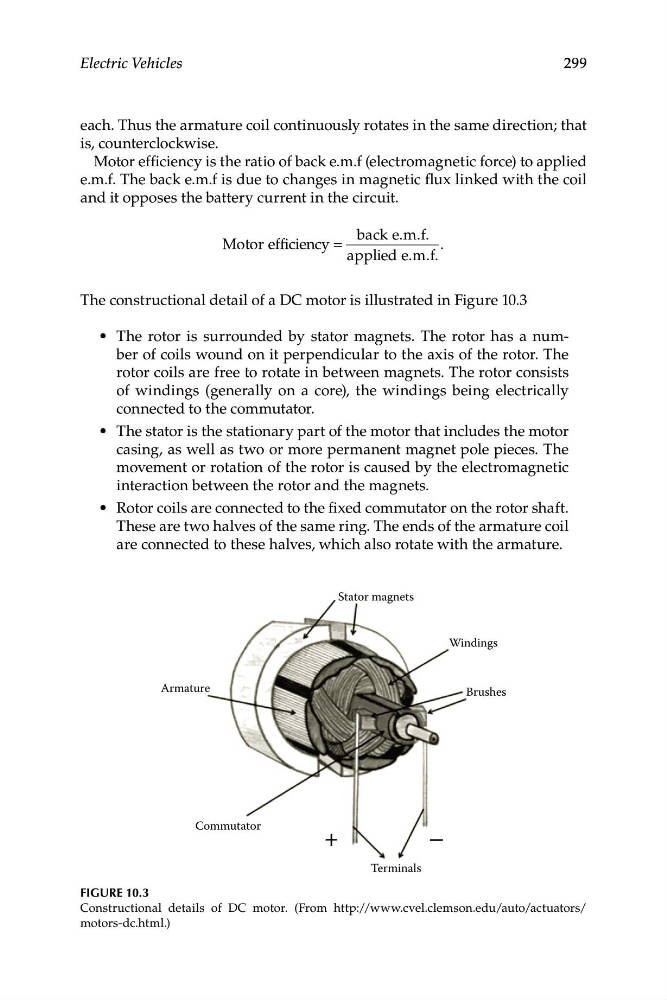
The constructional detail of a DC motor is illustrated in Figure 1 0.3
• The rotor is surrounded by stator magnets. The rotor has a number of coils wound on it perpendicular to the axis of the rotor. The
rotor coils are free to rotate in between magnets. The rotor consists
of windings (generally on a core), the windings being electrically
connected to the commutator.
• The stator is the stationary part of the motor that includes the motor
casing, as well as two or more permanent magnet pole pieces. The
movement or rotation of the rotor is caused by the electromagnetic
interaction between the rotor and the magnets.
• Rotor coils are connected to the fixed commutator on the rotor shaft.
These are two halves of the same ring. The ends of the armature coil
are connected to these halves, which also rotate with the armature.
Figure 10.3
Constructional details of DC motor. (From http://www.cvel.clemson.edu/auto/actuators/
motors-dc.html.)
Armature
Windings
Brushes
Commutator
Stator magnets
Terminals
Electric Vehicles
each. Thus the armature coil continuously rotates in the same direction; that
is, counterclockwise.
Motor efficiency is the ratio of back e.m.f (electromagnetic force) to applied
e.m.f. The back e.m.f is due to changes in magnetic flux linked with the coil
and it opposes the battery current in the circuit.
back e.m.f.
Motor efficiency =
.
applied e.m.f.
The constructional detail of a DC motor is illustrated in Figure 1 0.3
• The rotor is surrounded by stator magnets. The rotor has a number of coils wound on it perpendicular to the axis of the rotor. The
rotor coils are free to rotate in between magnets. The rotor consists
of windings (generally on a core), the windings being electrically
connected to the commutator.
• The stator is the stationary part of the motor that includes the motor
casing, as well as two or more permanent magnet pole pieces. The
movement or rotation of the rotor is caused by the electromagnetic
interaction between the rotor and the magnets.
• Rotor coils are connected to the fixed commutator on the rotor shaft.
These are two halves of the same ring. The ends of the armature coil
are connected to these halves, which also rotate with the armature.
Figure 10.3
Constructional details of DC motor. (From http://www.cvel.clemson.edu/auto/actuators/
motors-dc.html.)