

276
Alternative Fuels for Transportation
To restore a good value of power output, especially for lean burn mixtures
(for lambda = 1.4, a naturally aspirated engine loses 50% of its power), a good
solution could be represented by a turbocharged engine with a higher charging pressure.
Additionally, CO 2 emissions can be reduced as a result of the substitution
of CNG by hydrogen. The special properties of hydrogen as a combustion
stimulant can produce leverage factors much greater than 1 by improving
fossil fuels and not just displacing them.
Hydrogen leverage is defined as the following ratio:
% Emissions Reduction
Hydrogen leverage =
.
% En nergy Supplied as Hydrogen
The increased efficiency makes this value higher than 1. An obvious benefit
of the leverage effect is that a CO 2 reduction is possible even if the hydrogen
used is produced by natural gas without any sequestration of CO 2 .
Experiments of application of blends of hydrogen and natural gas in ICEs
started in 1991, in the framework of a research program financed by DoE
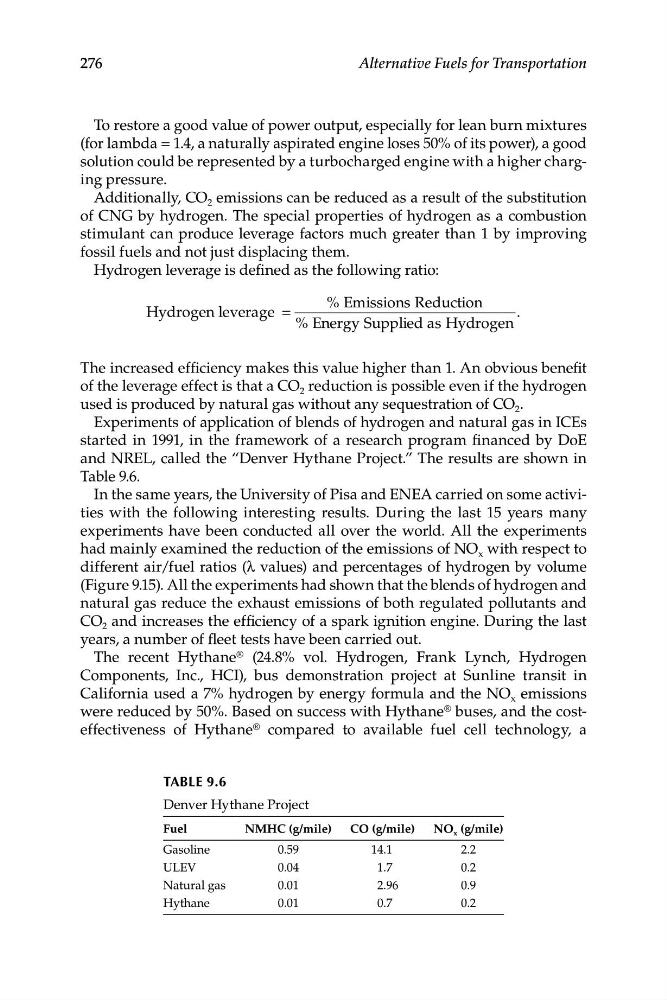
and NREL, called the “Denver Hythane Project.” The results are shown in
Table 9.6.
In the same years, the University of Pisa and ENEA carried on some activities with the following interesting results. During the last 15 years many
experiments have been conducted all over the world. All the experiments
had mainly examined the reduction of the emissions of NO x with respect to
different air/fuel ratios (λ values) and percentages of hydrogen by volume
(Figure 9.15). All the experiments had shown that the blends of hydrogen and
natural gas reduce the exhaust emissions of both regulated pollutants and
CO 2 and increases the efficiency of a spark ignition engine. During the last
years, a number of fleet tests have been carried out.
The recent Hythane ® (24.8% vol. Hydrogen, Frank Lynch, Hydrogen
Components, Inc., HCI), bus demonstration project at Sunline transit in
California used a 7% hydrogen by energy formula and the NO x emissions
were reduced by 50%. Based on success with Hythane ® buses, and the costeffectiveness of Hythane ® compared to available fuel cell technology, a
TABLe 9.6
Denver Hythane Project
Fuel
NMHC (g/mile)
CO (g/mile)
NO x (g/mile)
Gasoline
0.59
14.1
2.2
ULEV
0.04
1.7
0.2
Natural gas
0.01
2.96
0.9
Hythane
0.01
0.7
0.2
Alternative Fuels for Transportation
To restore a good value of power output, especially for lean burn mixtures
(for lambda = 1.4, a naturally aspirated engine loses 50% of its power), a good
solution could be represented by a turbocharged engine with a higher charging pressure.
Additionally, CO 2 emissions can be reduced as a result of the substitution
of CNG by hydrogen. The special properties of hydrogen as a combustion
stimulant can produce leverage factors much greater than 1 by improving
fossil fuels and not just displacing them.
Hydrogen leverage is defined as the following ratio:
% Emissions Reduction
Hydrogen leverage =
.
% En nergy Supplied as Hydrogen
The increased efficiency makes this value higher than 1. An obvious benefit
of the leverage effect is that a CO 2 reduction is possible even if the hydrogen
used is produced by natural gas without any sequestration of CO 2 .
Experiments of application of blends of hydrogen and natural gas in ICEs
started in 1991, in the framework of a research program financed by DoE
and NREL, called the “Denver Hythane Project.” The results are shown in
Table 9.6.
In the same years, the University of Pisa and ENEA carried on some activities with the following interesting results. During the last 15 years many
experiments have been conducted all over the world. All the experiments
had mainly examined the reduction of the emissions of NO x with respect to
different air/fuel ratios (λ values) and percentages of hydrogen by volume
(Figure 9.15). All the experiments had shown that the blends of hydrogen and
natural gas reduce the exhaust emissions of both regulated pollutants and
CO 2 and increases the efficiency of a spark ignition engine. During the last
years, a number of fleet tests have been carried out.
The recent Hythane ® (24.8% vol. Hydrogen, Frank Lynch, Hydrogen
Components, Inc., HCI), bus demonstration project at Sunline transit in
California used a 7% hydrogen by energy formula and the NO x emissions
were reduced by 50%. Based on success with Hythane ® buses, and the costeffectiveness of Hythane ® compared to available fuel cell technology, a
TABLe 9.6
Denver Hythane Project
Fuel
NMHC (g/mile)
CO (g/mile)
NO x (g/mile)
Gasoline
0.59
14.1
2.2
ULEV
0.04
1.7
0.2
Natural gas
0.01
2.96
0.9
Hythane
0.01
0.7
0.2