

LHV
60
50
40
30
20
10
0
LHV (MJ/kg)
LHV (MJ/m 3 )
0
10
20
30
40
% volume H 2
Hydrogen
275
(lambda) is much higher than for the stoichiometric condition, the combustion of methane is not as stable as with HCNG.
As a consequence of the addition of hydrogen to natural gas an overall better combustion had been verified, even in a wide range of operating conditions (lambda, compression ratio, etc.), finding the following main benefits:
a higher efficiency; and lower CO 2 production and emissions. Because of
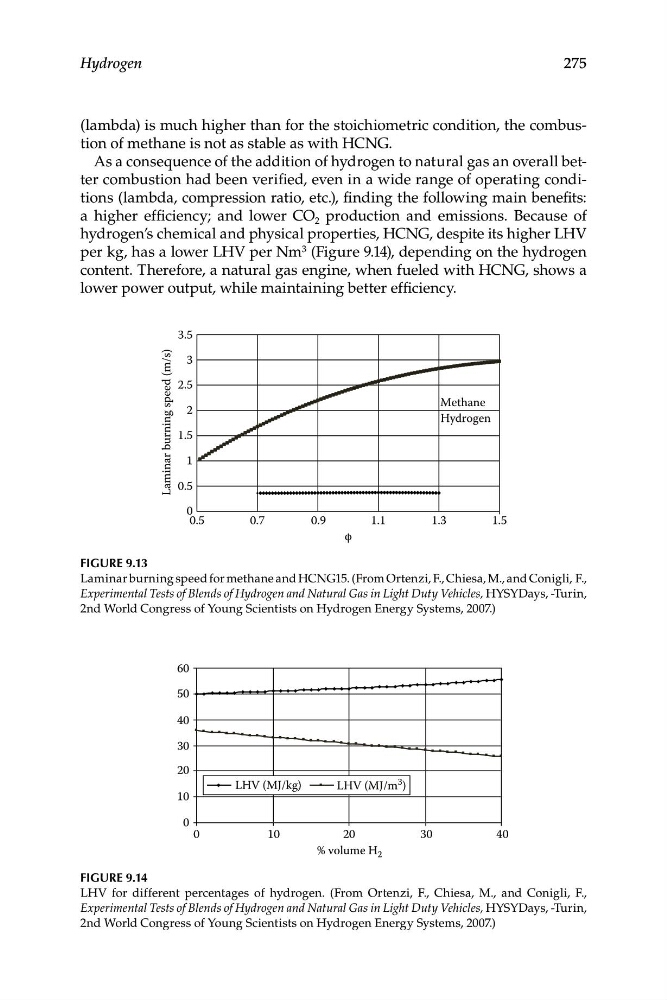
hydrogen’s chemical and physical properties, HCNG, despite its higher LHV
per kg, has a lower LHV per Nm 3 (Figure 9.14), depending on the hydrogen
content. Therefore, a natural gas engine, when fueled with HCNG, shows a
lower power output, while maintaining better efficiency.
φ
0.5
3.5
3
2.5
2
1.5
1
0.5
Laminar burning speed (m/s)
0
0.7
0.9
1.1
1.3
1.5
Methane
Hydrogen
Figure 9.13
Laminar burning speed for methane and HCNG15. (From Ortenzi, F., Chiesa, M., and Conigli, F.,
Experimental Tests of Blends of Hydrogen and Natural Gas in Light Duty Vehicles, HYSYDays, -Turin,
2nd World Congress of Young Scientists on Hydrogen Energy Systems, 2007.)
Figure 9.14
LHV for different percentages of hydrogen. (From Ortenzi, F., Chiesa, M., and Conigli, F.,
Experimental Tests of Blends of Hydrogen and Natural Gas in Light Duty Vehicles, HYSYDays, -Turin,
2nd World Congress of Young Scientists on Hydrogen Energy Systems, 2007.)
60
50
40
30
20
10
0
LHV (MJ/kg)
LHV (MJ/m 3 )
0
10
20
30
40
% volume H 2
Hydrogen
275
(lambda) is much higher than for the stoichiometric condition, the combustion of methane is not as stable as with HCNG.
As a consequence of the addition of hydrogen to natural gas an overall better combustion had been verified, even in a wide range of operating conditions (lambda, compression ratio, etc.), finding the following main benefits:
a higher efficiency; and lower CO 2 production and emissions. Because of
hydrogen’s chemical and physical properties, HCNG, despite its higher LHV
per kg, has a lower LHV per Nm 3 (Figure 9.14), depending on the hydrogen
content. Therefore, a natural gas engine, when fueled with HCNG, shows a
lower power output, while maintaining better efficiency.
φ
0.5
3.5
3
2.5
2
1.5
1
0.5
Laminar burning speed (m/s)
0
0.7
0.9
1.1
1.3
1.5
Methane
Hydrogen
Figure 9.13
Laminar burning speed for methane and HCNG15. (From Ortenzi, F., Chiesa, M., and Conigli, F.,
Experimental Tests of Blends of Hydrogen and Natural Gas in Light Duty Vehicles, HYSYDays, -Turin,
2nd World Congress of Young Scientists on Hydrogen Energy Systems, 2007.)
Figure 9.14
LHV for different percentages of hydrogen. (From Ortenzi, F., Chiesa, M., and Conigli, F.,
Experimental Tests of Blends of Hydrogen and Natural Gas in Light Duty Vehicles, HYSYDays, -Turin,
2nd World Congress of Young Scientists on Hydrogen Energy Systems, 2007.)