

NO
1400
1200
1000
800
600
400
200
0
x concentration (ppm)
Diesel
Hydrogen
3
35
4
45
5
5.5
6
6.5
7
7.5
Indicated mean effective pressure (IMEP) (bar)
274
Alternative Fuels for Transportation
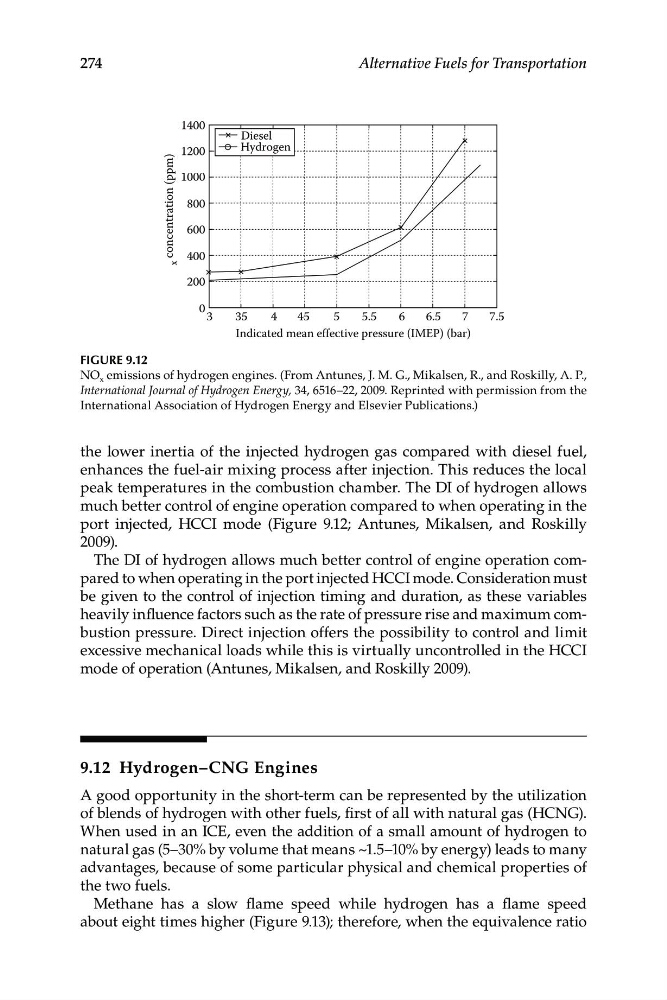
Figure 9.12
NO x emissions of hydrogen engines. (From Antunes, J. M. G., Mikalsen, R., and Roskilly, A. P.,
International Journal of Hydrogen Energy, 34, 6516–22, 2009. Reprinted with permission from the
International Association of Hydrogen Energy and Elsevier Publications.)
the lower inertia of the injected hydrogen gas compared with diesel fuel,
enhances the fuel-air mixing process after injection. This reduces the local
peak temperatures in the combustion chamber. The DI of hydrogen allows
much better control of engine operation compared to when operating in the
port injected, HCCI mode (Figure 9.12; Antunes, Mikalsen, and Roskilly
2009).
The DI of hydrogen allows much better control of engine operation compared to when operating in the port injected HCCI mode. Consideration must
be given to the control of injection timing and duration, as these variables
heavily influence factors such as the rate of pressure rise and maximum combustion pressure. Direct injection offers the possibility to control and limit
excessive mechanical loads while this is virtually uncontrolled in the HCCI
mode of operation (Antunes, Mikalsen, and Roskilly 2009).
9.12 Hydrogen–CNG Engines
A good opportunity in the short-term can be represented by the utilization
of blends of hydrogen with other fuels, first of all with natural gas (HCNG).
When used in an ICE, even the addition of a small amount of hydrogen to
natural gas (5–30% by volume that means ~1.5–10% by energy) leads to many
advantages, because of some particular physical and chemical properties of
the two fuels.
Methane has a slow flame speed while hydrogen has a flame speed
about eight times higher (Figure 9.13); therefore, when the equivalence ratio
1400
1200
1000
800
600
400
200
0
x concentration (ppm)
Diesel
Hydrogen
3
35
4
45
5
5.5
6
6.5
7
7.5
Indicated mean effective pressure (IMEP) (bar)
274
Alternative Fuels for Transportation
Figure 9.12
NO x emissions of hydrogen engines. (From Antunes, J. M. G., Mikalsen, R., and Roskilly, A. P.,
International Journal of Hydrogen Energy, 34, 6516–22, 2009. Reprinted with permission from the
International Association of Hydrogen Energy and Elsevier Publications.)
the lower inertia of the injected hydrogen gas compared with diesel fuel,
enhances the fuel-air mixing process after injection. This reduces the local
peak temperatures in the combustion chamber. The DI of hydrogen allows
much better control of engine operation compared to when operating in the
port injected, HCCI mode (Figure 9.12; Antunes, Mikalsen, and Roskilly
2009).
The DI of hydrogen allows much better control of engine operation compared to when operating in the port injected HCCI mode. Consideration must
be given to the control of injection timing and duration, as these variables
heavily influence factors such as the rate of pressure rise and maximum combustion pressure. Direct injection offers the possibility to control and limit
excessive mechanical loads while this is virtually uncontrolled in the HCCI
mode of operation (Antunes, Mikalsen, and Roskilly 2009).
9.12 Hydrogen–CNG Engines
A good opportunity in the short-term can be represented by the utilization
of blends of hydrogen with other fuels, first of all with natural gas (HCNG).
When used in an ICE, even the addition of a small amount of hydrogen to
natural gas (5–30% by volume that means ~1.5–10% by energy) leads to many
advantages, because of some particular physical and chemical properties of
the two fuels.
Methane has a slow flame speed while hydrogen has a flame speed
about eight times higher (Figure 9.13); therefore, when the equivalence ratio