

Hydrogen
277
5.00
0.93
0.78
0.63
36%
20%
0%
0.00
1.00
2.00
3.00
Equivalent ratio
4.00
NOx, gr/HPh
H 2 by volume
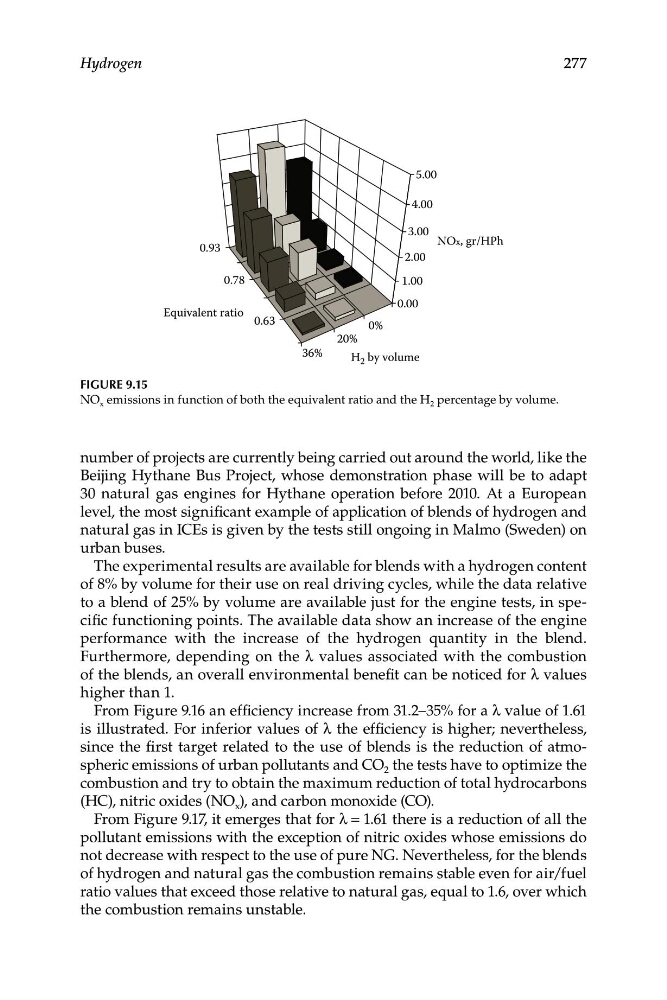
Figure 9.15
NO x emissions in function of both the equivalent ratio and the H 2 percentage by volume.
number of projects are currently being carried out around the world, like the
Beijing Hythane Bus Project, whose demonstration phase will be to adapt
30 natural gas engines for Hythane operation before 2010. At a European
level, the most significant example of application of blends of hydrogen and
natural gas in ICEs is given by the tests still ongoing in Malmo (Sweden) on
urban buses.
The experimental results are available for blends with a hydrogen content
of 8% by volume for their use on real driving cycles, while the data relative
to a blend of 25% by volume are available just for the engine tests, in specific functioning points. The available data show an increase of the engine
performance with the increase of the hydrogen quantity in the blend.
Furthermore, depending on the λ values associated with the combustion
of the blends, an overall environmental benefit can be noticed for λ values
higher than 1.
From Figure 9.16 an efficiency increase from 31.2–35% for a λ value of 1.61
is illustrated. For inferior values of λ the efficiency is higher; nevertheless,
since the first target related to the use of blends is the reduction of atmospheric emissions of urban pollutants and CO 2 the tests have to optimize the
combustion and try to obtain the maximum reduction of total hydrocarbons
(HC), nitric oxides (NO x ), and carbon monoxide (CO).
From Figure 9.17, it emerges that for λ = 1.61 there is a reduction of all the
pollutant emissions with the exception of nitric oxides whose emissions do
not decrease with respect to the use of pure NG. Nevertheless, for the blends
of hydrogen and natural gas the combustion remains stable even for air/fuel
ratio values that exceed those relative to natural gas, equal to 1.6, over which
the combustion remains unstable.
277
5.00
0.93
0.78
0.63
36%
20%
0%
0.00
1.00
2.00
3.00
Equivalent ratio
4.00
NOx, gr/HPh
H 2 by volume
Figure 9.15
NO x emissions in function of both the equivalent ratio and the H 2 percentage by volume.
number of projects are currently being carried out around the world, like the
Beijing Hythane Bus Project, whose demonstration phase will be to adapt
30 natural gas engines for Hythane operation before 2010. At a European
level, the most significant example of application of blends of hydrogen and
natural gas in ICEs is given by the tests still ongoing in Malmo (Sweden) on
urban buses.
The experimental results are available for blends with a hydrogen content
of 8% by volume for their use on real driving cycles, while the data relative
to a blend of 25% by volume are available just for the engine tests, in specific functioning points. The available data show an increase of the engine
performance with the increase of the hydrogen quantity in the blend.
Furthermore, depending on the λ values associated with the combustion
of the blends, an overall environmental benefit can be noticed for λ values
higher than 1.
From Figure 9.16 an efficiency increase from 31.2–35% for a λ value of 1.61
is illustrated. For inferior values of λ the efficiency is higher; nevertheless,
since the first target related to the use of blends is the reduction of atmospheric emissions of urban pollutants and CO 2 the tests have to optimize the
combustion and try to obtain the maximum reduction of total hydrocarbons
(HC), nitric oxides (NO x ), and carbon monoxide (CO).
From Figure 9.17, it emerges that for λ = 1.61 there is a reduction of all the
pollutant emissions with the exception of nitric oxides whose emissions do
not decrease with respect to the use of pure NG. Nevertheless, for the blends
of hydrogen and natural gas the combustion remains stable even for air/fuel
ratio values that exceed those relative to natural gas, equal to 1.6, over which
the combustion remains unstable.