

Hydrogen
249
and compactness, clean carbon by-product, and reduction in CO 2 and CO
emissions. The chemical reaction can be written as,
1
C H → nC + mH .
n m
2
2
9.3.3 Plasma reforming
In plasma reforming the overall reforming reactions are the same as conventional reforming, however, energy and free radicals used for the reforming
reaction are provided by plasma typically generated with electricity or heat.
When water or steam is injected with the fuel, H, OH, and O radicals in
addition to electrons are formed, thus creating conditions for both reductive
and oxidative reactions to occur. This process operates at lower temperatures
than traditional reforming and is high sulfur tolerant.
9.3.4 Biohydrogen
Biohydrogen production is explained in Chapter 13.
9.3.5 Hydrogen from Water
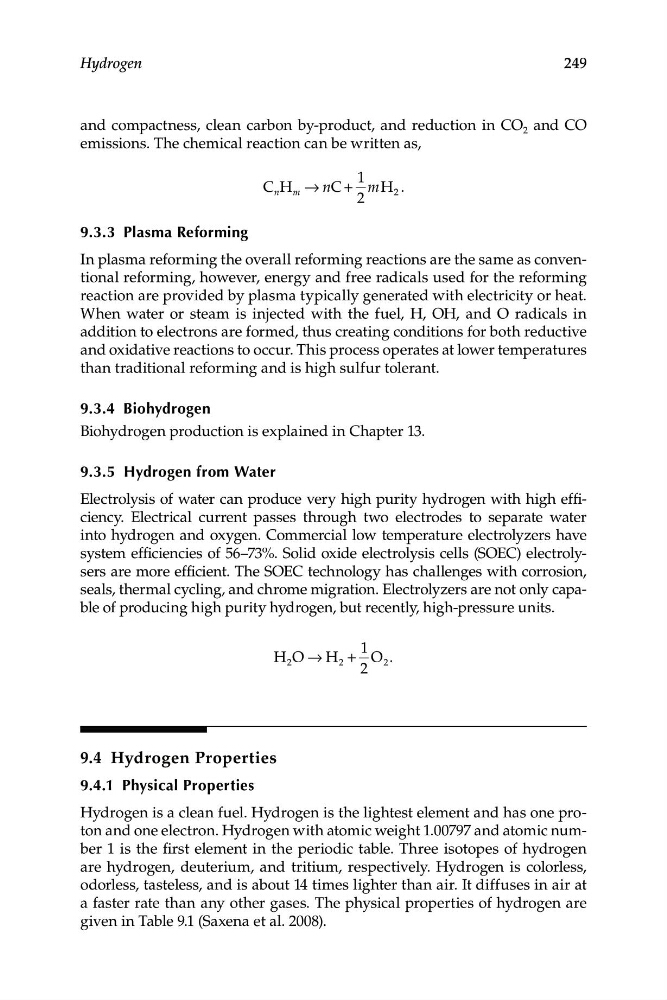
Electrolysis of water can produce very high purity hydrogen with high efficiency. Electrical current passes through two electrodes to separate water
into hydrogen and oxygen. Commercial low temperature electrolyzers have
system efficiencies of 56–73%. Solid oxide electrolysis cells (SOEC) electrolysers are more efficient. The SOEC technology has challenges with corrosion,
seals, thermal cycling, and chrome migration. Electrolyzers are not only capable of producing high purity hydrogen, but recently, high-pressure units.
1
H O → H + O .
2
2
2
2
9.4 Hydrogen Properties
9.4.1 Physical Properties
Hydrogen is a clean fuel. Hydrogen is the lightest element and has one proton and one electron. Hydrogen with atomic weight 1.00797 and atomic number 1 is the first element in the periodic table. Three isotopes of hydrogen
are hydrogen, deuterium, and tritium, respectively. Hydrogen is colorless,
odorless, tasteless, and is about 14 times lighter than air. It diffuses in air at
a faster rate than any other gases. The physical properties of hydrogen are
given in Table 9.1 (Saxena et al. 2008).
249
and compactness, clean carbon by-product, and reduction in CO 2 and CO
emissions. The chemical reaction can be written as,
1
C H → nC + mH .
n m
2
2
9.3.3 Plasma reforming
In plasma reforming the overall reforming reactions are the same as conventional reforming, however, energy and free radicals used for the reforming
reaction are provided by plasma typically generated with electricity or heat.
When water or steam is injected with the fuel, H, OH, and O radicals in
addition to electrons are formed, thus creating conditions for both reductive
and oxidative reactions to occur. This process operates at lower temperatures
than traditional reforming and is high sulfur tolerant.
9.3.4 Biohydrogen
Biohydrogen production is explained in Chapter 13.
9.3.5 Hydrogen from Water
Electrolysis of water can produce very high purity hydrogen with high efficiency. Electrical current passes through two electrodes to separate water
into hydrogen and oxygen. Commercial low temperature electrolyzers have
system efficiencies of 56–73%. Solid oxide electrolysis cells (SOEC) electrolysers are more efficient. The SOEC technology has challenges with corrosion,
seals, thermal cycling, and chrome migration. Electrolyzers are not only capable of producing high purity hydrogen, but recently, high-pressure units.
1
H O → H + O .
2
2
2
2
9.4 Hydrogen Properties
9.4.1 Physical Properties
Hydrogen is a clean fuel. Hydrogen is the lightest element and has one proton and one electron. Hydrogen with atomic weight 1.00797 and atomic number 1 is the first element in the periodic table. Three isotopes of hydrogen
are hydrogen, deuterium, and tritium, respectively. Hydrogen is colorless,
odorless, tasteless, and is about 14 times lighter than air. It diffuses in air at
a faster rate than any other gases. The physical properties of hydrogen are
given in Table 9.1 (Saxena et al. 2008).