

248
Alternative Fuels for Transportation
Solid fuel
Liquid fuel
Natural gas
Gasification
Gas cleaning and
Desulfurization
Reforming
High temp fuel cells
(SOFC, MCFC)
Water gas shift
CO clean up (PROX,
membrane, PSA etc.)
Syngas prod
H 2 /CO ~ 2
Fischer–Tropsch
Synthesis
Methanol/dme
Synthesis
Ethanol synthesis
Other high value
Products
Low temp fuel cells
(PEMFC)
Hydrogen storage
Desulfurization
Desulfurization
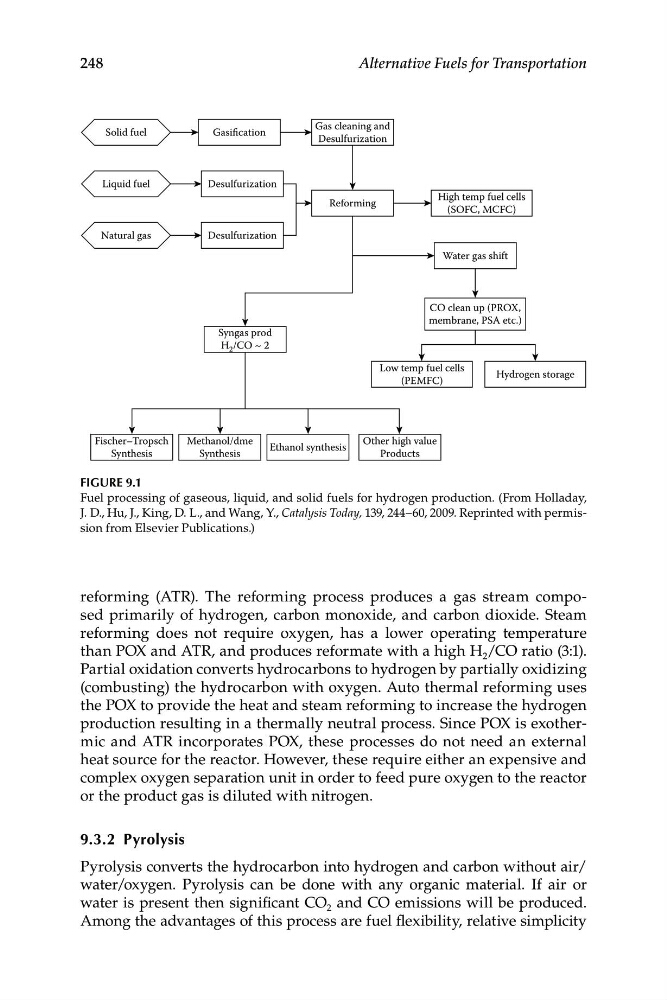
Figure 9.1
Fuel processing of gaseous, liquid, and solid fuels for hydrogen production. (From Holladay,
J. D ., Hu, J., King, D. L., and Wang, Y., Catalysis Today, 139, 244–60, 2009. Reprinted with permission from Elsevier Publications.)
reforming (ATR). The reforming process produces a gas stream composed primarily of hydrogen, carbon monoxide, and carbon dioxide. Steam
reforming does not require oxygen, has a lower operating temperature
than POX and ATR, and produces reformate with a high H 2 /CO ratio (3:1).
Partial oxidation converts hydrocarbons to hydrogen by partially oxidizing
(combusting) the hydrocarbon with oxygen. Auto thermal reforming uses
the POX to provide the heat and steam reforming to increase the hydrogen
production resulting in a thermally neutral process. Since POX is exothermic and ATR incorporates POX, these processes do not need an external
heat source for the reactor. However, these require either an expensive and
complex oxygen separation unit in order to feed pure oxygen to the reactor
or the product gas is diluted with nitrogen.
9.3.2 Pyrolysis
Pyrolysis converts the hydrocarbon into hydrogen and carbon without air/
water/oxygen. Pyrolysis can be done with any organic material. If air or
water is present then significant CO 2 and CO emissions will be produced.
Among the advantages of this process are fuel flexibility, relative simplicity
Alternative Fuels for Transportation
Solid fuel
Liquid fuel
Natural gas
Gasification
Gas cleaning and
Desulfurization
Reforming
High temp fuel cells
(SOFC, MCFC)
Water gas shift
CO clean up (PROX,
membrane, PSA etc.)
Syngas prod
H 2 /CO ~ 2
Fischer–Tropsch
Synthesis
Methanol/dme
Synthesis
Ethanol synthesis
Other high value
Products
Low temp fuel cells
(PEMFC)
Hydrogen storage
Desulfurization
Desulfurization
Figure 9.1
Fuel processing of gaseous, liquid, and solid fuels for hydrogen production. (From Holladay,
J. D ., Hu, J., King, D. L., and Wang, Y., Catalysis Today, 139, 244–60, 2009. Reprinted with permission from Elsevier Publications.)
reforming (ATR). The reforming process produces a gas stream composed primarily of hydrogen, carbon monoxide, and carbon dioxide. Steam
reforming does not require oxygen, has a lower operating temperature
than POX and ATR, and produces reformate with a high H 2 /CO ratio (3:1).
Partial oxidation converts hydrocarbons to hydrogen by partially oxidizing
(combusting) the hydrocarbon with oxygen. Auto thermal reforming uses
the POX to provide the heat and steam reforming to increase the hydrogen
production resulting in a thermally neutral process. Since POX is exothermic and ATR incorporates POX, these processes do not need an external
heat source for the reactor. However, these require either an expensive and
complex oxygen separation unit in order to feed pure oxygen to the reactor
or the product gas is diluted with nitrogen.
9.3.2 Pyrolysis
Pyrolysis converts the hydrocarbon into hydrogen and carbon without air/
water/oxygen. Pyrolysis can be done with any organic material. If air or
water is present then significant CO 2 and CO emissions will be produced.
Among the advantages of this process are fuel flexibility, relative simplicity