

250
Alternative Fuels for Transportation
A stream of hydrogen from a leak is invisible in daylight. Hydrogen has a
very low density of about 0.09 kg/m 3 20ºC. The liquid density of hydrogen is
70.03 kg/m 3 . Higher cylinder capacity is required to store sufficient amounts
of hydrogen for the operation of a vehicle. Moreover, as the energy density
reduces, the power output also decreases. On cooling, hydrogen condenses
to liquid at –253ºC and to solid at –259ºC. Hydrogen in gaseous form has a
heat capacity of 14.4 kJ/kgK (Pant and Gupta 2009).
Hydrogen engines will not face any starting problems as it has a very low
boiling point. Even in very severe winter temperatures a hydrogen engine
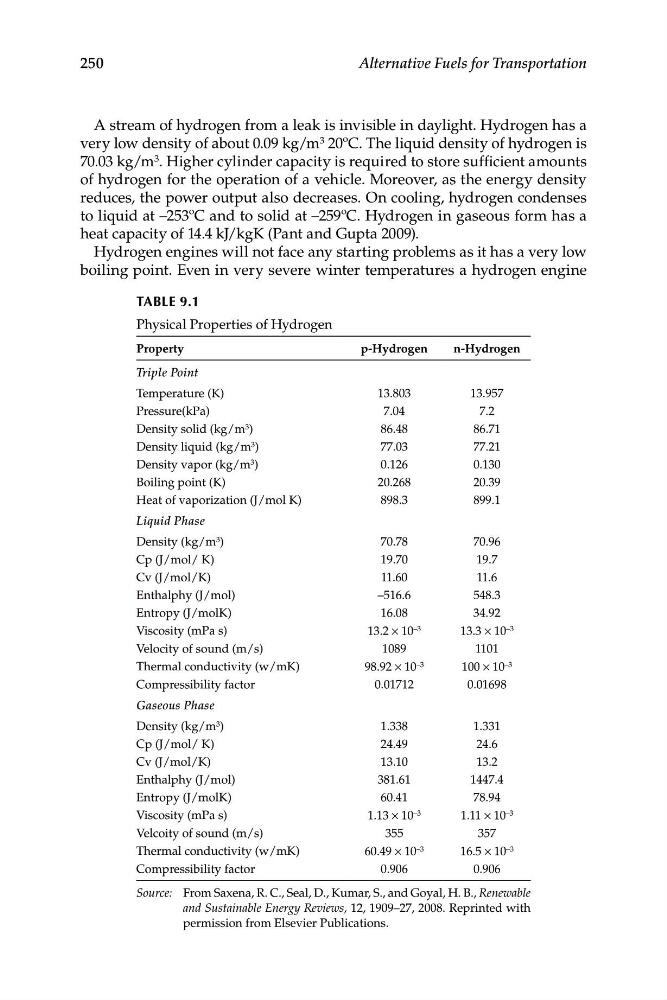
TABLe 9.1
Physical Properties of Hydrogen
Property
p-Hydrogen
n-Hydrogen
Triple Point
Temperature (K)
13.803
13.957
Pressure(kPa)
7.04
7.2
Density solid (kg/m 3 )
86.48
86.71
Density liquid (kg/m 3 )
77.03
77.21
Density vapor (kg/m 3 )
0.126
0.130
Boiling point (K)
20.268
20.39
Heat of vaporization (J/mol K)
898.3
899.1
Liquid Phase
Density (kg/m 3 )
70.78
70.96
Cp (J/mol/ K)
19.70
19.7
Cv (J/mol/K)
11.60
11.6
Enthalphy (J/mol)
–516.6
548.3
Entropy (J/molK)
16.08
34.92
Viscosity (mPa s)
13.2 × 10 –3
13.3 × 10 –3
Velocity of sound (m/s)
1089
1101
Thermal conductivity (w/mK)
98.92 × 10 –3
100 × 10 –3
Compressibility factor
0.01712
0.01698
Gaseous Phase
Density (kg/m 3 )
1.338
1.331
Cp (J/mol/ K)
24.49
24.6
Cv (J/mol/K)
13.10
13.2
Enthalphy (J/mol)
381.61
1447.4
Entropy (J/molK)
60.41
78.94
Viscosity (mPa s)
1.13 × 10 –3
1.11 × 10 –3
Velcoity of sound (m/s)
355
357
Thermal conductivity (w/mK)
60.49 × 10 –3
16.5 × 10 –3
Compressibility factor
0.906
0.906
Source: From Saxena, R. C., Seal, D., Kumar, S., and Goyal, H. B., Renewable
and Sustainable Energy Reviews, 12, 1909–27, 2008. Reprinted with
permission from Elsevier Publications.
Alternative Fuels for Transportation
A stream of hydrogen from a leak is invisible in daylight. Hydrogen has a
very low density of about 0.09 kg/m 3 20ºC. The liquid density of hydrogen is
70.03 kg/m 3 . Higher cylinder capacity is required to store sufficient amounts
of hydrogen for the operation of a vehicle. Moreover, as the energy density
reduces, the power output also decreases. On cooling, hydrogen condenses
to liquid at –253ºC and to solid at –259ºC. Hydrogen in gaseous form has a
heat capacity of 14.4 kJ/kgK (Pant and Gupta 2009).
Hydrogen engines will not face any starting problems as it has a very low
boiling point. Even in very severe winter temperatures a hydrogen engine
TABLe 9.1
Physical Properties of Hydrogen
Property
p-Hydrogen
n-Hydrogen
Triple Point
Temperature (K)
13.803
13.957
Pressure(kPa)
7.04
7.2
Density solid (kg/m 3 )
86.48
86.71
Density liquid (kg/m 3 )
77.03
77.21
Density vapor (kg/m 3 )
0.126
0.130
Boiling point (K)
20.268
20.39
Heat of vaporization (J/mol K)
898.3
899.1
Liquid Phase
Density (kg/m 3 )
70.78
70.96
Cp (J/mol/ K)
19.70
19.7
Cv (J/mol/K)
11.60
11.6
Enthalphy (J/mol)
–516.6
548.3
Entropy (J/molK)
16.08
34.92
Viscosity (mPa s)
13.2 × 10 –3
13.3 × 10 –3
Velocity of sound (m/s)
1089
1101
Thermal conductivity (w/mK)
98.92 × 10 –3
100 × 10 –3
Compressibility factor
0.01712
0.01698
Gaseous Phase
Density (kg/m 3 )
1.338
1.331
Cp (J/mol/ K)
24.49
24.6
Cv (J/mol/K)
13.10
13.2
Enthalphy (J/mol)
381.61
1447.4
Entropy (J/molK)
60.41
78.94
Viscosity (mPa s)
1.13 × 10 –3
1.11 × 10 –3
Velcoity of sound (m/s)
355
357
Thermal conductivity (w/mK)
60.49 × 10 –3
16.5 × 10 –3
Compressibility factor
0.906
0.906
Source: From Saxena, R. C., Seal, D., Kumar, S., and Goyal, H. B., Renewable
and Sustainable Energy Reviews, 12, 1909–27, 2008. Reprinted with
permission from Elsevier Publications.