

219
Liquefied Petroleum Gas
0
35
30
25
20
15
10
500
400
300
200
100
0
20
40
Fuel conversion efficiency (%)
bsfc (g/hp.h)
60
80
100
N = 1500 rpm
m propane /(m diesel + m propane ) = 40%
η fc -diesel fuel
bsfc-diesel
bsfc-dual
η fc -dual fuel
Load (%)
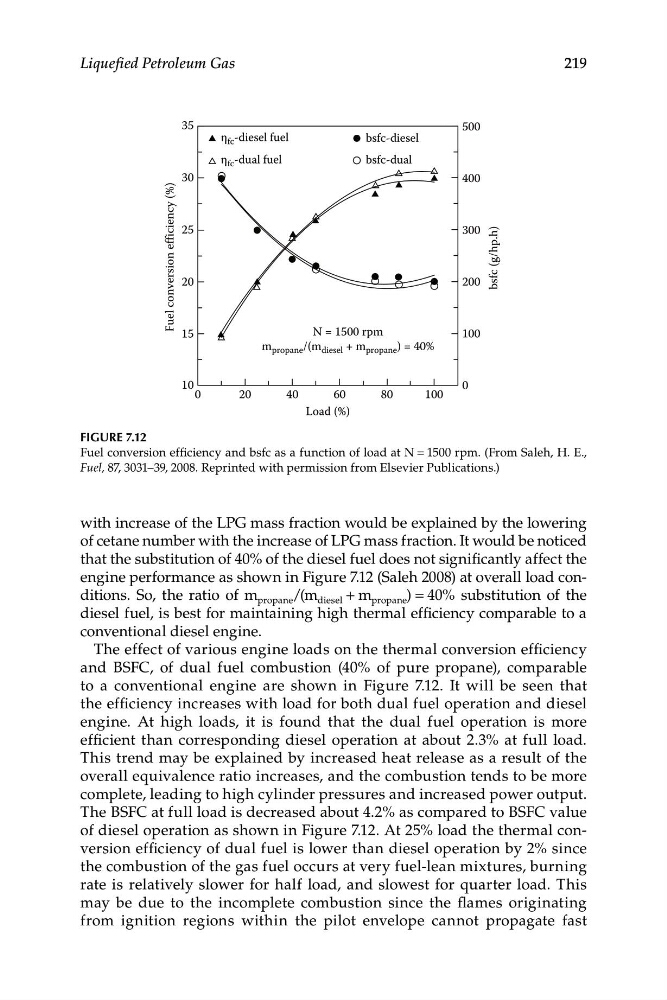
Figure 7.12
Fuel conversion efficiency and bsfc as a function of load at N = 1500 rpm. (From Saleh, H. E.,
Fuel, 87, 3031–39, 2008. Reprinted with permission from Elsevier Publications.)
with increase of the LPG mass fraction would be explained by the lowering
of cetane number with the increase of LPG mass fraction. It would be noticed
that the substitution of 40% of the diesel fuel does not significantly affect the
engine performance as shown in Figure 7.12 (Saleh 2008) at overall load conditions. So, the ratio of m propane /(m diesel + m propane ) = 40% substitution of the
diesel fuel, is best for maintaining high thermal efficiency comparable to a
conventional diesel engine.
The effect of various engine loads on the thermal conversion efficiency
and BSFC, of dual fuel combustion (40% of pure propane), comparable
to a conventional engine are shown in Figure 7.12. It will be seen that
the efficiency increases with load for both dual fuel operation and diesel
engine. At high loads, it is found that the dual fuel operation is more
efficient than corresponding diesel operation at about 2.3% at full load.
This trend may be explained by increased heat release as a result of the
overall equivalence ratio increases, and the combustion tends to be more
complete, leading to high cylinder pressures and increased power output.
The BSFC at full load is decreased about 4.2% as compared to BSFC value
of diesel operation as shown in Figure 7.12. At 25% load the thermal conversion efficiency of dual fuel is lower than diesel operation by 2% since
the combustion of the gas fuel occurs at very fuel-lean mixtures, burning
rate is relatively slower for half load, and slowest for quarter load. This
may be due to the incomplete combustion since the flames originating
from ignition regions within the pilot envelope cannot propagate fast
Liquefied Petroleum Gas
0
35
30
25
20
15
10
500
400
300
200
100
0
20
40
Fuel conversion efficiency (%)
bsfc (g/hp.h)
60
80
100
N = 1500 rpm
m propane /(m diesel + m propane ) = 40%
η fc -diesel fuel
bsfc-diesel
bsfc-dual
η fc -dual fuel
Load (%)
Figure 7.12
Fuel conversion efficiency and bsfc as a function of load at N = 1500 rpm. (From Saleh, H. E.,
Fuel, 87, 3031–39, 2008. Reprinted with permission from Elsevier Publications.)
with increase of the LPG mass fraction would be explained by the lowering
of cetane number with the increase of LPG mass fraction. It would be noticed
that the substitution of 40% of the diesel fuel does not significantly affect the
engine performance as shown in Figure 7.12 (Saleh 2008) at overall load conditions. So, the ratio of m propane /(m diesel + m propane ) = 40% substitution of the
diesel fuel, is best for maintaining high thermal efficiency comparable to a
conventional diesel engine.
The effect of various engine loads on the thermal conversion efficiency
and BSFC, of dual fuel combustion (40% of pure propane), comparable
to a conventional engine are shown in Figure 7.12. It will be seen that
the efficiency increases with load for both dual fuel operation and diesel
engine. At high loads, it is found that the dual fuel operation is more
efficient than corresponding diesel operation at about 2.3% at full load.
This trend may be explained by increased heat release as a result of the
overall equivalence ratio increases, and the combustion tends to be more
complete, leading to high cylinder pressures and increased power output.
The BSFC at full load is decreased about 4.2% as compared to BSFC value
of diesel operation as shown in Figure 7.12. At 25% load the thermal conversion efficiency of dual fuel is lower than diesel operation by 2% since
the combustion of the gas fuel occurs at very fuel-lean mixtures, burning
rate is relatively slower for half load, and slowest for quarter load. This
may be due to the incomplete combustion since the flames originating
from ignition regions within the pilot envelope cannot propagate fast