

NO
E h u
mp
u
C
220
Alternative Fuels for Transportation
and far enough within the time available to consume the entire fuel-lean
mixture.
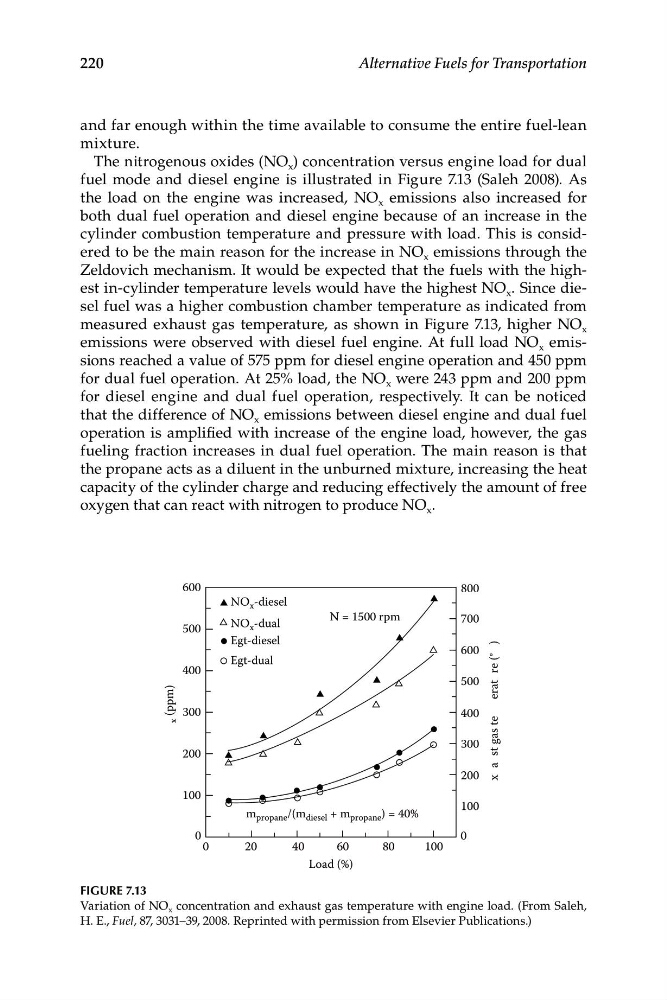
The nitrogenous oxides (NO x ) concentration versus engine load for dual
fuel mode and diesel engine is illustrated in Figure 7.13 (Saleh 2008). As
the load on the engine was increased, NO x emissions also increased for
both dual fuel operation and diesel engine because of an increase in the
cylinder combustion temperature and pressure with load. This is considered to be the main reason for the increase in NO x emissions through the
Zeldovich mechanism. It would be expected that the fuels with the highest in-cylinder temperature levels would have the highest NO x . Since diesel fuel was a higher combustion chamber temperature as indicated from
measured exhaust gas temperature, as shown in Figure 7.13, higher NO x
emissions were observed with diesel fuel engine. At full load NO x emissions reached a value of 575 ppm for diesel engine operation and 450 ppm
for dual fuel operation. At 25% load, the NO x were 243 ppm and 200 ppm
for diesel engine and dual fuel operation, respectively. It can be noticed
that the difference of NO x emissions between diesel engine and dual fuel
operation is amplified with increase of the engine load, however, the gas
fueling fraction increases in dual fuel operation. The main reason is that
the propane acts as a diluent in the unburned mixture, increasing the heat
capacity of the cylinder charge and reducing effectively the amount of free
oxygen that can react with nitrogen to produce NO x .
600
800
700
600
500
400
300
200
100
0
500
400
300
200
100
0
x (ppm)
x a st gas te erat re (° )
NO x -diesel
NO x -dual
Egt-diesel
Egt-dual
N = 1500 rpm
m propane /(m diesel + m propane ) = 40%
0
20
4 0
6 0
80
100
Load (%)
Figure 7.13
Variation of NO x concentration and exhaust gas temperature with engine load. (From Saleh,
H. E., Fuel, 87, 3031–39, 2008. Reprinted with permission from Elsevier Publications.)
E h u
mp
u
C
220
Alternative Fuels for Transportation
and far enough within the time available to consume the entire fuel-lean
mixture.
The nitrogenous oxides (NO x ) concentration versus engine load for dual
fuel mode and diesel engine is illustrated in Figure 7.13 (Saleh 2008). As
the load on the engine was increased, NO x emissions also increased for
both dual fuel operation and diesel engine because of an increase in the
cylinder combustion temperature and pressure with load. This is considered to be the main reason for the increase in NO x emissions through the
Zeldovich mechanism. It would be expected that the fuels with the highest in-cylinder temperature levels would have the highest NO x . Since diesel fuel was a higher combustion chamber temperature as indicated from
measured exhaust gas temperature, as shown in Figure 7.13, higher NO x
emissions were observed with diesel fuel engine. At full load NO x emissions reached a value of 575 ppm for diesel engine operation and 450 ppm
for dual fuel operation. At 25% load, the NO x were 243 ppm and 200 ppm
for diesel engine and dual fuel operation, respectively. It can be noticed
that the difference of NO x emissions between diesel engine and dual fuel
operation is amplified with increase of the engine load, however, the gas
fueling fraction increases in dual fuel operation. The main reason is that
the propane acts as a diluent in the unburned mixture, increasing the heat
capacity of the cylinder charge and reducing effectively the amount of free
oxygen that can react with nitrogen to produce NO x .
600
800
700
600
500
400
300
200
100
0
500
400
300
200
100
0
x (ppm)
x a st gas te erat re (° )
NO x -diesel
NO x -dual
Egt-diesel
Egt-dual
N = 1500 rpm
m propane /(m diesel + m propane ) = 40%
0
20
4 0
6 0
80
100
Load (%)
Figure 7.13
Variation of NO x concentration and exhaust gas temperature with engine load. (From Saleh,
H. E., Fuel, 87, 3031–39, 2008. Reprinted with permission from Elsevier Publications.)