

218
Alternative Fuels for Transportation
exhibits longer ignition delay periods when compared to methane–air–diesel
mixtures and diesel–air mixtures. For the diesel engine, there has been usually a trade-off between several targets, for example, reducing exhaust emissions, reducing engine noise, reducing fuel consumption, and increasing
specific outputs.
As mentioned above, for dual fuel operation the propane is aspirated
with the incoming air to the cylinder, so the combustion occurs partially
in premixed mode. The diesel pilot flame acts as an ignition source for the
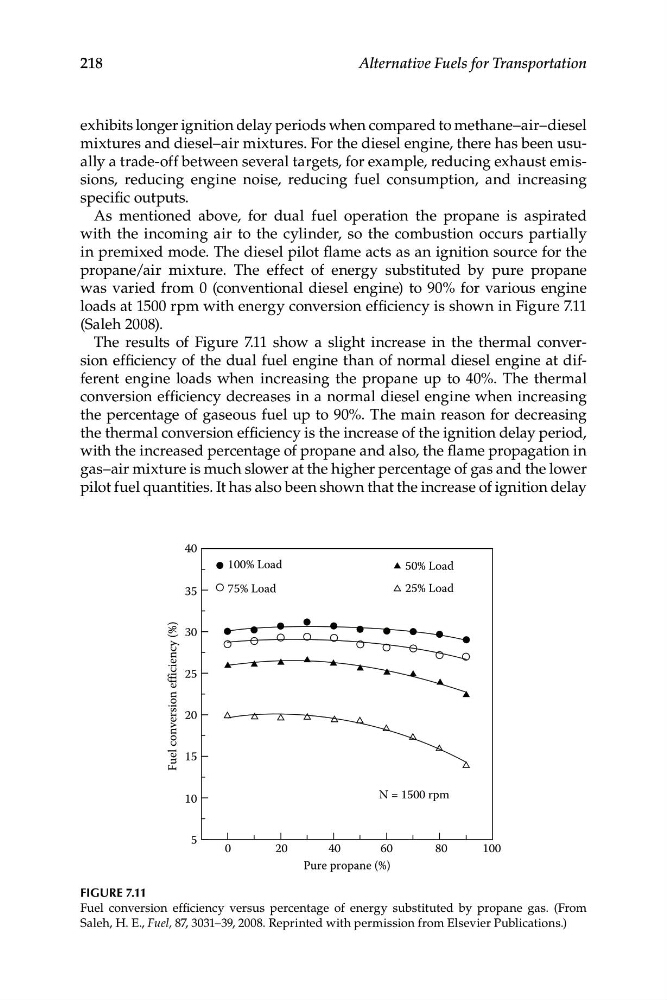
propane/air mixture. The effect of energy substituted by pure propane
was varied from 0 (conventional diesel engine) to 90% for various engine
loads at 1500 rpm with energy conversion efficiency is shown in Figure 7.11
(Saleh 2008).
The results of Figure 7.11 show a slight increase in the thermal conversion efficiency of the dual fuel engine than of normal diesel engine at different engine loads when increasing the propane up to 40%. The thermal
conversion efficiency decreases in a normal diesel engine when increasing
the percentage of gaseous fuel up to 90%. The main reason for decreasing
the thermal conversion efficiency is the increase of the ignition delay period,
with the increased percentage of propane and also, the flame propagation in
gas–air mixture is much slower at the higher percentage of gas and the lower
pilot fuel quantities. It has also been shown that the increase of ignition delay
Fuel conversion efficiency (%)
40
35
30
25
20
15
10
5
N = 1500 rpm
100% Load
50% Load
25% Load
75% Load
0
2 0
4 0
60
80
100
Pure propane (%)
Figure 7.11
Fuel conversion efficiency versus percentage of energy substituted by propane gas. (From
Saleh, H. E., Fuel, 87, 3031–39, 2008. Reprinted with permission from Elsevier Publications.)
Alternative Fuels for Transportation
exhibits longer ignition delay periods when compared to methane–air–diesel
mixtures and diesel–air mixtures. For the diesel engine, there has been usually a trade-off between several targets, for example, reducing exhaust emissions, reducing engine noise, reducing fuel consumption, and increasing
specific outputs.
As mentioned above, for dual fuel operation the propane is aspirated
with the incoming air to the cylinder, so the combustion occurs partially
in premixed mode. The diesel pilot flame acts as an ignition source for the
propane/air mixture. The effect of energy substituted by pure propane
was varied from 0 (conventional diesel engine) to 90% for various engine
loads at 1500 rpm with energy conversion efficiency is shown in Figure 7.11
(Saleh 2008).
The results of Figure 7.11 show a slight increase in the thermal conversion efficiency of the dual fuel engine than of normal diesel engine at different engine loads when increasing the propane up to 40%. The thermal
conversion efficiency decreases in a normal diesel engine when increasing
the percentage of gaseous fuel up to 90%. The main reason for decreasing
the thermal conversion efficiency is the increase of the ignition delay period,
with the increased percentage of propane and also, the flame propagation in
gas–air mixture is much slower at the higher percentage of gas and the lower
pilot fuel quantities. It has also been shown that the increase of ignition delay
Fuel conversion efficiency (%)
40
35
30
25
20
15
10
5
N = 1500 rpm
100% Load
50% Load
25% Load
75% Load
0
2 0
4 0
60
80
100
Pure propane (%)
Figure 7.11
Fuel conversion efficiency versus percentage of energy substituted by propane gas. (From
Saleh, H. E., Fuel, 87, 3031–39, 2008. Reprinted with permission from Elsevier Publications.)