

4
Alternative Fuels for Transportation
to war-like situations in the past, especially involving supply from the Gulf
countries. The amount of crude oil is finite being the product of burial and
transformation of biomass over 200 million years. Even now fossil fuels
are being created under pressure and temperature; however, they are more
rapidly consumed than they are produced. So there is a chance of a fuel
shortage in the near future. The petroleum resources around the world are
continuously utilized and thus these resources are fast depleting. This fast
depletion of the resources leads to one another global factor (i.e., the everincreasing cost of fuels). Hence, there is an urgent need to understand the
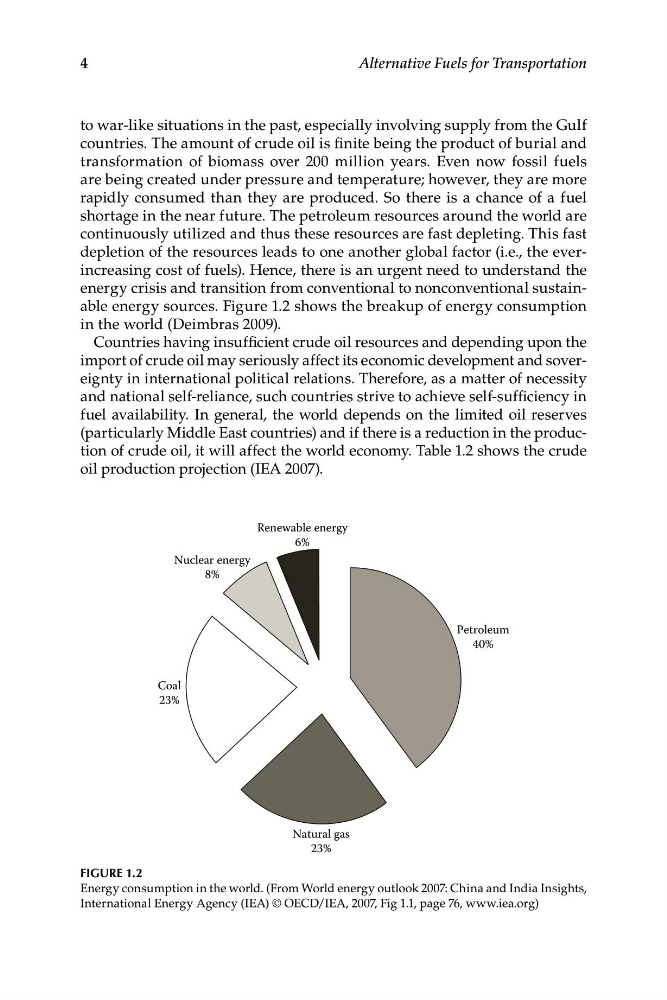
energy crisis and transition from conventional to nonconventional sustainable energy sources. Figure 1.2 shows the breakup of energy consumption
in the world (Deimbras 2009).
Countries having insufficient crude oil resources and depending upon the
import of crude oil may seriously affect its economic development and sovereignty in international political relations. Therefore, as a matter of necessity
and national self-reliance, such countries strive to achieve self-sufficiency in
fuel availability. In general, the world depends on the limited oil reserves
(particularly Middle East countries) and if there is a reduction in the production of crude oil, it will affect the world economy. Table 1.2 shows the crude
oil production projection (IEA 2007).
Renewable energy
6%
Nuclear energy
8%
Coal
23%
Petroleum
40%
Natural gas
23%
Figure 1.2
Energy consumption in the world. (From World energy outlook 2007: China and India Insights,
International Energy Agency (IEA) © OECD/IEA, 2007, Fig 1.1, page 76, www.iea.org)
Alternative Fuels for Transportation
to war-like situations in the past, especially involving supply from the Gulf
countries. The amount of crude oil is finite being the product of burial and
transformation of biomass over 200 million years. Even now fossil fuels
are being created under pressure and temperature; however, they are more
rapidly consumed than they are produced. So there is a chance of a fuel
shortage in the near future. The petroleum resources around the world are
continuously utilized and thus these resources are fast depleting. This fast
depletion of the resources leads to one another global factor (i.e., the everincreasing cost of fuels). Hence, there is an urgent need to understand the
energy crisis and transition from conventional to nonconventional sustainable energy sources. Figure 1.2 shows the breakup of energy consumption
in the world (Deimbras 2009).
Countries having insufficient crude oil resources and depending upon the
import of crude oil may seriously affect its economic development and sovereignty in international political relations. Therefore, as a matter of necessity
and national self-reliance, such countries strive to achieve self-sufficiency in
fuel availability. In general, the world depends on the limited oil reserves
(particularly Middle East countries) and if there is a reduction in the production of crude oil, it will affect the world economy. Table 1.2 shows the crude
oil production projection (IEA 2007).
Renewable energy
6%
Nuclear energy
8%
Coal
23%
Petroleum
40%
Natural gas
23%
Figure 1.2
Energy consumption in the world. (From World energy outlook 2007: China and India Insights,
International Energy Agency (IEA) © OECD/IEA, 2007, Fig 1.1, page 76, www.iea.org)