

210
Alternative Fuels for Transportation
1
2
3
4
5
6
7
8
9
10
11
12
13
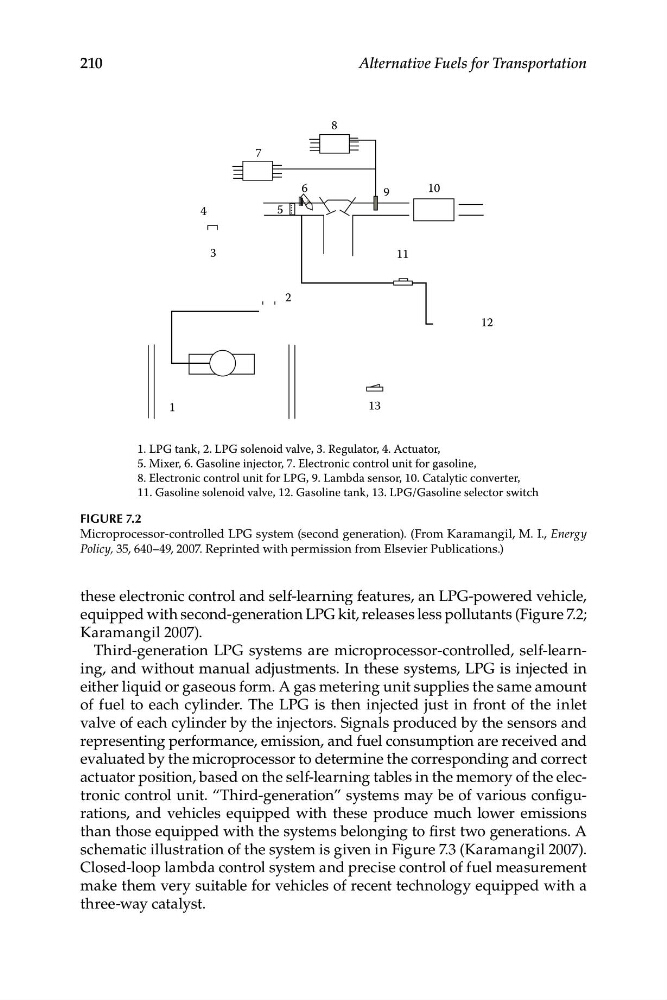
1. LPG tank, 2. LPG solenoid valve, 3. Regulator, 4. Actuator,
5. Mixer, 6. Gasoline injector, 7. Electronic control unit for gasoline,
8. Electronic control unit for LPG, 9. Lambda sensor, 10. Catalytic converter,
11. Gasoline solenoid valve, 12. Gasoline tank, 13. LPG/Gasoline selector switch
Figure 7.2
Microprocessor-controlled LPG system (second generation). (From Karamangil, M. I., Energy
Policy, 35, 640–49, 2007. Reprinted with permission from Elsevier Publications.)
these electronic control and self-learning features, an LPG-powered vehicle,
equipped with second-generation LPG kit, releases less pollutants (Figure 7.2;
Karamangil 2007).
Third-generation LPG systems are microprocessor-controlled, self-learning, and without manual adjustments. In these systems, LPG is injected in
either liquid or gaseous form. A gas metering unit supplies the same amount
of fuel to each cylinder. The LPG is then injected just in front of the inlet
valve of each cylinder by the injectors. Signals produced by the sensors and
representing performance, emission, and fuel consumption are received and
evaluated by the microprocessor to determine the corresponding and correct
actuator position, based on the self-learning tables in the memory of the electronic control unit. “Third-generation” systems may be of various configurations, and vehicles equipped with these produce much lower emissions
than those equipped with the systems belonging to first two generations. A
schematic illustration of the system is given in Figure 7.3 (Karamangil 2007).
Closed-loop lambda control system and precise control of fuel measurement
make them very suitable for vehicles of recent technology equipped with a
three-way catalyst.
Alternative Fuels for Transportation
1
2
3
4
5
6
7
8
9
10
11
12
13
1. LPG tank, 2. LPG solenoid valve, 3. Regulator, 4. Actuator,
5. Mixer, 6. Gasoline injector, 7. Electronic control unit for gasoline,
8. Electronic control unit for LPG, 9. Lambda sensor, 10. Catalytic converter,
11. Gasoline solenoid valve, 12. Gasoline tank, 13. LPG/Gasoline selector switch
Figure 7.2
Microprocessor-controlled LPG system (second generation). (From Karamangil, M. I., Energy
Policy, 35, 640–49, 2007. Reprinted with permission from Elsevier Publications.)
these electronic control and self-learning features, an LPG-powered vehicle,
equipped with second-generation LPG kit, releases less pollutants (Figure 7.2;
Karamangil 2007).
Third-generation LPG systems are microprocessor-controlled, self-learning, and without manual adjustments. In these systems, LPG is injected in
either liquid or gaseous form. A gas metering unit supplies the same amount
of fuel to each cylinder. The LPG is then injected just in front of the inlet
valve of each cylinder by the injectors. Signals produced by the sensors and
representing performance, emission, and fuel consumption are received and
evaluated by the microprocessor to determine the corresponding and correct
actuator position, based on the self-learning tables in the memory of the electronic control unit. “Third-generation” systems may be of various configurations, and vehicles equipped with these produce much lower emissions
than those equipped with the systems belonging to first two generations. A
schematic illustration of the system is given in Figure 7.3 (Karamangil 2007).
Closed-loop lambda control system and precise control of fuel measurement
make them very suitable for vehicles of recent technology equipped with a
three-way catalyst.