

211
Liquefied Petroleum Gas
8
1
2
3
4
5
6
7
9
10
o
11
13
12
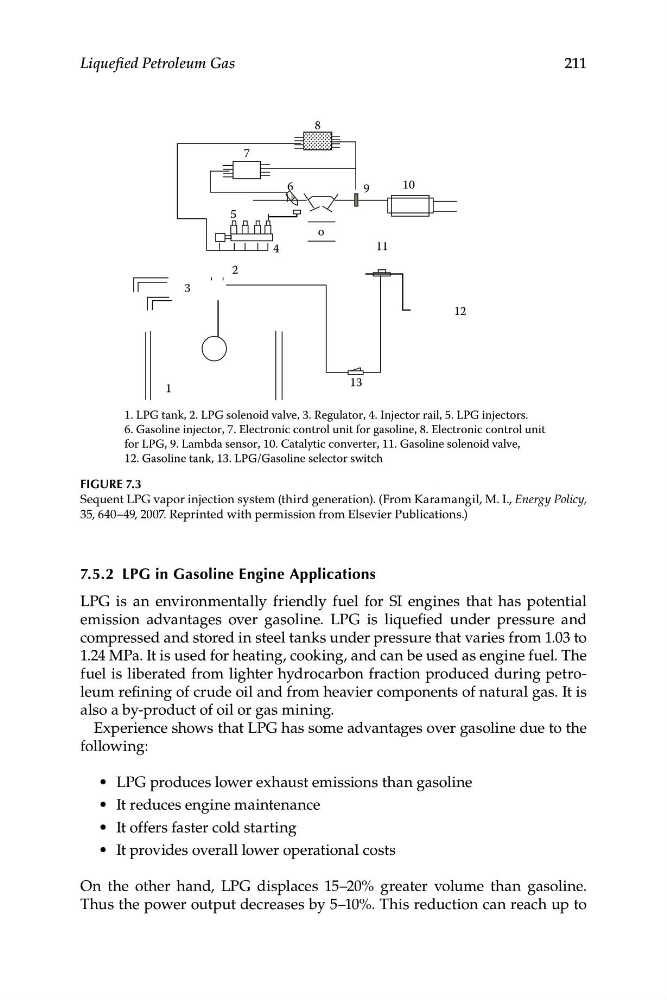
1. LPG tank, 2. LPG solenoid valve, 3. Regulator, 4. Injector rail, 5. LPG injectors.
6. Gasoline injector, 7. Electronic control unit for gasoline, 8. Electronic control unit
for LPG, 9. Lambda sensor, 10. Catalytic converter, 11. Gasoline solenoid valve,
12. Gasoline tank, 13. LPG/Gasoline selector switch
Figure 7.3
Sequent LPG vapor injection system (third generation). (From Karamangil, M. I., Energy Policy,
35, 640–49, 2007. Reprinted with permission from Elsevier Publications.)
7.5.2 LPg in gasoline engine Applications
LPG is an environmentally friendly fuel for SI engines that has potential
emission advantages over gasoline. LPG is liquefied under pressure and
compressed and stored in steel tanks under pressure that varies from 1.03 to
1.24 MPa. It is used for heating, cooking, and can be used as engine fuel. The
fuel is liberated from lighter hydrocarbon fraction produced during petroleum refining of crude oil and from heavier components of natural gas. It is
also a by-product of oil or gas mining.
Experience shows that LPG has some advantages over gasoline due to the
following:
• LPG produces lower exhaust emissions than gasoline
• It reduces engine maintenance
• It offers faster cold starting
• It provides overall lower operational costs
On the other hand, LPG displaces 15–20% greater volume than gasoline.
Thus the power output decreases by 5–10%. This reduction can reach up to
Liquefied Petroleum Gas
8
1
2
3
4
5
6
7
9
10
o
11
13
12
1. LPG tank, 2. LPG solenoid valve, 3. Regulator, 4. Injector rail, 5. LPG injectors.
6. Gasoline injector, 7. Electronic control unit for gasoline, 8. Electronic control unit
for LPG, 9. Lambda sensor, 10. Catalytic converter, 11. Gasoline solenoid valve,
12. Gasoline tank, 13. LPG/Gasoline selector switch
Figure 7.3
Sequent LPG vapor injection system (third generation). (From Karamangil, M. I., Energy Policy,
35, 640–49, 2007. Reprinted with permission from Elsevier Publications.)
7.5.2 LPg in gasoline engine Applications
LPG is an environmentally friendly fuel for SI engines that has potential
emission advantages over gasoline. LPG is liquefied under pressure and
compressed and stored in steel tanks under pressure that varies from 1.03 to
1.24 MPa. It is used for heating, cooking, and can be used as engine fuel. The
fuel is liberated from lighter hydrocarbon fraction produced during petroleum refining of crude oil and from heavier components of natural gas. It is
also a by-product of oil or gas mining.
Experience shows that LPG has some advantages over gasoline due to the
following:
• LPG produces lower exhaust emissions than gasoline
• It reduces engine maintenance
• It offers faster cold starting
• It provides overall lower operational costs
On the other hand, LPG displaces 15–20% greater volume than gasoline.
Thus the power output decreases by 5–10%. This reduction can reach up to