

190
Alternative Fuels for Transportation
less formation of NO. Already in the first studies, a reduction in NO x emissions of about 70% was achieved (Fleisch et al. 1995; Sorenson and Mikkelsen
1995). The limiting factor in the amount of EGR that could be used was the
increase in the CO emissions.
Modern engine tests on diesel fuel give NO x emissions on regulatory emissions testing cycles of about 3 g/kWh. It is normally possible to obtain lower
NO x emissions on DME than with diesel fuel, and at the lowest possible
diesel levels, DME engines exhibit a slightly higher thermal efficiency but
still do not produce particulate emissions (Gill et al. 2001). Typical results
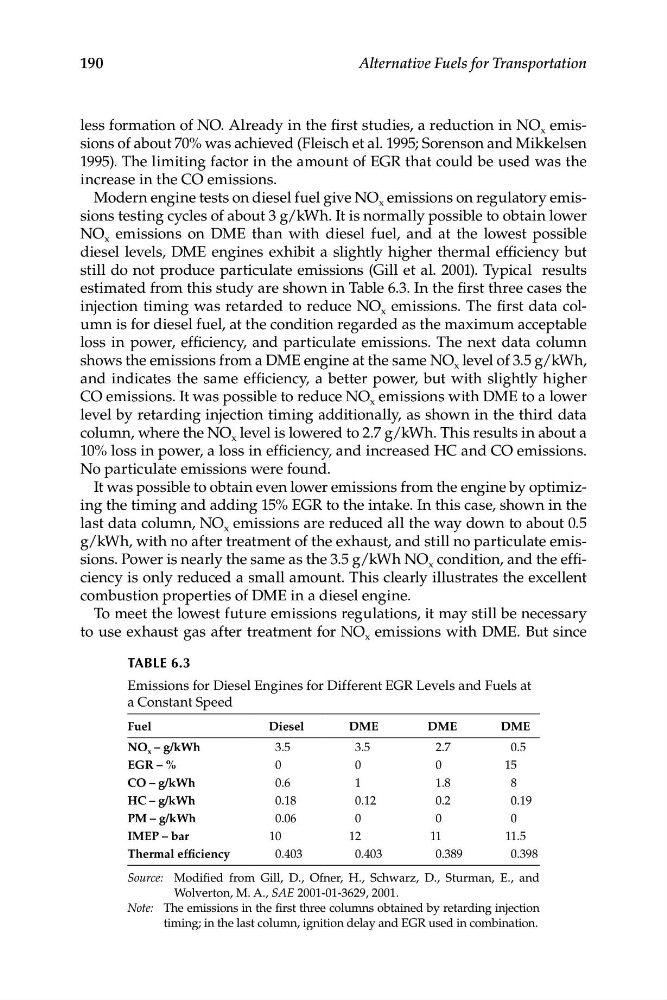
estimated from this study are shown in Table 6.3. In the first three cases the
injection timing was retarded to reduce NO x emissions. The first data column is for diesel fuel, at the condition regarded as the maximum acceptable
loss in power, efficiency, and particulate emissions. The next data column
shows the emissions from a DME engine at the same NO x level of 3.5 g/kWh,
and indicates the same efficiency, a better power, but with slightly higher
CO emissions. It was possible to reduce NO x emissions with DME to a lower
level by retarding injection timing additionally, as shown in the third data
column, where the NO x level is lowered to 2.7 g/kWh. This results in about a
10% loss in power, a loss in efficiency, and increased HC and CO emissions.
No particulate emissions were found.
It was possible to obtain even lower emissions from the engine by optimizing the timing and adding 15% EGR to the intake. In this case, shown in the
last data column, NO x emissions are reduced all the way down to about 0.5
g/kWh, with no after treatment of the exhaust, and still no particulate emissions. Power is nearly the same as the 3.5 g/kWh NO x condition, and the efficiency is only reduced a small amount. This clearly illustrates the excellent
combustion properties of DME in a diesel engine.
To meet the lowest future emissions regulations, it may still be necessary
to use exhaust gas after treatment for NO x emissions with DME. But since
TABLe 6.3
Emissions for Diesel Engines for Different EGR Levels and Fuels at
a Constant Speed
Fuel
Diesel
DME
DME
DME
NO x – g/kWh
3.5
3.5
2.7
0.5
EGR – %
0
0
0
15
CO – g/kWh
0.6
1
1.8
8
HC – g/kWh
0.18
0.12
0.2
0.19
PM – g/kWh
0.06
0
0
0
IMEP – bar
10
12
11
11.5
Thermal efficiency
0.403
0.403
0.389
0.398
Source: Modified from Gill, D., Ofner, H., Schwarz, D., Sturman, E., and
Wolverton, M. A., SAE 2001-01-3629, 2001.
Note: The emissions in the first three columns obtained by retarding injection
timing; in the last column, ignition delay and EGR used in combination.
Alternative Fuels for Transportation
less formation of NO. Already in the first studies, a reduction in NO x emissions of about 70% was achieved (Fleisch et al. 1995; Sorenson and Mikkelsen
1995). The limiting factor in the amount of EGR that could be used was the
increase in the CO emissions.
Modern engine tests on diesel fuel give NO x emissions on regulatory emissions testing cycles of about 3 g/kWh. It is normally possible to obtain lower
NO x emissions on DME than with diesel fuel, and at the lowest possible
diesel levels, DME engines exhibit a slightly higher thermal efficiency but
still do not produce particulate emissions (Gill et al. 2001). Typical results
estimated from this study are shown in Table 6.3. In the first three cases the
injection timing was retarded to reduce NO x emissions. The first data column is for diesel fuel, at the condition regarded as the maximum acceptable
loss in power, efficiency, and particulate emissions. The next data column
shows the emissions from a DME engine at the same NO x level of 3.5 g/kWh,
and indicates the same efficiency, a better power, but with slightly higher
CO emissions. It was possible to reduce NO x emissions with DME to a lower
level by retarding injection timing additionally, as shown in the third data
column, where the NO x level is lowered to 2.7 g/kWh. This results in about a
10% loss in power, a loss in efficiency, and increased HC and CO emissions.
No particulate emissions were found.
It was possible to obtain even lower emissions from the engine by optimizing the timing and adding 15% EGR to the intake. In this case, shown in the
last data column, NO x emissions are reduced all the way down to about 0.5
g/kWh, with no after treatment of the exhaust, and still no particulate emissions. Power is nearly the same as the 3.5 g/kWh NO x condition, and the efficiency is only reduced a small amount. This clearly illustrates the excellent
combustion properties of DME in a diesel engine.
To meet the lowest future emissions regulations, it may still be necessary
to use exhaust gas after treatment for NO x emissions with DME. But since
TABLe 6.3
Emissions for Diesel Engines for Different EGR Levels and Fuels at
a Constant Speed
Fuel
Diesel
DME
DME
DME
NO x – g/kWh
3.5
3.5
2.7
0.5
EGR – %
0
0
0
15
CO – g/kWh
0.6
1
1.8
8
HC – g/kWh
0.18
0.12
0.2
0.19
PM – g/kWh
0.06
0
0
0
IMEP – bar
10
12
11
11.5
Thermal efficiency
0.403
0.403
0.389
0.398
Source: Modified from Gill, D., Ofner, H., Schwarz, D., Sturman, E., and
Wolverton, M. A., SAE 2001-01-3629, 2001.
Note: The emissions in the first three columns obtained by retarding injection
timing; in the last column, ignition delay and EGR used in combination.