

189
Dimethyl Ether
0
1
2
3
4
5
6
7
8
9
Emission - g/kWh
0
1
2
3
4
5
Bosch smoke number
No x DME
No x diesel
Bosch DME
Bosch diesel
1.0
1.5
2.0
2.5
3.0
3.5
Indicated power - kW
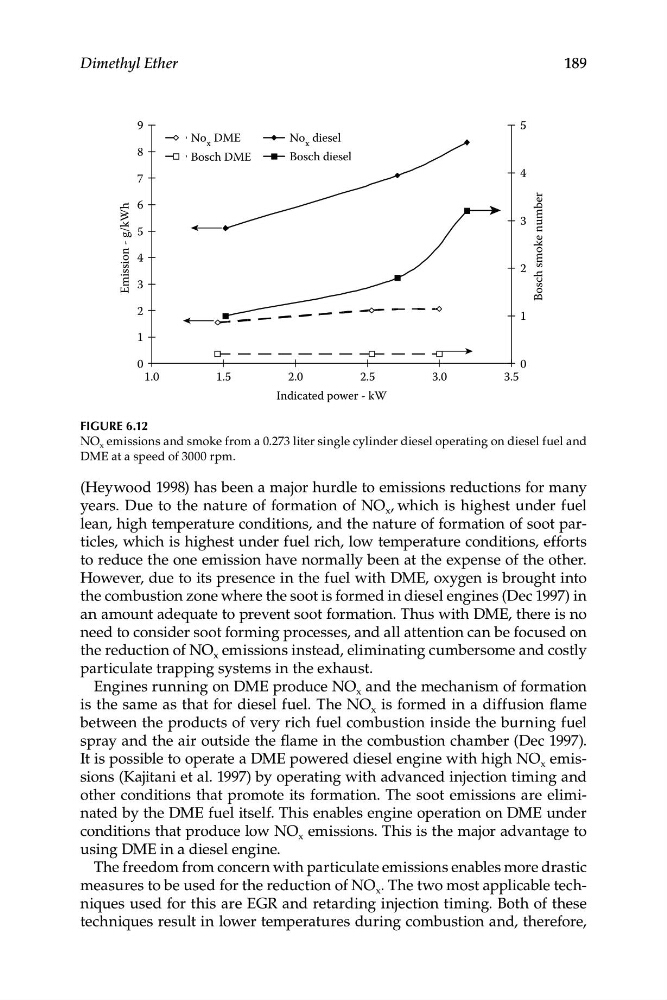
Figure 6.12
NO x emissions and smoke from a 0.273 liter single cylinder diesel operating on diesel fuel and
DME at a speed of 3000 rpm.
(Heywood 1998) has been a major hurdle to emissions reductions for many
years. Due to the nature of formation of NO x , which is highest under fuel
lean, high temperature conditions, and the nature of formation of soot particles, which is highest under fuel rich, low temperature conditions, efforts
to reduce the one emission have normally been at the expense of the other.
However, due to its presence in the fuel with DME, oxygen is brought into
the combustion zone where the soot is formed in diesel engines (Dec 1997) in
an amount adequate to prevent soot formation. Thus with DME, there is no
need to consider soot forming processes, and all attention can be focused on
the reduction of NO x emissions instead, eliminating cumbersome and costly
particulate trapping systems in the exhaust.
Engines running on DME produce NO x and the mechanism of formation
is the same as that for diesel fuel. The NO x is formed in a diffusion flame
between the products of very rich fuel combustion inside the burning fuel
spray and the air outside the flame in the combustion chamber (Dec 1997).
It is possible to operate a DME powered diesel engine with high NO x emissions (Kajitani et al. 1997) by operating with advanced injection timing and
other conditions that promote its formation. The soot emissions are eliminated by the DME fuel itself. This enables engine operation on DME under
conditions that produce low NO x emissions. This is the major advantage to
using DME in a diesel engine.
The freedom from concern with particulate emissions enables more drastic
measures to be used for the reduction of NO x . The two most applicable techniques used for this are EGR and retarding injection timing. Both of these
techniques result in lower temperatures during combustion and, therefore,
Dimethyl Ether
0
1
2
3
4
5
6
7
8
9
Emission - g/kWh
0
1
2
3
4
5
Bosch smoke number
No x DME
No x diesel
Bosch DME
Bosch diesel
1.0
1.5
2.0
2.5
3.0
3.5
Indicated power - kW
Figure 6.12
NO x emissions and smoke from a 0.273 liter single cylinder diesel operating on diesel fuel and
DME at a speed of 3000 rpm.
(Heywood 1998) has been a major hurdle to emissions reductions for many
years. Due to the nature of formation of NO x , which is highest under fuel
lean, high temperature conditions, and the nature of formation of soot particles, which is highest under fuel rich, low temperature conditions, efforts
to reduce the one emission have normally been at the expense of the other.
However, due to its presence in the fuel with DME, oxygen is brought into
the combustion zone where the soot is formed in diesel engines (Dec 1997) in
an amount adequate to prevent soot formation. Thus with DME, there is no
need to consider soot forming processes, and all attention can be focused on
the reduction of NO x emissions instead, eliminating cumbersome and costly
particulate trapping systems in the exhaust.
Engines running on DME produce NO x and the mechanism of formation
is the same as that for diesel fuel. The NO x is formed in a diffusion flame
between the products of very rich fuel combustion inside the burning fuel
spray and the air outside the flame in the combustion chamber (Dec 1997).
It is possible to operate a DME powered diesel engine with high NO x emissions (Kajitani et al. 1997) by operating with advanced injection timing and
other conditions that promote its formation. The soot emissions are eliminated by the DME fuel itself. This enables engine operation on DME under
conditions that produce low NO x emissions. This is the major advantage to
using DME in a diesel engine.
The freedom from concern with particulate emissions enables more drastic
measures to be used for the reduction of NO x . The two most applicable techniques used for this are EGR and retarding injection timing. Both of these
techniques result in lower temperatures during combustion and, therefore,