

191
Dimethyl Ether
such low engine out emission levels have been shown to be achievable, the
amount to be removed in the exhaust should be lower than that for diesel
engines, reducing the requirements on this system.
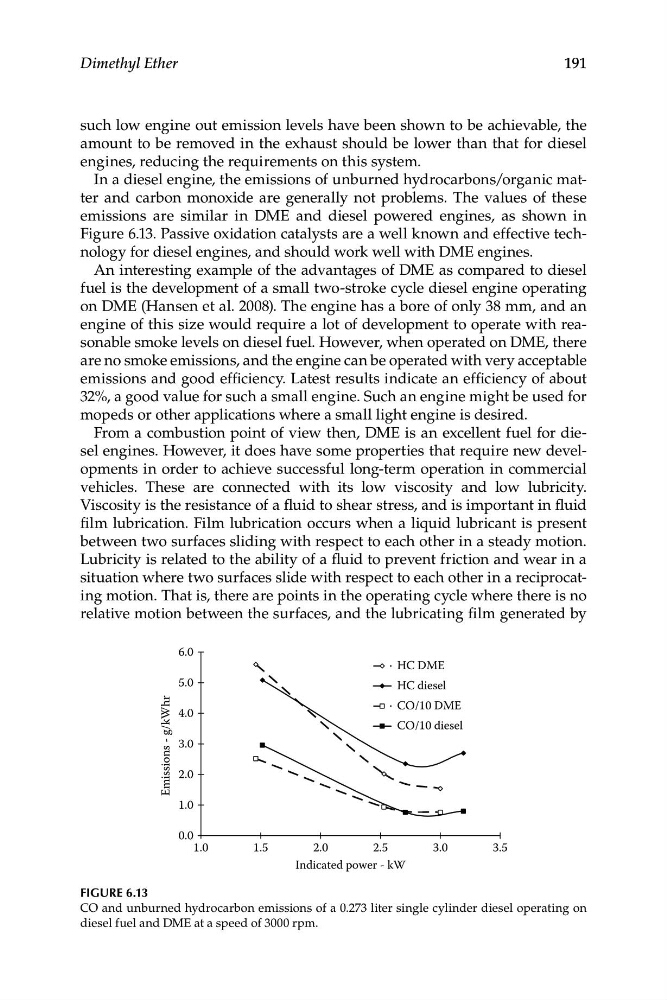
In a diesel engine, the emissions of unburned hydrocarbons/organic matter and carbon monoxide are generally not problems. The values of these
emissions are similar in DME and diesel powered engines, as shown in
Figure 6.13. Passive oxidation catalysts are a well known and effective technology for diesel engines, and should work well with DME engines.
An interesting example of the advantages of DME as compared to diesel
fuel is the development of a small two-stroke cycle diesel engine operating
on DME (Hansen et al. 2008). The engine has a bore of only 38 mm, and an
engine of this size would require a lot of development to operate with reasonable smoke levels on diesel fuel. However, when operated on DME, there
are no smoke emissions, and the engine can be operated with very acceptable
emissions and good efficiency. Latest results indicate an efficiency of about
32%, a good value for such a small engine. Such an engine might be used for
mopeds or other applications where a small light engine is desired.
From a combustion point of view then, DME is an excellent fuel for diesel engines. However, it does have some properties that require new developments in order to achieve successful long-term operation in commercial
vehicles. These are connected with its low viscosity and low lubricity.
Viscosity is the resistance of a fluid to shear stress, and is important in fluid
film lubrication. Film lubrication occurs when a liquid lubricant is present
between two surfaces sliding with respect to each other in a steady motion.
Lubricity is related to the ability of a fluid to prevent friction and wear in a
situation where two surfaces slide with respect to each other in a reciprocating motion. That is, there are points in the operating cycle where there is no
relative motion between the surfaces, and the lubricating film generated by
0.0
1.0
2.0
3.0
4.0
5.0
6.0
1.0
1.5
2.0
2.5
3.0
3.5
Emissions - g/kWhr
HC DME
HC diesel
CO/10 DME
CO/10 diesel
Indicated power - kW
Figure 6.13
CO and unburned hydrocarbon emissions of a 0.273 liter single cylinder diesel operating on
diesel fuel and DME at a speed of 3000 rpm.
Dimethyl Ether
such low engine out emission levels have been shown to be achievable, the
amount to be removed in the exhaust should be lower than that for diesel
engines, reducing the requirements on this system.
In a diesel engine, the emissions of unburned hydrocarbons/organic matter and carbon monoxide are generally not problems. The values of these
emissions are similar in DME and diesel powered engines, as shown in
Figure 6.13. Passive oxidation catalysts are a well known and effective technology for diesel engines, and should work well with DME engines.
An interesting example of the advantages of DME as compared to diesel
fuel is the development of a small two-stroke cycle diesel engine operating
on DME (Hansen et al. 2008). The engine has a bore of only 38 mm, and an
engine of this size would require a lot of development to operate with reasonable smoke levels on diesel fuel. However, when operated on DME, there
are no smoke emissions, and the engine can be operated with very acceptable
emissions and good efficiency. Latest results indicate an efficiency of about
32%, a good value for such a small engine. Such an engine might be used for
mopeds or other applications where a small light engine is desired.
From a combustion point of view then, DME is an excellent fuel for diesel engines. However, it does have some properties that require new developments in order to achieve successful long-term operation in commercial
vehicles. These are connected with its low viscosity and low lubricity.
Viscosity is the resistance of a fluid to shear stress, and is important in fluid
film lubrication. Film lubrication occurs when a liquid lubricant is present
between two surfaces sliding with respect to each other in a steady motion.
Lubricity is related to the ability of a fluid to prevent friction and wear in a
situation where two surfaces slide with respect to each other in a reciprocating motion. That is, there are points in the operating cycle where there is no
relative motion between the surfaces, and the lubricating film generated by
0.0
1.0
2.0
3.0
4.0
5.0
6.0
1.0
1.5
2.0
2.5
3.0
3.5
Emissions - g/kWhr
HC DME
HC diesel
CO/10 DME
CO/10 diesel
Indicated power - kW
Figure 6.13
CO and unburned hydrocarbon emissions of a 0.273 liter single cylinder diesel operating on
diesel fuel and DME at a speed of 3000 rpm.