

Ethanol
155
100
0
0
100
One phase
Two phases
% w/w THF
THF-Tetrahydrofuran
cosolvent
% w/w Ethanol/water
mixture
0 100
%
0%
1.3%
2.5%
3.7%
5%
% w/w diesel
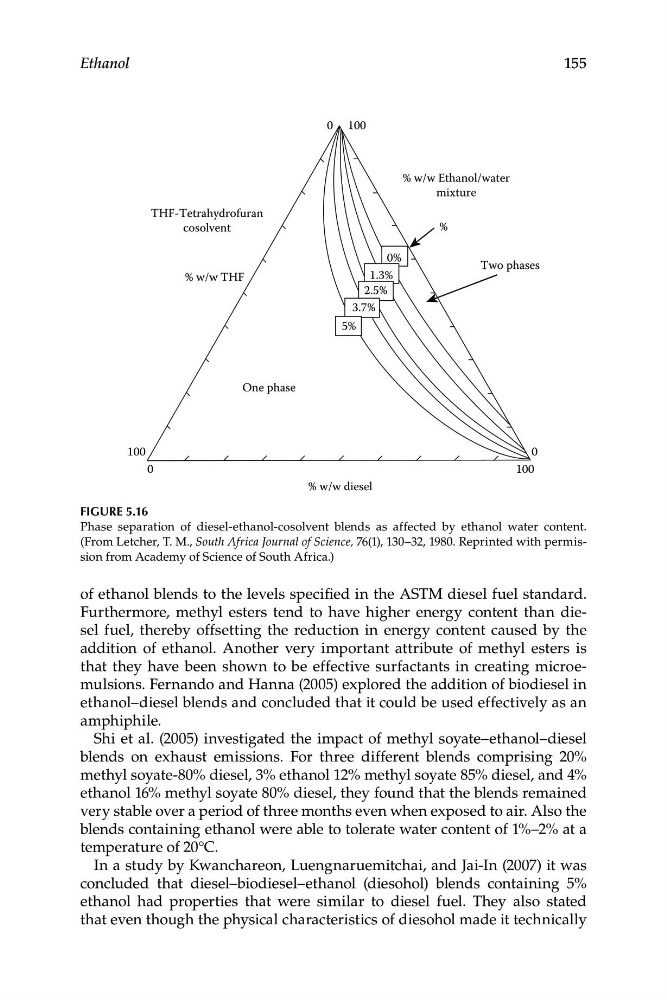
Figure 5.16
Phase separation of diesel-ethanol-cosolvent blends as affected by ethanol water content.
(From Letcher, T. M., South Africa Journal of Science, 76(1), 130–32, 1980. Reprinted with permission from Academy of Science of South Africa.)
of ethanol blends to the levels specified in the ASTM diesel fuel standard.
Furthermore, methyl esters tend to have higher energy content than diesel fuel, thereby offsetting the reduction in energy content caused by the
addition of ethanol. Another very important attribute of methyl esters is
that they have been shown to be effective surfactants in creating microemulsions. Fernando and Hanna (2005) explored the addition of biodiesel in
ethanol–diesel blends and concluded that it could be used effectively as an
amphiphile.
Shi et al. (2005) investigated the impact of methyl soyate–ethanol–diesel
blends on exhaust emissions. For three different blends comprising 20%
methyl soyate-80% diesel, 3% ethanol 12% methyl soyate 85% diesel, and 4%
ethanol 16% methyl soyate 80% diesel, they found that the blends remained
very stable over a period of three months even when exposed to air. Also the
blends containing ethanol were able to tolerate water content of 1%–2% at a
temperature of 20°C.
In a study by Kwanchareon, Luengnaruemitchai, and Jai-In (2007) it was
concluded that diesel–biodiesel–ethanol (diesohol) blends containing 5%
ethanol had properties that were similar to diesel fuel. They also stated
that even though the physical characteristics of diesohol made it technically
155
100
0
0
100
One phase
Two phases
% w/w THF
THF-Tetrahydrofuran
cosolvent
% w/w Ethanol/water
mixture
0 100
%
0%
1.3%
2.5%
3.7%
5%
% w/w diesel
Figure 5.16
Phase separation of diesel-ethanol-cosolvent blends as affected by ethanol water content.
(From Letcher, T. M., South Africa Journal of Science, 76(1), 130–32, 1980. Reprinted with permission from Academy of Science of South Africa.)
of ethanol blends to the levels specified in the ASTM diesel fuel standard.
Furthermore, methyl esters tend to have higher energy content than diesel fuel, thereby offsetting the reduction in energy content caused by the
addition of ethanol. Another very important attribute of methyl esters is
that they have been shown to be effective surfactants in creating microemulsions. Fernando and Hanna (2005) explored the addition of biodiesel in
ethanol–diesel blends and concluded that it could be used effectively as an
amphiphile.
Shi et al. (2005) investigated the impact of methyl soyate–ethanol–diesel
blends on exhaust emissions. For three different blends comprising 20%
methyl soyate-80% diesel, 3% ethanol 12% methyl soyate 85% diesel, and 4%
ethanol 16% methyl soyate 80% diesel, they found that the blends remained
very stable over a period of three months even when exposed to air. Also the
blends containing ethanol were able to tolerate water content of 1%–2% at a
temperature of 20°C.
In a study by Kwanchareon, Luengnaruemitchai, and Jai-In (2007) it was
concluded that diesel–biodiesel–ethanol (diesohol) blends containing 5%
ethanol had properties that were similar to diesel fuel. They also stated
that even though the physical characteristics of diesohol made it technically