

154
Alternative Fuels for Transportation
0°C
0
100
15°C
30°C
Ethanol (m/m %)
Ethyl acetate
(m/m %)
Two phases
Wax precipitate
One phase
100
0
0
100
Diesel (m/m %)
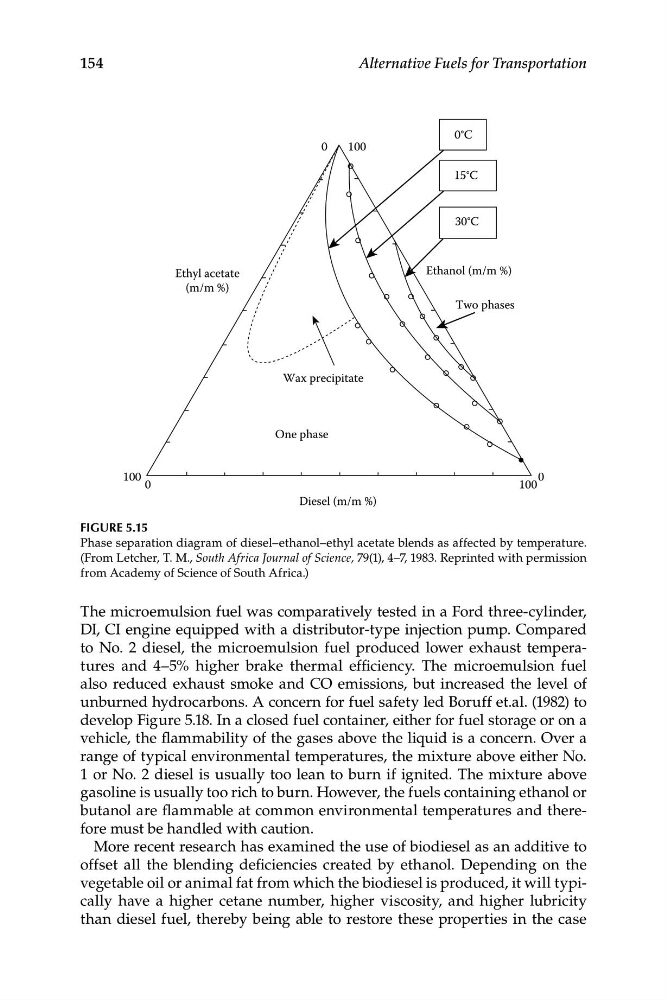
Figure 5.15
Phase separation diagram of diesel–ethanol–ethyl acetate blends as affected by temperature.
(From Letcher, T. M., South Africa Journal of Science, 79(1), 4–7, 1983. Reprinted with permission
from Academy of Science of South Africa.)
The microemulsion fuel was comparatively tested in a Ford three-cylinder,
DI, CI engine equipped with a distributor-type injection pump. Compared
to No. 2 diesel, the microemulsion fuel produced lower exhaust temperatures and 4–5% higher brake thermal efficiency. The microemulsion fuel
also reduced exhaust smoke and CO emissions, but increased the level of
unburned hydrocarbons. A concern for fuel safety led Boruff et.al. (1982) to
develop Figure 5.18. In a closed fuel container, either for fuel storage or on a
vehicle, the flammability of the gases above the liquid is a concern. Over a
range of typical environmental temperatures, the mixture above either No.
1 or No. 2 diesel is usually too lean to burn if ignited. The mixture above
gasoline is usually too rich to burn. However, the fuels containing ethanol or
butanol are flammable at common environmental temperatures and therefore must be handled with caution.
More recent research has examined the use of biodiesel as an additive to
offset all the blending deficiencies created by ethanol. Depending on the
vegetable oil or animal fat from which the biodiesel is produced, it will typically have a higher cetane number, higher viscosity, and higher lubricity
than diesel fuel, thereby being able to restore these properties in the case
Alternative Fuels for Transportation
0°C
0
100
15°C
30°C
Ethanol (m/m %)
Ethyl acetate
(m/m %)
Two phases
Wax precipitate
One phase
100
0
0
100
Diesel (m/m %)
Figure 5.15
Phase separation diagram of diesel–ethanol–ethyl acetate blends as affected by temperature.
(From Letcher, T. M., South Africa Journal of Science, 79(1), 4–7, 1983. Reprinted with permission
from Academy of Science of South Africa.)
The microemulsion fuel was comparatively tested in a Ford three-cylinder,
DI, CI engine equipped with a distributor-type injection pump. Compared
to No. 2 diesel, the microemulsion fuel produced lower exhaust temperatures and 4–5% higher brake thermal efficiency. The microemulsion fuel
also reduced exhaust smoke and CO emissions, but increased the level of
unburned hydrocarbons. A concern for fuel safety led Boruff et.al. (1982) to
develop Figure 5.18. In a closed fuel container, either for fuel storage or on a
vehicle, the flammability of the gases above the liquid is a concern. Over a
range of typical environmental temperatures, the mixture above either No.
1 or No. 2 diesel is usually too lean to burn if ignited. The mixture above
gasoline is usually too rich to burn. However, the fuels containing ethanol or
butanol are flammable at common environmental temperatures and therefore must be handled with caution.
More recent research has examined the use of biodiesel as an additive to
offset all the blending deficiencies created by ethanol. Depending on the
vegetable oil or animal fat from which the biodiesel is produced, it will typically have a higher cetane number, higher viscosity, and higher lubricity
than diesel fuel, thereby being able to restore these properties in the case