

102
Alternative Fuels for Transportation
50
40
30
20
10
0
M0
M5
M10
M15
BTE (%)
15
20
25
Injection timing (CA), BTDC
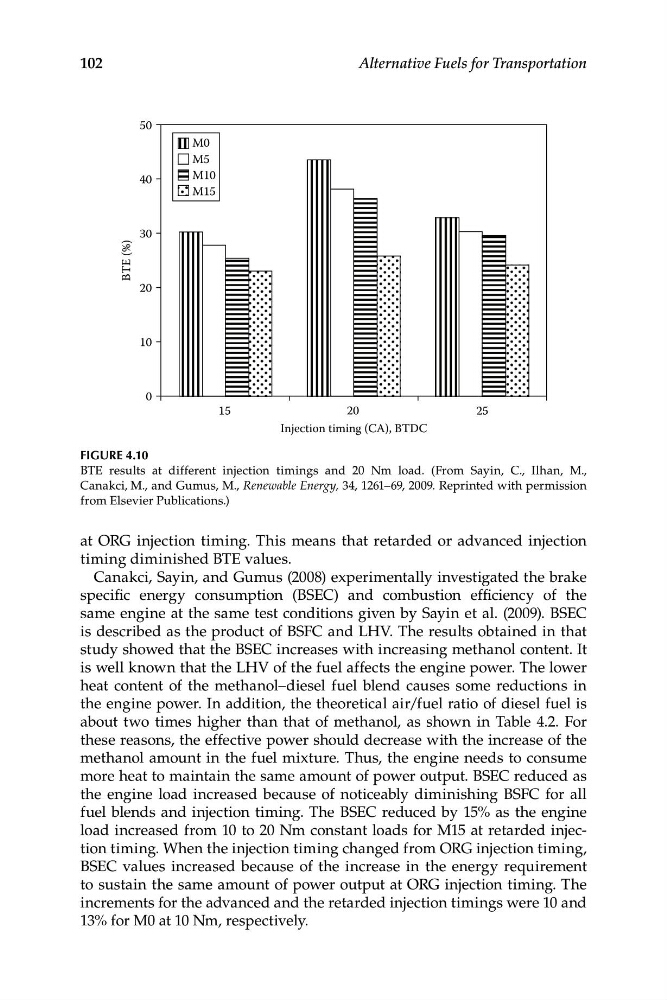
Figure 4.10
BTE results at different injection timings and 20 Nm load. (From Sayin, C., Ilhan, M.,
Canakci, M ., and Gumus, M., Renewable Energy, 34, 1261–69, 2009. Reprinted with permission
from Elsevier Publications.)
at ORG injection timing. This means that retarded or advanced injection
timing diminished BTE values.
Canakci, Sayin, and Gumus (2008) experimentally investigated the brake
specific energy consumption (BSEC) and combustion efficiency of the
same engine at the same test conditions given by Sayin et al. (2009). BSEC
is described as the product of BSFC and LHV. The results obtained in that
study showed that the BSEC increases with increasing methanol content. It
is well known that the LHV of the fuel affects the engine power. The lower
heat content of the methanol–diesel fuel blend causes some reductions in
the engine power. In addition, the theoretical air/fuel ratio of diesel fuel is
about two times higher than that of methanol, as shown in Table 4.2. For
these reasons, the effective power should decrease with the increase of the
methanol amount in the fuel mixture. Thus, the engine needs to consume
more heat to maintain the same amount of power output. BSEC reduced as
the engine load increased because of noticeably diminishing BSFC for all
fuel blends and injection timing. The BSEC reduced by 15% as the engine
load increased from 10 to 20 Nm constant loads for M15 at retarded injection timing. When the injection timing changed from ORG injection timing,
BSEC values increased because of the increase in the energy requirement
to sustain the same amount of power output at ORG injection timing. The
increments for the advanced and the retarded injection timings were 10 and
13% for M0 at 10 Nm, respectively.
Alternative Fuels for Transportation
50
40
30
20
10
0
M0
M5
M10
M15
BTE (%)
15
20
25
Injection timing (CA), BTDC
Figure 4.10
BTE results at different injection timings and 20 Nm load. (From Sayin, C., Ilhan, M.,
Canakci, M ., and Gumus, M., Renewable Energy, 34, 1261–69, 2009. Reprinted with permission
from Elsevier Publications.)
at ORG injection timing. This means that retarded or advanced injection
timing diminished BTE values.
Canakci, Sayin, and Gumus (2008) experimentally investigated the brake
specific energy consumption (BSEC) and combustion efficiency of the
same engine at the same test conditions given by Sayin et al. (2009). BSEC
is described as the product of BSFC and LHV. The results obtained in that
study showed that the BSEC increases with increasing methanol content. It
is well known that the LHV of the fuel affects the engine power. The lower
heat content of the methanol–diesel fuel blend causes some reductions in
the engine power. In addition, the theoretical air/fuel ratio of diesel fuel is
about two times higher than that of methanol, as shown in Table 4.2. For
these reasons, the effective power should decrease with the increase of the
methanol amount in the fuel mixture. Thus, the engine needs to consume
more heat to maintain the same amount of power output. BSEC reduced as
the engine load increased because of noticeably diminishing BSFC for all
fuel blends and injection timing. The BSEC reduced by 15% as the engine
load increased from 10 to 20 Nm constant loads for M15 at retarded injection timing. When the injection timing changed from ORG injection timing,
BSEC values increased because of the increase in the energy requirement
to sustain the same amount of power output at ORG injection timing. The
increments for the advanced and the retarded injection timings were 10 and
13% for M0 at 10 Nm, respectively.