

Methanol
101
the fuel consumption. Figure 4.8 indicates the variations of BSFC for different methanol-blended diesel fuels under different injection timing at 20
Nm constant loads. When the injection timing was retarded 5° CA BTDC
compared to ORG injection timing, BSFC increased by 30% for M15. As will
be discussed later, with advancing injection timing, the ignition delay will
be longer and speed of the flame will be shorter. This causes reduction of
maximum pressure and engine output power. Thus, fuel consumption per
output power will increase. On the other hand, retarding injection timing
means later combustion, and therefore pressure rises only when the cylinder volume is expanding rapidly and results in a reduced effective pressure
to work. In that study, the minimum BSFC was obtained at ORG injection
timing for all the fuel blends.
Brake thermal efficiency indicates the ability of the combustion system
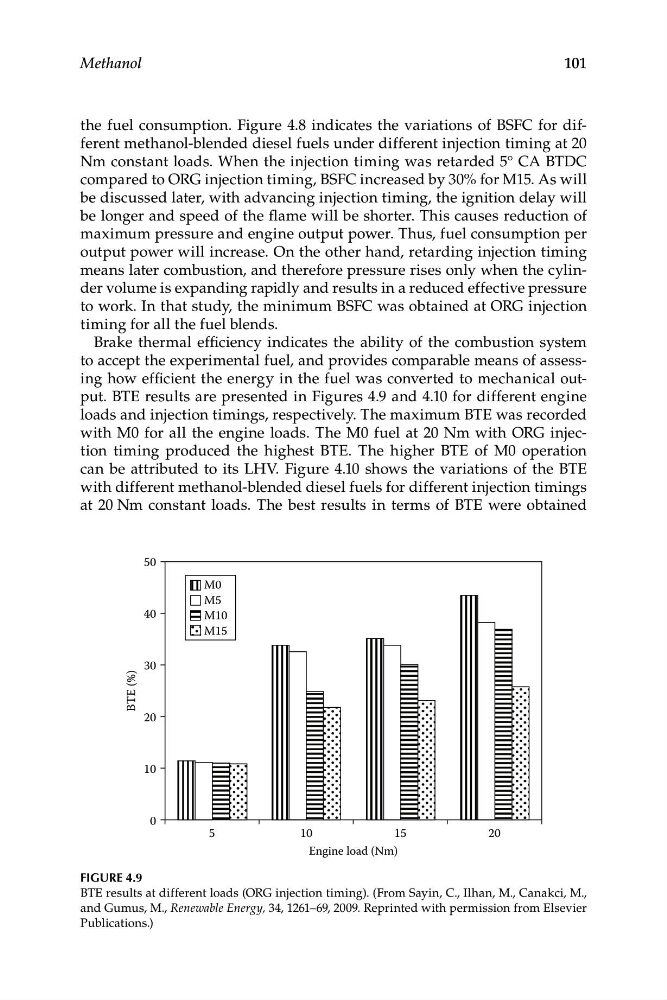
to accept the experimental fuel, and provides comparable means of assessing how efficient the energy in the fuel was converted to mechanical output. BTE results are presented in Figures 4.9 and 4.10 for different engine
loads and injection timings, respectively. The maximum BTE was recorded
with M0 for all the engine loads. The M0 fuel at 20 Nm with ORG injection timing produced the highest BTE. The higher BTE of M0 operation
can be attributed to its LHV. Figure 4.10 shows the variations of the BTE
with different methanol-blended diesel fuels for different injection timings
at 20 Nm constant loads. The best results in terms of BTE were obtained
50
40
30
20
10
0
M0
M5
M10
M15
BTE (%)
5
10
15
20
Engine load (Nm)
Figure 4.9
BTE results at different loads (ORG injection timing). (From Sayin, C., Ilhan, M., Canakci, M.,
and Gumus, M., Renewable Energy, 34, 1261–69, 2009. Reprinted with permission from Elsevier
Publications.)
101
the fuel consumption. Figure 4.8 indicates the variations of BSFC for different methanol-blended diesel fuels under different injection timing at 20
Nm constant loads. When the injection timing was retarded 5° CA BTDC
compared to ORG injection timing, BSFC increased by 30% for M15. As will
be discussed later, with advancing injection timing, the ignition delay will
be longer and speed of the flame will be shorter. This causes reduction of
maximum pressure and engine output power. Thus, fuel consumption per
output power will increase. On the other hand, retarding injection timing
means later combustion, and therefore pressure rises only when the cylinder volume is expanding rapidly and results in a reduced effective pressure
to work. In that study, the minimum BSFC was obtained at ORG injection
timing for all the fuel blends.
Brake thermal efficiency indicates the ability of the combustion system
to accept the experimental fuel, and provides comparable means of assessing how efficient the energy in the fuel was converted to mechanical output. BTE results are presented in Figures 4.9 and 4.10 for different engine
loads and injection timings, respectively. The maximum BTE was recorded
with M0 for all the engine loads. The M0 fuel at 20 Nm with ORG injection timing produced the highest BTE. The higher BTE of M0 operation
can be attributed to its LHV. Figure 4.10 shows the variations of the BTE
with different methanol-blended diesel fuels for different injection timings
at 20 Nm constant loads. The best results in terms of BTE were obtained
50
40
30
20
10
0
M0
M5
M10
M15
BTE (%)
5
10
15
20
Engine load (Nm)
Figure 4.9
BTE results at different loads (ORG injection timing). (From Sayin, C., Ilhan, M., Canakci, M.,
and Gumus, M., Renewable Energy, 34, 1261–69, 2009. Reprinted with permission from Elsevier
Publications.)