

Methanol
93
TABLe 4.1
Properties of Methanol and Gasoline
Characteristics
Methanol
Gasoline
Molecular weight [g/mole]
32.04
~100
Elemental composition by weight
% Oxygen
50.0%
(mix of C 4 to C 14
% Carbon
37.5%
hydrocarbons)
% Hydrogen
12.5%
Specific gravity (@ 15.5°C)
0.79
0.72–0.78
Boiling point (°C)
64.7
27–225
Water solubility (mg/L)
miscible
100–200
Vapor pressure
(mm Hg)(@ 25°C)
126
—
(psi) (@ 100°F)
4.63
7–15
Heat of combustion (kJ/kg)
19,930
43,030
Henry’s Law constant (atm m 3 g –1 mole –1 )
4.55 × 10 –6
—
Henry’s Law constant (@ 25°C)
1.087 × 10 –4
—
Liquid dispersion coefficient @ (m 2 /s) 25°C
1.65 × 10 –9
—
Flammability limits:
Lower (LFL)
6.0
1.4
Volume percent
7
–43
Temperature (°C)
Upper (UFL)
Volume percent
36.5
7.6
Temperature (°C)
43
–30 to –12
Flash point (°C)
12
–43
Vapor density (@1 atm; 10°C)
1.4
2–5
Source: From Pirnie, M., Evaluation of the Fate and Transport of Methanol in the
Environment, Washington, DC: Technical memorandum, prepared for
American Methanol Institute, 1999.
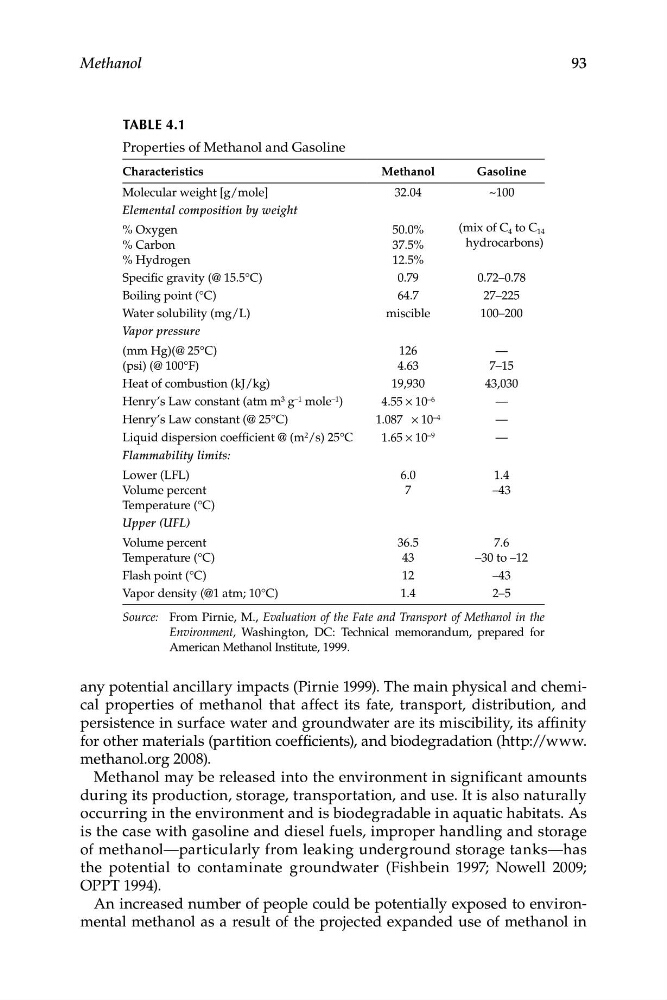
any potential ancillary impacts (Pirnie 1999). The main physical and chemical properties of methanol that affect its fate, transport, distribution, and
persistence in surface water and groundwater are its miscibility, its affinity
for other materials (partition coefficients), and biodegradation (http://www.
methanol.org 2008).
Methanol may be released into the environment in significant amounts
during its production, storage, transportation, and use. It is also naturally
occurring in the environment and is biodegradable in aquatic habitats. As
is the case with gasoline and diesel fuels, improper handling and storage
of methanol—particularly from leaking underground storage tanks—has
the potential to contaminate groundwater (Fishbein 1997; Nowell 2009;
OPPT 1994).
An increased number of people could be potentially exposed to environmental methanol as a result of the projected expanded use of methanol in
93
TABLe 4.1
Properties of Methanol and Gasoline
Characteristics
Methanol
Gasoline
Molecular weight [g/mole]
32.04
~100
Elemental composition by weight
% Oxygen
50.0%
(mix of C 4 to C 14
% Carbon
37.5%
hydrocarbons)
% Hydrogen
12.5%
Specific gravity (@ 15.5°C)
0.79
0.72–0.78
Boiling point (°C)
64.7
27–225
Water solubility (mg/L)
miscible
100–200
Vapor pressure
(mm Hg)(@ 25°C)
126
—
(psi) (@ 100°F)
4.63
7–15
Heat of combustion (kJ/kg)
19,930
43,030
Henry’s Law constant (atm m 3 g –1 mole –1 )
4.55 × 10 –6
—
Henry’s Law constant (@ 25°C)
1.087 × 10 –4
—
Liquid dispersion coefficient @ (m 2 /s) 25°C
1.65 × 10 –9
—
Flammability limits:
Lower (LFL)
6.0
1.4
Volume percent
7
–43
Temperature (°C)
Upper (UFL)
Volume percent
36.5
7.6
Temperature (°C)
43
–30 to –12
Flash point (°C)
12
–43
Vapor density (@1 atm; 10°C)
1.4
2–5
Source: From Pirnie, M., Evaluation of the Fate and Transport of Methanol in the
Environment, Washington, DC: Technical memorandum, prepared for
American Methanol Institute, 1999.
any potential ancillary impacts (Pirnie 1999). The main physical and chemical properties of methanol that affect its fate, transport, distribution, and
persistence in surface water and groundwater are its miscibility, its affinity
for other materials (partition coefficients), and biodegradation (http://www.
methanol.org 2008).
Methanol may be released into the environment in significant amounts
during its production, storage, transportation, and use. It is also naturally
occurring in the environment and is biodegradable in aquatic habitats. As
is the case with gasoline and diesel fuels, improper handling and storage
of methanol—particularly from leaking underground storage tanks—has
the potential to contaminate groundwater (Fishbein 1997; Nowell 2009;
OPPT 1994).
An increased number of people could be potentially exposed to environmental methanol as a result of the projected expanded use of methanol in