

Others
DMT
17%
2%
Gasoline/Fuel
Formaldehyde
2%
34%
Methyl
methacrylate
3%
Solvents
4%
Acetic acid
10%
MTBE/TAME
28%
92
Alternative Fuels for Transportation
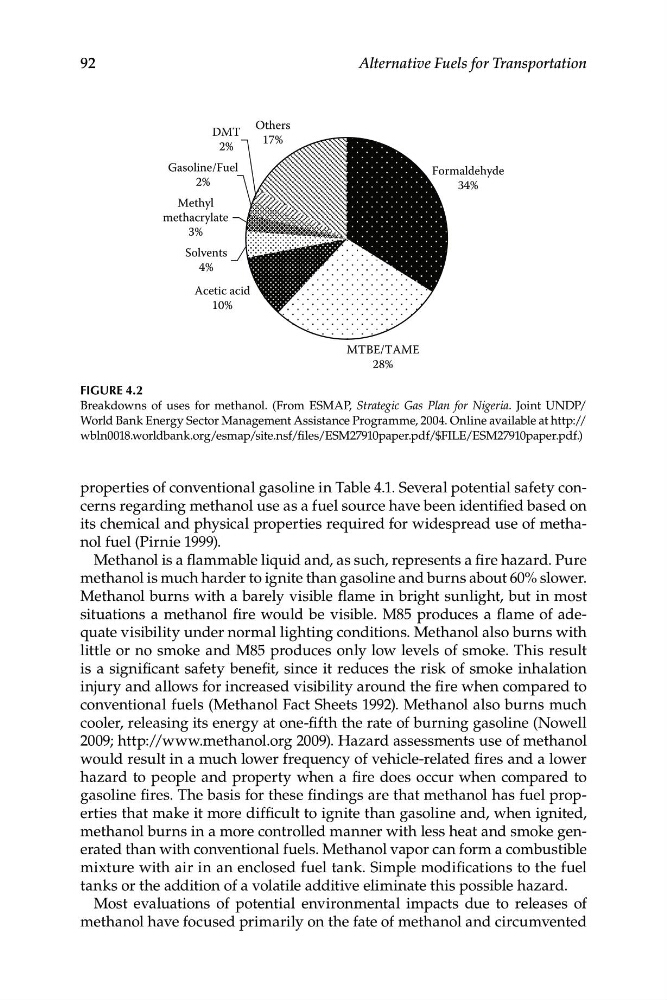
Figure 4.2
Breakdowns of uses for methanol. (From ESMAP, Strategic Gas Plan for Nigeria. Joint UNDP/
World Bank Energy Sector Management Assistance Programme, 2004. Online available at http://
wbln0018.worldbank.org/esmap/site.nsf/files/ESM27910paper.pdf/$FILE/ESM27910paper.pdf.)
properties of conventional gasoline in Table 4.1. Several potential safety concerns regarding methanol use as a fuel source have been identified based on
its chemical and physical properties required for widespread use of methanol fuel (Pirnie 1999).
Methanol is a flammable liquid and, as such, represents a fire hazard. Pure
methanol is much harder to ignite than gasoline and burns about 60% slower.
Methanol burns with a barely visible flame in bright sunlight, but in most
situations a methanol fire would be visible. M85 produces a flame of adequate visibility under normal lighting conditions. Methanol also burns with
little or no smoke and M85 produces only low levels of smoke. This result
is a significant safety benefit, since it reduces the risk of smoke inhalation
injury and allows for increased visibility around the fire when compared to
conventional fuels (Methanol Fact Sheets 1992). Methanol also burns much
cooler, releasing its energy at one-fifth the rate of burning gasoline (Nowell
2009; http://www.methanol.org 2009). Hazard assessments use of methanol
would result in a much lower frequency of vehicle-related fires and a lower
hazard to people and property when a fire does occur when compared to
gasoline fires. The basis for these findings are that methanol has fuel properties that make it more difficult to ignite than gasoline and, when ignited,
methanol burns in a more controlled manner with less heat and smoke generated than with conventional fuels. Methanol vapor can form a combustible
mixture with air in an enclosed fuel tank. Simple modifications to the fuel
tanks or the addition of a volatile additive eliminate this possible hazard.
Most evaluations of potential environmental impacts due to releases of
methanol have focused primarily on the fate of methanol and circumvented
DMT
17%
2%
Gasoline/Fuel
Formaldehyde
2%
34%
Methyl
methacrylate
3%
Solvents
4%
Acetic acid
10%
MTBE/TAME
28%
92
Alternative Fuels for Transportation
Figure 4.2
Breakdowns of uses for methanol. (From ESMAP, Strategic Gas Plan for Nigeria. Joint UNDP/
World Bank Energy Sector Management Assistance Programme, 2004. Online available at http://
wbln0018.worldbank.org/esmap/site.nsf/files/ESM27910paper.pdf/$FILE/ESM27910paper.pdf.)
properties of conventional gasoline in Table 4.1. Several potential safety concerns regarding methanol use as a fuel source have been identified based on
its chemical and physical properties required for widespread use of methanol fuel (Pirnie 1999).
Methanol is a flammable liquid and, as such, represents a fire hazard. Pure
methanol is much harder to ignite than gasoline and burns about 60% slower.
Methanol burns with a barely visible flame in bright sunlight, but in most
situations a methanol fire would be visible. M85 produces a flame of adequate visibility under normal lighting conditions. Methanol also burns with
little or no smoke and M85 produces only low levels of smoke. This result
is a significant safety benefit, since it reduces the risk of smoke inhalation
injury and allows for increased visibility around the fire when compared to
conventional fuels (Methanol Fact Sheets 1992). Methanol also burns much
cooler, releasing its energy at one-fifth the rate of burning gasoline (Nowell
2009; http://www.methanol.org 2009). Hazard assessments use of methanol
would result in a much lower frequency of vehicle-related fires and a lower
hazard to people and property when a fire does occur when compared to
gasoline fires. The basis for these findings are that methanol has fuel properties that make it more difficult to ignite than gasoline and, when ignited,
methanol burns in a more controlled manner with less heat and smoke generated than with conventional fuels. Methanol vapor can form a combustible
mixture with air in an enclosed fuel tank. Simple modifications to the fuel
tanks or the addition of a volatile additive eliminate this possible hazard.
Most evaluations of potential environmental impacts due to releases of
methanol have focused primarily on the fate of methanol and circumvented