

Property
Methanol
Diesel
Chemical formula
CH 3 OH
C 14 H 28
Molecular weight (g)
32
196
Boiling temperature (°C)
64.7
190–280
Density (g/cm 3 , at 20°C)
0.79
0.84
Flash point (°C)
11
78
Autoignition temperature (°C)
316
464
Lower heating value (MJ/kg)
20.27
42.74
Cetane number
4
56.5
Octane number
110
—
C/H ratio
0.25
0.50
Viscosity (mm 2 /s, at 25°C)
0.59
3.35
Carbon content (wt.%)
37.5
86
Hydrogen content (wt.%)
12.5
14
Oxygen content (wt.%)
50
0
Sulfur content (ppm wt)
0
<50
Stoichiometric air–fuel ratio
6.66
14.28
Heat of vaporization (MJ/kg)
1.11
0.27
Flame temperature (°C)
1890
2054
Source: From MERCK, Product Specification, Germany,
2006; TUPRAS, Product Specification, Turkey, 2005.
95
Methanol
the ground. The use of double-walled containment tanks and leak detection monitors greatly reduces the likelihood of methanol spills. Also most
methanol are removed from water by biodegradation. The degradation products of CH 4 and CO 2 were detected from aqueous cultures of mixed bacteria
isolated from sewage sludge. Aerobic, gram-negative bacteria (65 strains) isolated from seawater, sand, mud, and weeds of marine origin utilized methanol as a sole carbon source. Aquatic hydrolysis, oxidation, and photolysis
are not significant fate processes for methanol (Fishbein 1997; Nowell 2009;
OPPT 1994).
4.6 Properties of Methanol
In order to understand the combustion and emissions of a diesel engine, it
is important to understand the basic fuel properties of the fuel used in the
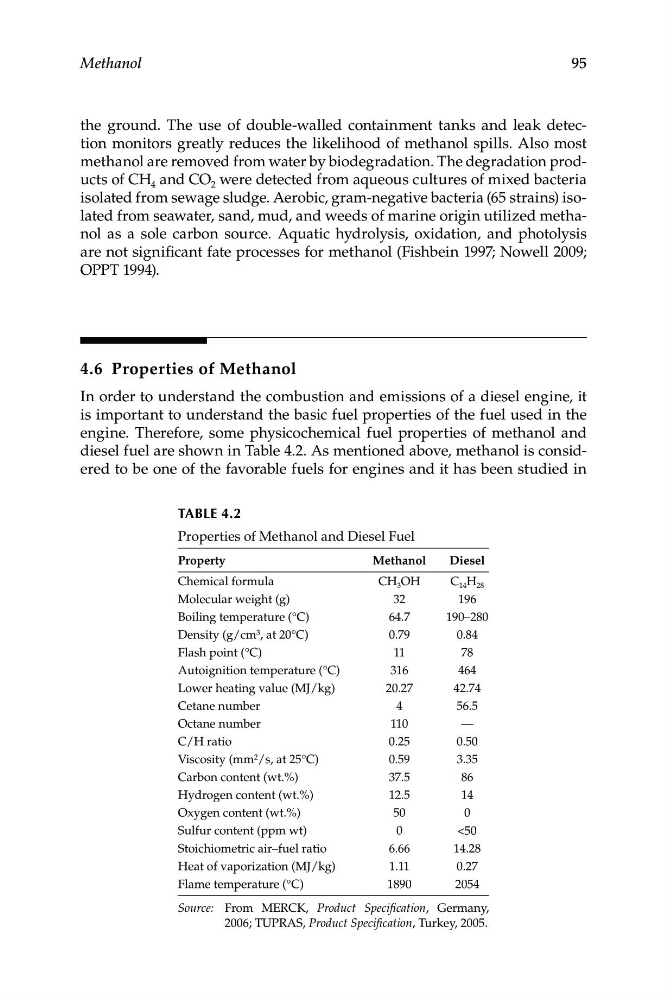
engine. Therefore, some physicochemical fuel properties of methanol and
diesel fuel are shown in Table 4.2. As mentioned above, methanol is considered to be one of the favorable fuels for engines and it has been studied in
TABLe 4.2
Properties of Methanol and Diesel Fuel
Methanol
Diesel
Chemical formula
CH 3 OH
C 14 H 28
Molecular weight (g)
32
196
Boiling temperature (°C)
64.7
190–280
Density (g/cm 3 , at 20°C)
0.79
0.84
Flash point (°C)
11
78
Autoignition temperature (°C)
316
464
Lower heating value (MJ/kg)
20.27
42.74
Cetane number
4
56.5
Octane number
110
—
C/H ratio
0.25
0.50
Viscosity (mm 2 /s, at 25°C)
0.59
3.35
Carbon content (wt.%)
37.5
86
Hydrogen content (wt.%)
12.5
14
Oxygen content (wt.%)
50
0
Sulfur content (ppm wt)
0
<50
Stoichiometric air–fuel ratio
6.66
14.28
Heat of vaporization (MJ/kg)
1.11
0.27
Flame temperature (°C)
1890
2054
Source: From MERCK, Product Specification, Germany,
2006; TUPRAS, Product Specification, Turkey, 2005.
95
Methanol
the ground. The use of double-walled containment tanks and leak detection monitors greatly reduces the likelihood of methanol spills. Also most
methanol are removed from water by biodegradation. The degradation products of CH 4 and CO 2 were detected from aqueous cultures of mixed bacteria
isolated from sewage sludge. Aerobic, gram-negative bacteria (65 strains) isolated from seawater, sand, mud, and weeds of marine origin utilized methanol as a sole carbon source. Aquatic hydrolysis, oxidation, and photolysis
are not significant fate processes for methanol (Fishbein 1997; Nowell 2009;
OPPT 1994).
4.6 Properties of Methanol
In order to understand the combustion and emissions of a diesel engine, it
is important to understand the basic fuel properties of the fuel used in the
engine. Therefore, some physicochemical fuel properties of methanol and
diesel fuel are shown in Table 4.2. As mentioned above, methanol is considered to be one of the favorable fuels for engines and it has been studied in
TABLe 4.2
Properties of Methanol and Diesel Fuel