

9 A Pair Ranking (PRank) Method for Assessing Assay …
171
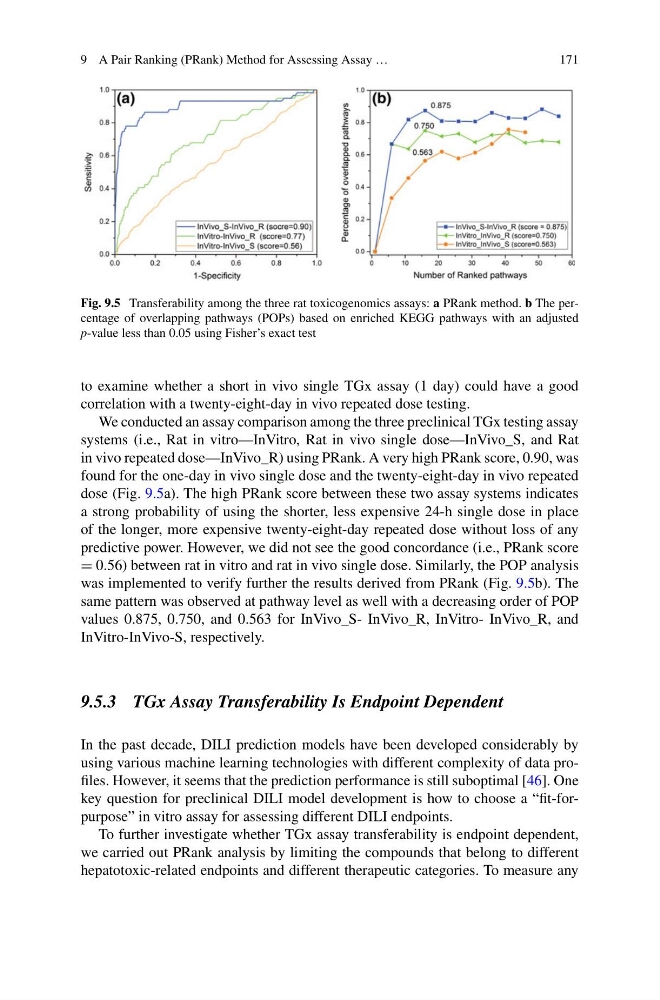
Fig. 9.5 Transferability among the three rat toxicogenomics assays: a PRank method. b The percentage of overlapping pathways (POPs) based on enriched KEGG pathways with an adjusted
p-value less than 0.05 using Fisher’s exact test
to examine whether a short in vivo single TGx assay (1 day) could have a good
correlation with a twenty-eight-day in vivo repeated dose testing.
We conducted an assay comparison among the three preclinical TGx testing assay
systems (i.e., Rat in vitro—InVitro, Rat in vivo single dose—InVivo_S, and Rat
in vivo repeated dose—InVivo_R) using PRank. A very high PRank score, 0.90, was
found for the one-day in vivo single dose and the twenty-eight-day in vivo repeated
dose (Fig. 9.5a). The high PRank score between these two assay systems indicates
a strong probability of using the shorter, less expensive 24-h single dose in place
of the longer, more expensive twenty-eight-day repeated dose without loss of any
predictive power. However, we did not see the good concordance (i.e., PRank score
= 0.56) between rat in vitro and rat in vivo single dose. Similarly, the POP analysis
was implemented to verify further the results derived from PRank (Fig. 9.5b). The
same pattern was observed at pathway level as well with a decreasing order of POP
values 0.875, 0.750, and 0.563 for InVivo_S- InVivo_R, InVitro- InVivo_R, and
InVitro-InVivo-S, respectively.
9.5.3 TGx Assay Transferability Is Endpoint Dependent
In the past decade, DILI prediction models have been developed considerably by
using various machine learning technologies with different complexity of data profiles. However, it seems that the prediction performance is still suboptimal [46]. One
key question for preclinical DILI model development is how to choose a “fit-forpurpose” in vitro assay for assessing different DILI endpoints.
To further investigate whether TGx assay transferability is endpoint dependent,
we carried out PRank analysis by limiting the compounds that belong to different
hepatotoxic-related endpoints and different therapeutic categories. To measure any
171
Fig. 9.5 Transferability among the three rat toxicogenomics assays: a PRank method. b The percentage of overlapping pathways (POPs) based on enriched KEGG pathways with an adjusted
p-value less than 0.05 using Fisher’s exact test
to examine whether a short in vivo single TGx assay (1 day) could have a good
correlation with a twenty-eight-day in vivo repeated dose testing.
We conducted an assay comparison among the three preclinical TGx testing assay
systems (i.e., Rat in vitro—InVitro, Rat in vivo single dose—InVivo_S, and Rat
in vivo repeated dose—InVivo_R) using PRank. A very high PRank score, 0.90, was
found for the one-day in vivo single dose and the twenty-eight-day in vivo repeated
dose (Fig. 9.5a). The high PRank score between these two assay systems indicates
a strong probability of using the shorter, less expensive 24-h single dose in place
of the longer, more expensive twenty-eight-day repeated dose without loss of any
predictive power. However, we did not see the good concordance (i.e., PRank score
= 0.56) between rat in vitro and rat in vivo single dose. Similarly, the POP analysis
was implemented to verify further the results derived from PRank (Fig. 9.5b). The
same pattern was observed at pathway level as well with a decreasing order of POP
values 0.875, 0.750, and 0.563 for InVivo_S- InVivo_R, InVitro- InVivo_R, and
InVitro-InVivo-S, respectively.
9.5.3 TGx Assay Transferability Is Endpoint Dependent
In the past decade, DILI prediction models have been developed considerably by
using various machine learning technologies with different complexity of data profiles. However, it seems that the prediction performance is still suboptimal [46]. One
key question for preclinical DILI model development is how to choose a “fit-forpurpose” in vitro assay for assessing different DILI endpoints.
To further investigate whether TGx assay transferability is endpoint dependent,
we carried out PRank analysis by limiting the compounds that belong to different
hepatotoxic-related endpoints and different therapeutic categories. To measure any