

7 Prediction of Bearing Remaining Useful Life Based on LSTM Network
87
The training set error continued to decrease and then stabilized, but the loss
of testing set during training process began to decreases, and then rises. This
phenomenon indicated the overfitting of the model. The reason for overfitting was
that the training set was noisy. Therefore, the training set and the testing set need to
be denoised.
7.5.2 The Result of Bearing RUL Prediction Combined
LSTM Network and VAE
Aiming at the phenomenon of overfitting, the paper used the VAE to denoise training
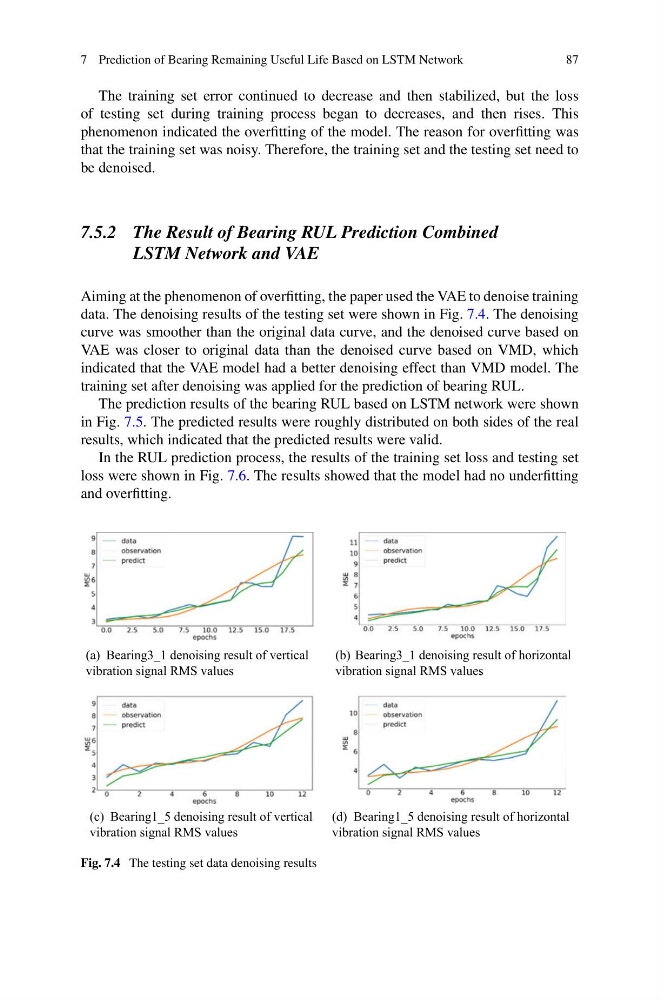
data. The denoising results of the testing set were shown in Fig. 7.4. The denoising
curve was smoother than the original data curve, and the denoised curve based on
VAE was closer to original data than the denoised curve based on VMD, which
indicated that the VAE model had a better denoising effect than VMD model. The
training set after denoising was applied for the prediction of bearing RUL.
The prediction results of the bearing RUL based on LSTM network were shown
in Fig. 7.5. The predicted results were roughly distributed on both sides of the real
results, which indicated that the predicted results were valid.
In the RUL prediction process, the results of the training set loss and testing set
loss were shown in Fig. 7.6. The results showed that the model had no underfitting
and overfitting.
(a) Bearing3_1 denoising result of vertical
vibration signal RMS values .
(b) Bearing3_1 denoising result of horizontal
vibration signal RMS values .
(c) Bearing1_5 denoising result of vertical
vibration signal RMS values
(d) Bearing1_5 denoising result of horizontal
vibration signal RMS values
Fig. 7.4 The testing set data denoising results
87
The training set error continued to decrease and then stabilized, but the loss
of testing set during training process began to decreases, and then rises. This
phenomenon indicated the overfitting of the model. The reason for overfitting was
that the training set was noisy. Therefore, the training set and the testing set need to
be denoised.
7.5.2 The Result of Bearing RUL Prediction Combined
LSTM Network and VAE
Aiming at the phenomenon of overfitting, the paper used the VAE to denoise training
data. The denoising results of the testing set were shown in Fig. 7.4. The denoising
curve was smoother than the original data curve, and the denoised curve based on
VAE was closer to original data than the denoised curve based on VMD, which
indicated that the VAE model had a better denoising effect than VMD model. The
training set after denoising was applied for the prediction of bearing RUL.
The prediction results of the bearing RUL based on LSTM network were shown
in Fig. 7.5. The predicted results were roughly distributed on both sides of the real
results, which indicated that the predicted results were valid.
In the RUL prediction process, the results of the training set loss and testing set
loss were shown in Fig. 7.6. The results showed that the model had no underfitting
and overfitting.
(a) Bearing3_1 denoising result of vertical
vibration signal RMS values .
(b) Bearing3_1 denoising result of horizontal
vibration signal RMS values .
(c) Bearing1_5 denoising result of vertical
vibration signal RMS values
(d) Bearing1_5 denoising result of horizontal
vibration signal RMS values
Fig. 7.4 The testing set data denoising results