

88
X. Wang et al.
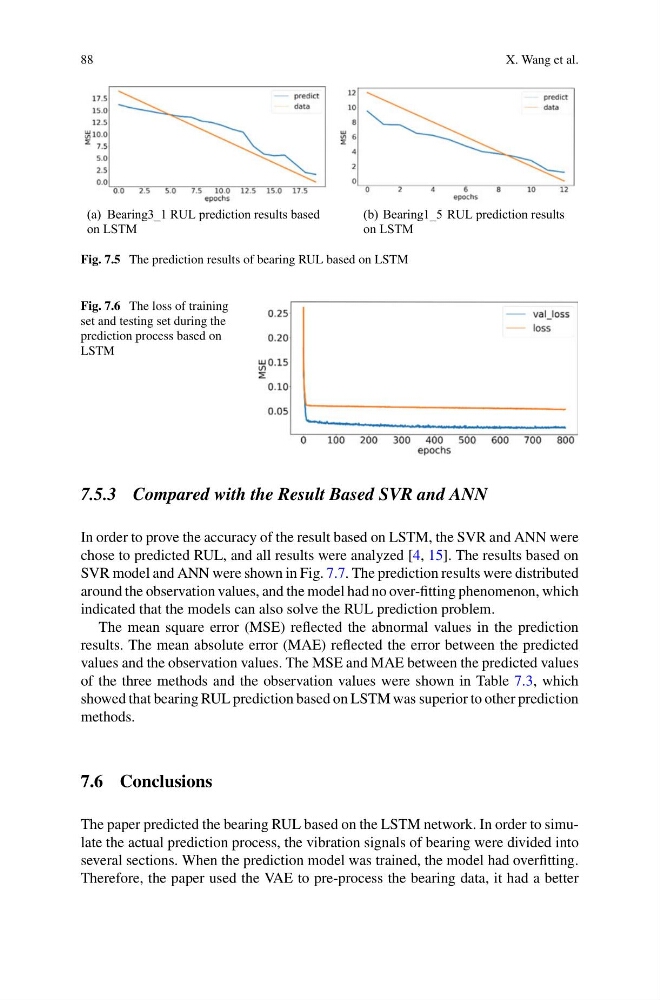
(a) Bearing3_1 RUL prediction results based
on LSTM
(b) Bearing1_5 RUL prediction results
on LSTM
Fig. 7.5 The prediction results of bearing RUL based on LSTM
Fig. 7.6 The loss of training
set and testing set during the
prediction process based on
LSTM
7.5.3 Compared with the Result Based SVR and ANN
In order to prove the accuracy of the result based on LSTM, the SVR and ANN were
chose to predicted RUL, and all results were analyzed [4, 15]. The results based on
SVR model and ANN were shown in Fig. 7.7. The prediction results were distributed
around the observation values, and the model had no over-fitting phenomenon, which
indicated that the models can also solve the RUL prediction problem.
The mean square error (MSE) reflected the abnormal values in the prediction
results. The mean absolute error (MAE) reflected the error between the predicted
values and the observation values. The MSE and MAE between the predicted values
of the three methods and the observation values were shown in Table 7.3, which
showed that bearing RUL prediction based on LSTM was superior to other prediction
methods.
7.6 Conclusions
The paper predicted the bearing RUL based on the LSTM network. In order to simulate the actual prediction process, the vibration signals of bearing were divided into
several sections. When the prediction model was trained, the model had overfitting.
Therefore, the paper used the VAE to pre-process the bearing data, it had a better
X. Wang et al.
(a) Bearing3_1 RUL prediction results based
on LSTM
(b) Bearing1_5 RUL prediction results
on LSTM
Fig. 7.5 The prediction results of bearing RUL based on LSTM
Fig. 7.6 The loss of training
set and testing set during the
prediction process based on
LSTM
7.5.3 Compared with the Result Based SVR and ANN
In order to prove the accuracy of the result based on LSTM, the SVR and ANN were
chose to predicted RUL, and all results were analyzed [4, 15]. The results based on
SVR model and ANN were shown in Fig. 7.7. The prediction results were distributed
around the observation values, and the model had no over-fitting phenomenon, which
indicated that the models can also solve the RUL prediction problem.
The mean square error (MSE) reflected the abnormal values in the prediction
results. The mean absolute error (MAE) reflected the error between the predicted
values and the observation values. The MSE and MAE between the predicted values
of the three methods and the observation values were shown in Table 7.3, which
showed that bearing RUL prediction based on LSTM was superior to other prediction
methods.
7.6 Conclusions
The paper predicted the bearing RUL based on the LSTM network. In order to simulate the actual prediction process, the vibration signals of bearing were divided into
several sections. When the prediction model was trained, the model had overfitting.
Therefore, the paper used the VAE to pre-process the bearing data, it had a better