

86
X. Wang et al.
the loss function, and the ‘adam’ algorithm was chosen as the optimizer. There
were 20 hidden nodes in the network, the input tensor size was (176, 10, 2), and
the number of training steps was 400.
c. Bearing RUL prediction. The testing set inputs the trained network to complete
bearing life prediction.
7.4.2 The RUL Prediction Combined LSTM Network
with VAE
In order to simulate the actual prediction process, the vibration signals of bearing
were divided into several sections, the length of which was 10. Other denoising
methods, for example, EMD, EEMD, CEEMD, cannot handle this kind of short time
data, so the VAE model was used to denoise in the paper. The training set data before
the denoised in Table 7.2 and the data that was denoised by VMD formed a new
training set, and it was used to train the VAE to obtain a denoising model.
The setting of the VAE model was as follows: the encoder input size was (176,
10, 2), the encoder hidden node was 5, the encoder output size was (176, 3, 2),
the encoder loss function was the cross-entropy function, and the optimizer was
‘rmsprop’ algorithm, and the training steps were 800. The decoder settings were the
same as the encoder.
The data used for bearing RUL prediction was processed by the VAE, and it was
input into the bearing RUL prediction model to complete the bearing RUL prediction.
7.5 Result
7.5.1 The Result of Bearing RUL Prediction based on LSTM
According to the above process, the bearing lives of Bearing3_1 and Bearing1_5 were
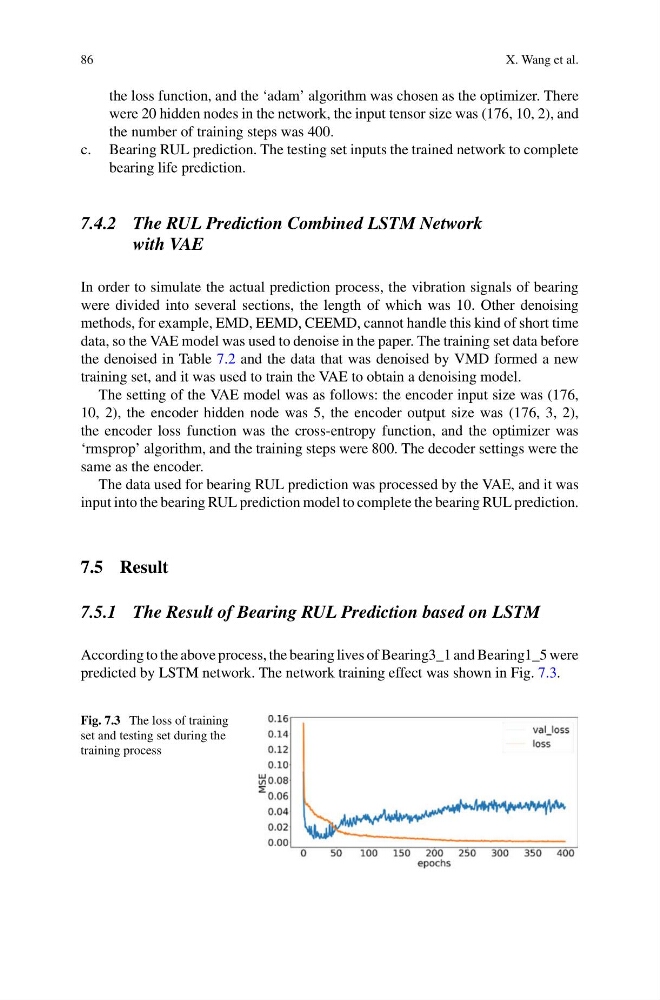
predicted by LSTM network. The network training effect was shown in Fig. 7.3.
Fig. 7.3 The loss of training
set and testing set during the
training process
X. Wang et al.
the loss function, and the ‘adam’ algorithm was chosen as the optimizer. There
were 20 hidden nodes in the network, the input tensor size was (176, 10, 2), and
the number of training steps was 400.
c. Bearing RUL prediction. The testing set inputs the trained network to complete
bearing life prediction.
7.4.2 The RUL Prediction Combined LSTM Network
with VAE
In order to simulate the actual prediction process, the vibration signals of bearing
were divided into several sections, the length of which was 10. Other denoising
methods, for example, EMD, EEMD, CEEMD, cannot handle this kind of short time
data, so the VAE model was used to denoise in the paper. The training set data before
the denoised in Table 7.2 and the data that was denoised by VMD formed a new
training set, and it was used to train the VAE to obtain a denoising model.
The setting of the VAE model was as follows: the encoder input size was (176,
10, 2), the encoder hidden node was 5, the encoder output size was (176, 3, 2),
the encoder loss function was the cross-entropy function, and the optimizer was
‘rmsprop’ algorithm, and the training steps were 800. The decoder settings were the
same as the encoder.
The data used for bearing RUL prediction was processed by the VAE, and it was
input into the bearing RUL prediction model to complete the bearing RUL prediction.
7.5 Result
7.5.1 The Result of Bearing RUL Prediction based on LSTM
According to the above process, the bearing lives of Bearing3_1 and Bearing1_5 were
predicted by LSTM network. The network training effect was shown in Fig. 7.3.
Fig. 7.3 The loss of training
set and testing set during the
training process