

19 Electro-Mechanical Co-Simulation of a 6-DOF …
245
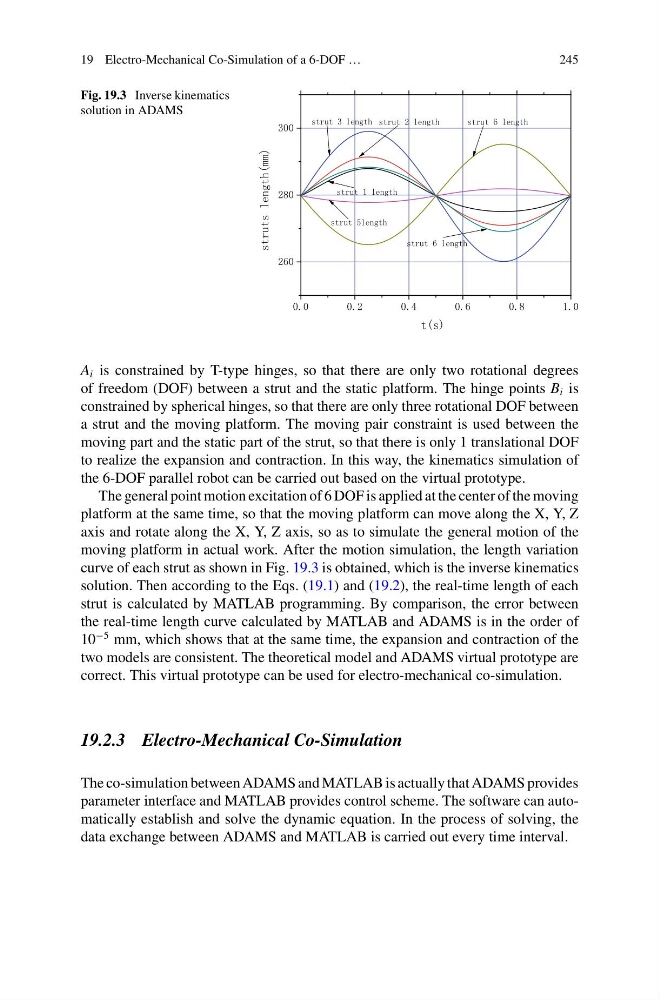
Fig. 19.3 Inverse kinematics
solution in ADAMS
A i is constrained by T-type hinges, so that there are only two rotational degrees
of freedom (DOF) between a strut and the static platform. The hinge points B i is
constrained by spherical hinges, so that there are only three rotational DOF between
a strut and the moving platform. The moving pair constraint is used between the
moving part and the static part of the strut, so that there is only 1 translational DOF
to realize the expansion and contraction. In this way, the kinematics simulation of
the 6-DOF parallel robot can be carried out based on the virtual prototype.
The general point motion excitation of 6 DOF is applied at the center of the moving
platform at the same time, so that the moving platform can move along the X, Y, Z
axis and rotate along the X, Y, Z axis, so as to simulate the general motion of the
moving platform in actual work. After the motion simulation, the length variation
curve of each strut as shown in Fig. 19.3 is obtained, which is the inverse kinematics
solution. Then according to the Eqs. (19.1) and (19.2), the real-time length of each
strut is calculated by MATLAB programming. By comparison, the error between
the real-time length curve calculated by MATLAB and ADAMS is in the order of
10
−5 mm, which shows that at the same time, the expansion and contraction of the
two models are consistent. The theoretical model and ADAMS virtual prototype are
correct. This virtual prototype can be used for electro-mechanical co-simulation.
19.2.3 Electro-Mechanical Co-Simulation
The co-simulation between ADAMS and MATLAB is actually that ADAMS provides
parameter interface and MATLAB provides control scheme. The software can automatically establish and solve the dynamic equation. In the process of solving, the
data exchange between ADAMS and MATLAB is carried out every time interval.
245
Fig. 19.3 Inverse kinematics
solution in ADAMS
A i is constrained by T-type hinges, so that there are only two rotational degrees
of freedom (DOF) between a strut and the static platform. The hinge points B i is
constrained by spherical hinges, so that there are only three rotational DOF between
a strut and the moving platform. The moving pair constraint is used between the
moving part and the static part of the strut, so that there is only 1 translational DOF
to realize the expansion and contraction. In this way, the kinematics simulation of
the 6-DOF parallel robot can be carried out based on the virtual prototype.
The general point motion excitation of 6 DOF is applied at the center of the moving
platform at the same time, so that the moving platform can move along the X, Y, Z
axis and rotate along the X, Y, Z axis, so as to simulate the general motion of the
moving platform in actual work. After the motion simulation, the length variation
curve of each strut as shown in Fig. 19.3 is obtained, which is the inverse kinematics
solution. Then according to the Eqs. (19.1) and (19.2), the real-time length of each
strut is calculated by MATLAB programming. By comparison, the error between
the real-time length curve calculated by MATLAB and ADAMS is in the order of
10
−5 mm, which shows that at the same time, the expansion and contraction of the
two models are consistent. The theoretical model and ADAMS virtual prototype are
correct. This virtual prototype can be used for electro-mechanical co-simulation.
19.2.3 Electro-Mechanical Co-Simulation
The co-simulation between ADAMS and MATLAB is actually that ADAMS provides
parameter interface and MATLAB provides control scheme. The software can automatically establish and solve the dynamic equation. In the process of solving, the
data exchange between ADAMS and MATLAB is carried out every time interval.