

18 The Effect of Surface Ultrasonic Rolling Processing …
227
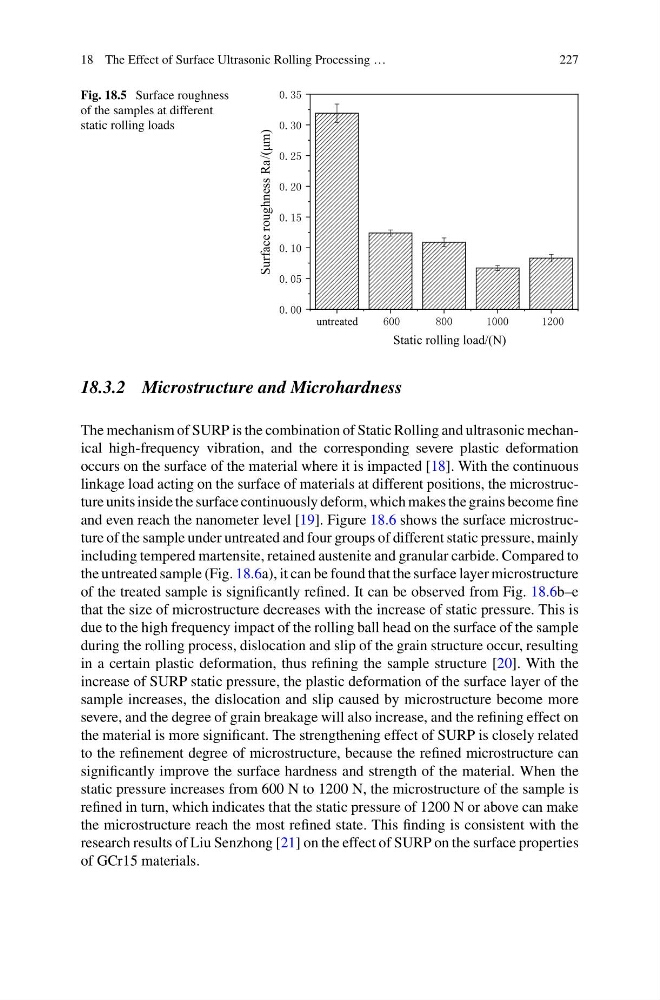
Fig. 18.5 Surface roughness
of the samples at different
static rolling loads
Surface roughness Ra/(μm)
Static rolling load/(N)
untreated
18.3.2 Microstructure and Microhardness
The mechanism of SURP is the combination of Static Rolling and ultrasonic mechanical high-frequency vibration, and the corresponding severe plastic deformation
occurs on the surface of the material where it is impacted [18]. With the continuous
linkage load acting on the surface of materials at different positions, the microstructure units inside the surface continuously deform, which makes the grains become fine
and even reach the nanometer level [19]. Figure 18.6 shows the surface microstructure of the sample under untreated and four groups of different static pressure, mainly
including tempered martensite, retained austenite and granular carbide. Compared to
the untreated sample (Fig. 18.6a), it can be found that the surface layer microstructure
of the treated sample is significantly refined. It can be observed from Fig. 18.6b–e
that the size of microstructure decreases with the increase of static pressure. This is
due to the high frequency impact of the rolling ball head on the surface of the sample
during the rolling process, dislocation and slip of the grain structure occur, resulting
in a certain plastic deformation, thus refining the sample structure [20]. With the
increase of SURP static pressure, the plastic deformation of the surface layer of the
sample increases, the dislocation and slip caused by microstructure become more
severe, and the degree of grain breakage will also increase, and the refining effect on
the material is more significant. The strengthening effect of SURP is closely related
to the refinement degree of microstructure, because the refined microstructure can
significantly improve the surface hardness and strength of the material. When the
static pressure increases from 600 N to 1200 N, the microstructure of the sample is
refined in turn, which indicates that the static pressure of 1200 N or above can make
the microstructure reach the most refined state. This finding is consistent with the
research results of Liu Senzhong [21] on the effect of SURP on the surface properties
of GCr15 materials.
227
Fig. 18.5 Surface roughness
of the samples at different
static rolling loads
Surface roughness Ra/(μm)
Static rolling load/(N)
untreated
18.3.2 Microstructure and Microhardness
The mechanism of SURP is the combination of Static Rolling and ultrasonic mechanical high-frequency vibration, and the corresponding severe plastic deformation
occurs on the surface of the material where it is impacted [18]. With the continuous
linkage load acting on the surface of materials at different positions, the microstructure units inside the surface continuously deform, which makes the grains become fine
and even reach the nanometer level [19]. Figure 18.6 shows the surface microstructure of the sample under untreated and four groups of different static pressure, mainly
including tempered martensite, retained austenite and granular carbide. Compared to
the untreated sample (Fig. 18.6a), it can be found that the surface layer microstructure
of the treated sample is significantly refined. It can be observed from Fig. 18.6b–e
that the size of microstructure decreases with the increase of static pressure. This is
due to the high frequency impact of the rolling ball head on the surface of the sample
during the rolling process, dislocation and slip of the grain structure occur, resulting
in a certain plastic deformation, thus refining the sample structure [20]. With the
increase of SURP static pressure, the plastic deformation of the surface layer of the
sample increases, the dislocation and slip caused by microstructure become more
severe, and the degree of grain breakage will also increase, and the refining effect on
the material is more significant. The strengthening effect of SURP is closely related
to the refinement degree of microstructure, because the refined microstructure can
significantly improve the surface hardness and strength of the material. When the
static pressure increases from 600 N to 1200 N, the microstructure of the sample is
refined in turn, which indicates that the static pressure of 1200 N or above can make
the microstructure reach the most refined state. This finding is consistent with the
research results of Liu Senzhong [21] on the effect of SURP on the surface properties
of GCr15 materials.