

1 Controlled and Localized Electrochemical Microfabrication …
11
1.3.3 Influences of Spherical Tip Diameter of Tool Electrode
Microchannels were fabricated by the tool electrode with a spherical tip diameter of
0.40 μm, 0.65 μm, and 0.90 μm. The applied voltage was 4 V, and the initial interelectrode was set as 1 μm. As the simulation results, the width of the spread of the
electric current density increased with increasing spherical tip diameter. It leads to an
increase in the width of the processed microchannels, which was in accordance with
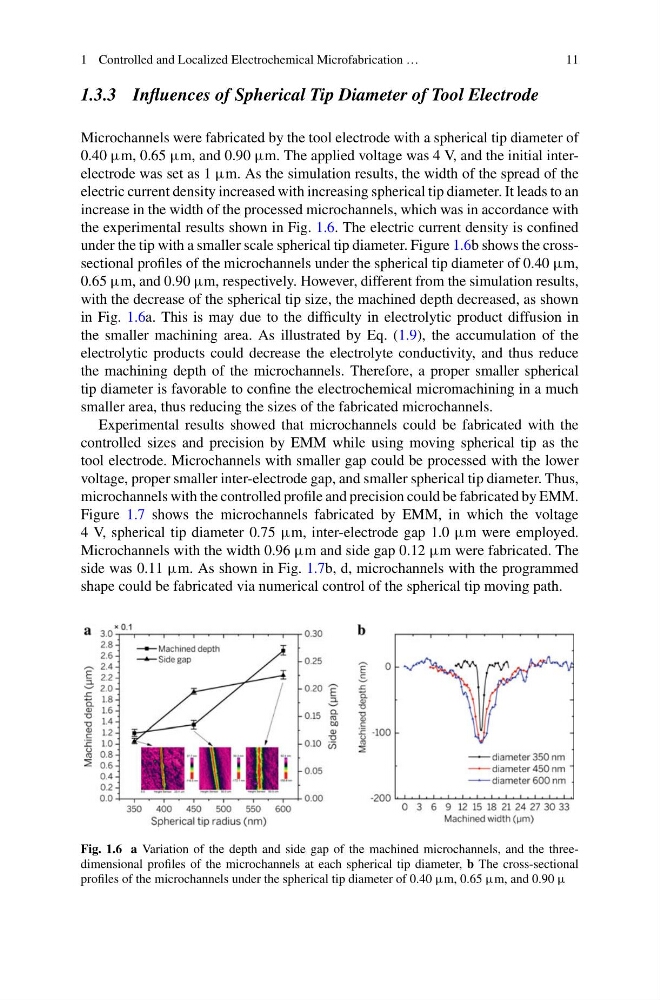
the experimental results shown in Fig. 1.6. The electric current density is confined
under the tip with a smaller scale spherical tip diameter. Figure 1.6b shows the crosssectional profiles of the microchannels under the spherical tip diameter of 0.40 μm,
0.65 μm, and 0.90 μm, respectively. However, different from the simulation results,
with the decrease of the spherical tip size, the machined depth decreased, as shown
in Fig. 1.6a. This is may due to the difficulty in electrolytic product diffusion in
the smaller machining area. As illustrated by Eq. (1.9), the accumulation of the
electrolytic products could decrease the electrolyte conductivity, and thus reduce
the machining depth of the microchannels. Therefore, a proper smaller spherical
tip diameter is favorable to confine the electrochemical micromachining in a much
smaller area, thus reducing the sizes of the fabricated microchannels.
Experimental results showed that microchannels could be fabricated with the
controlled sizes and precision by EMM while using moving spherical tip as the
tool electrode. Microchannels with smaller gap could be processed with the lower
voltage, proper smaller inter-electrode gap, and smaller spherical tip diameter. Thus,
microchannels with the controlled profile and precision could be fabricated by EMM.
Figure 1.7 shows the microchannels fabricated by EMM, in which the voltage
4 V, spherical tip diameter 0.75 μm, inter-electrode gap 1.0 μm were employed.
Microchannels with the width 0.96 μm and side gap 0.12 μm were fabricated. The
side was 0.11 μm. As shown in Fig. 1.7b, d, microchannels with the programmed
shape could be fabricated via numerical control of the spherical tip moving path.
Fig. 1.6 a Variation of the depth and side gap of the machined microchannels, and the threedimensional profiles of the microchannels at each spherical tip diameter, b The cross-sectional
profiles of the microchannels under the spherical tip diameter of 0.40 μm, 0.65 μm, and 0.90 μ
11
1.3.3 Influences of Spherical Tip Diameter of Tool Electrode
Microchannels were fabricated by the tool electrode with a spherical tip diameter of
0.40 μm, 0.65 μm, and 0.90 μm. The applied voltage was 4 V, and the initial interelectrode was set as 1 μm. As the simulation results, the width of the spread of the
electric current density increased with increasing spherical tip diameter. It leads to an
increase in the width of the processed microchannels, which was in accordance with
the experimental results shown in Fig. 1.6. The electric current density is confined
under the tip with a smaller scale spherical tip diameter. Figure 1.6b shows the crosssectional profiles of the microchannels under the spherical tip diameter of 0.40 μm,
0.65 μm, and 0.90 μm, respectively. However, different from the simulation results,
with the decrease of the spherical tip size, the machined depth decreased, as shown
in Fig. 1.6a. This is may due to the difficulty in electrolytic product diffusion in
the smaller machining area. As illustrated by Eq. (1.9), the accumulation of the
electrolytic products could decrease the electrolyte conductivity, and thus reduce
the machining depth of the microchannels. Therefore, a proper smaller spherical
tip diameter is favorable to confine the electrochemical micromachining in a much
smaller area, thus reducing the sizes of the fabricated microchannels.
Experimental results showed that microchannels could be fabricated with the
controlled sizes and precision by EMM while using moving spherical tip as the
tool electrode. Microchannels with smaller gap could be processed with the lower
voltage, proper smaller inter-electrode gap, and smaller spherical tip diameter. Thus,
microchannels with the controlled profile and precision could be fabricated by EMM.
Figure 1.7 shows the microchannels fabricated by EMM, in which the voltage
4 V, spherical tip diameter 0.75 μm, inter-electrode gap 1.0 μm were employed.
Microchannels with the width 0.96 μm and side gap 0.12 μm were fabricated. The
side was 0.11 μm. As shown in Fig. 1.7b, d, microchannels with the programmed
shape could be fabricated via numerical control of the spherical tip moving path.
Fig. 1.6 a Variation of the depth and side gap of the machined microchannels, and the threedimensional profiles of the microchannels at each spherical tip diameter, b The cross-sectional
profiles of the microchannels under the spherical tip diameter of 0.40 μm, 0.65 μm, and 0.90 μ