

10 Tube Hydro-Forming Process Design Based …
125
T j,I (x) = α(t) exp
−S
2
j,I (x)
2σ
2
(t)
(10.6)
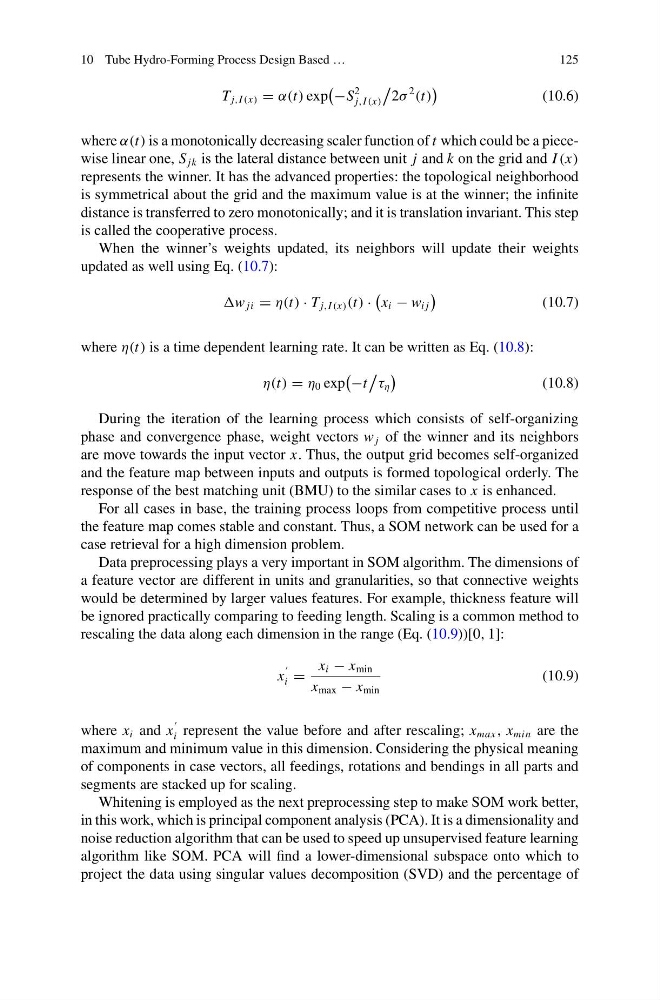
where α(t) is a monotonically decreasing scaler function of t which could be a piecewise linear one, S jk is the lateral distance between unit j and k on the grid and I (x)
represents the winner. It has the advanced properties: the topological neighborhood
is symmetrical about the grid and the maximum value is at the winner; the infinite
distance is transferred to zero monotonically; and it is translation invariant. This step
is called the cooperative process.
When the winner’s weights updated, its neighbors will update their weights
updated as well using Eq. (10.7):
w ji = η(t) · T j,I (x) (t) ·
x i − w i j
(10.7)
where η(t) is a time dependent learning rate. It can be written as Eq. (10.8):
η(t) = η 0 exp
−t
τ η
(10.8)
During the iteration of the learning process which consists of self-organizing
phase and convergence phase, weight vectors w j of the winner and its neighbors
are move towards the input vector x. Thus, the output grid becomes self-organized
and the feature map between inputs and outputs is formed topological orderly. The
response of the best matching unit (BMU) to the similar cases to x is enhanced.
For all cases in base, the training process loops from competitive process until
the feature map comes stable and constant. Thus, a SOM network can be used for a
case retrieval for a high dimension problem.
Data preprocessing plays a very important in SOM algorithm. The dimensions of
a feature vector are different in units and granularities, so that connective weights
would be determined by larger values features. For example, thickness feature will
be ignored practically comparing to feeding length. Scaling is a common method to
rescaling the data along each dimension in the range (Eq. (10.9))[0, 1]:
x
i =
x i − x min
x max − x min
(10.9)
where x i and x
i represent the value before and after rescaling; x max , x min are the
maximum and minimum value in this dimension. Considering the physical meaning
of components in case vectors, all feedings, rotations and bendings in all parts and
segments are stacked up for scaling.
Whitening is employed as the next preprocessing step to make SOM work better,
in this work, which is principal component analysis (PCA). It is a dimensionality and
noise reduction algorithm that can be used to speed up unsupervised feature learning
algorithm like SOM. PCA will find a lower-dimensional subspace onto which to
project the data using singular values decomposition (SVD) and the percentage of
125
T j,I (x) = α(t) exp
−S
2
j,I (x)
2σ
2
(t)
(10.6)
where α(t) is a monotonically decreasing scaler function of t which could be a piecewise linear one, S jk is the lateral distance between unit j and k on the grid and I (x)
represents the winner. It has the advanced properties: the topological neighborhood
is symmetrical about the grid and the maximum value is at the winner; the infinite
distance is transferred to zero monotonically; and it is translation invariant. This step
is called the cooperative process.
When the winner’s weights updated, its neighbors will update their weights
updated as well using Eq. (10.7):
w ji = η(t) · T j,I (x) (t) ·
x i − w i j
(10.7)
where η(t) is a time dependent learning rate. It can be written as Eq. (10.8):
η(t) = η 0 exp
−t
τ η
(10.8)
During the iteration of the learning process which consists of self-organizing
phase and convergence phase, weight vectors w j of the winner and its neighbors
are move towards the input vector x. Thus, the output grid becomes self-organized
and the feature map between inputs and outputs is formed topological orderly. The
response of the best matching unit (BMU) to the similar cases to x is enhanced.
For all cases in base, the training process loops from competitive process until
the feature map comes stable and constant. Thus, a SOM network can be used for a
case retrieval for a high dimension problem.
Data preprocessing plays a very important in SOM algorithm. The dimensions of
a feature vector are different in units and granularities, so that connective weights
would be determined by larger values features. For example, thickness feature will
be ignored practically comparing to feeding length. Scaling is a common method to
rescaling the data along each dimension in the range (Eq. (10.9))[0, 1]:
x
i =
x i − x min
x max − x min
(10.9)
where x i and x
i represent the value before and after rescaling; x max , x min are the
maximum and minimum value in this dimension. Considering the physical meaning
of components in case vectors, all feedings, rotations and bendings in all parts and
segments are stacked up for scaling.
Whitening is employed as the next preprocessing step to make SOM work better,
in this work, which is principal component analysis (PCA). It is a dimensionality and
noise reduction algorithm that can be used to speed up unsupervised feature learning
algorithm like SOM. PCA will find a lower-dimensional subspace onto which to
project the data using singular values decomposition (SVD) and the percentage of